
Glass vs. Drywall Partition Walls: Which Is Better for Homes & Offices?
Partition walls may seem minor, but they greatly influence light, privacy, acoustics, aesthetics, and long-term costs. Two dominant options are glass partition walls and drywall (gypsum) partitions. Both have their strengths, and this guide helps you choose the right one.
1. What Are Partition Walls?
Partition walls are non-load-bearing dividers that separate interior spaces without supporting structural weight. Common uses:
- Homes: living areas, bedrooms, home offices
- Offices: meeting rooms, breakout zones, private offices
- Retail and commercial: changing rooms, work areas
- Studios/creative spaces: flexible layouts
Most common systems:
- Glass partition walls
- Drywall (gypsum) partitions
2. Glass Partition Walls
Glass partitions use tempered or laminated glass panels, often frameless or with slim frames, to divide spaces while allowing natural light to flow. Ideal where openness, light, and modern aesthetics matter.
Explore real-world examples and finishes in this details on glass partition walls.
Glass partitions come in:
- Clear, frosted, or tinted glass
- Frameless or slim-framed systems
- Fixed or demountable types
3. Drywall Partitions
Drywall partitions use metal or timber studs with plasterboard (gypsum) panels. They are widely used for privacy, sound insulation, and finishing flexibility.
Key features:
- Fully opaque walls
- Paint, wallpaper, or tiles applied easily
- Can house wiring, insulation, and fixtures
- Cost-effective for permanent layouts
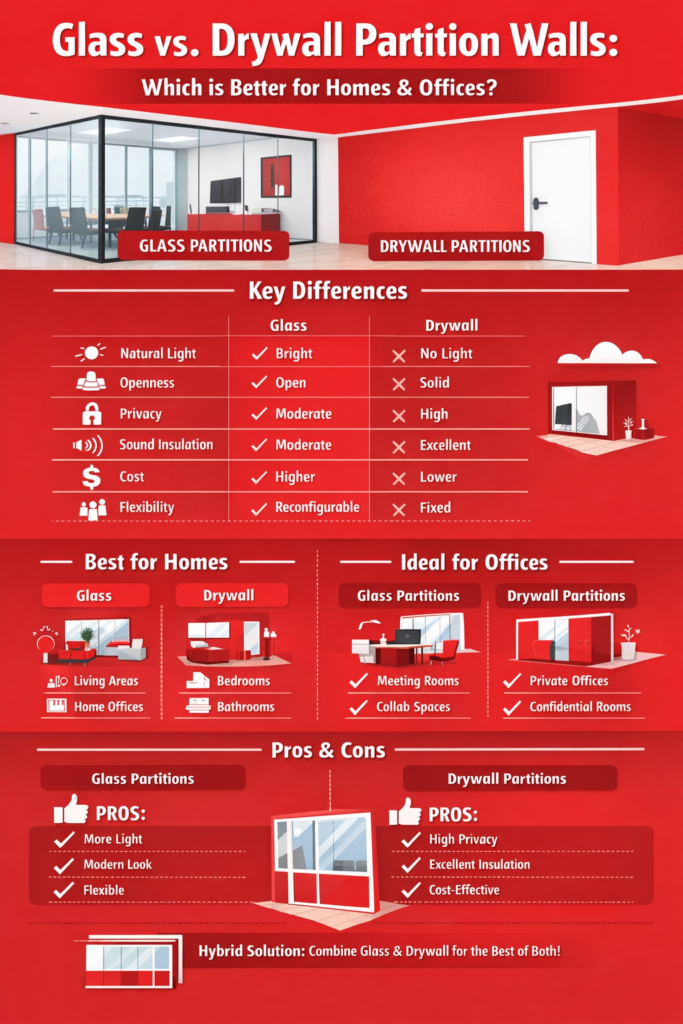
4. Glass vs. Drywall: Comparison
| Feature | Glass Partition Walls | Drywall Partitions |
|---|---|---|
| Natural Light | Excellent | Blocks light |
| Visual Openness | Very High | Low |
| Privacy | Medium–High (frosted/acoustic glass) | High |
| Acoustic Performance | Moderate–High with acoustic glass | High |
| Installation Disruption | Fast, minimal mess | Slower, dusty |
| Initial Cost | Higher | Lower |
| Long-Term Flexibility | High | Low |
| Maintenance | Easy wipe | Patching/repaint |
5. Aesthetics & Space Perception
Glass Partitions
Allow daylight to penetrate interiors, improving brightness, visual connection, and openness. Perfect for:
- Open-plan offices
- Reception areas
- Modern residential layouts
See more insights on light and transparency benefits: mrglassmirror.com
Drywall Partitions
Provide a solid, traditional feel, ideal for privacy and areas where containment is essential:
- Bedrooms
- Bathrooms
- Confidential offices
Additional reading: officerenovation.com
6. Acoustic Performance & Privacy
- Drywall: Superior sound insulation; ideal for bedrooms, meeting rooms, offices (partition.my)
- Glass: Moderate to high with acoustic laminated glass and seals (prancebuilding.com)
Hybrid solutions (solid lower panels + glass upper panels) are popular in modern office layouts.
7. Cost & Installation
Initial Cost
- Drywall: Lower upfront cost (whatblueprint.com)
- Glass: Higher cost due to premium materials
Installation
- Glass partitions: Fast, low mess (officemantra.in)
- Drywall: Slower, dusty, requires finishing
Long-Term Value
- Glass partitions (demountable/modular) allow reconfiguration, saving renovation costs (kovapartitions.co.uk)
- Drywall may require patching, repainting, or rebuild when layouts change
8. Maintenance & Durability
| Aspect | Glass | Drywall |
|---|---|---|
| Cleaning | Easy wipe | Repaint/patch |
| Impact Resistance | Good | Moderate |
| Moisture Resistance | Excellent | Sensitive unless treated |
| Visual Wear | Minimal | May require touch-ups |
9. Fire Safety & Building Codes
- Drywall: Naturally fire-resistant (partition.my)
- Glass: Must specify fire-rated glass for compliance (prancebuilding.com)
Consult qualified contractors for compliance.
10. Best Choice by Space
Homes
- Bedrooms & Bathrooms: Drywall
- Home offices & Living areas: Glass
- Small interiors: Glass enhances light and space
Offices
- Meeting rooms & collaboration zones: Glass
- Private/confidential offices: Drywall or acoustic glass
- Flexible workplaces: Demountable glass partitions
11. Hybrid Solutions
Combine solid lower panels for privacy with glass upper panels for light and openness. This balances functionality, aesthetics, and acoustic performance.
12. Conclusion
No universal winner:
- Drywall: Best for privacy, sound insulation, and cost-sensitive projects
- Glass partitions: Best for light, openness, aesthetics, flexibility, and long-term adaptability