
Soundproof Partition Walls: What Actually Works (And What Doesn’t)
In an increasingly noisy world — from open‑plan offices to shared apartments — the ability to block unwanted sound has become essential. Whether you’re creating quiet meeting rooms, peaceful home spaces, or professional studios, the right kind of soundproof partition walls can make all the difference.
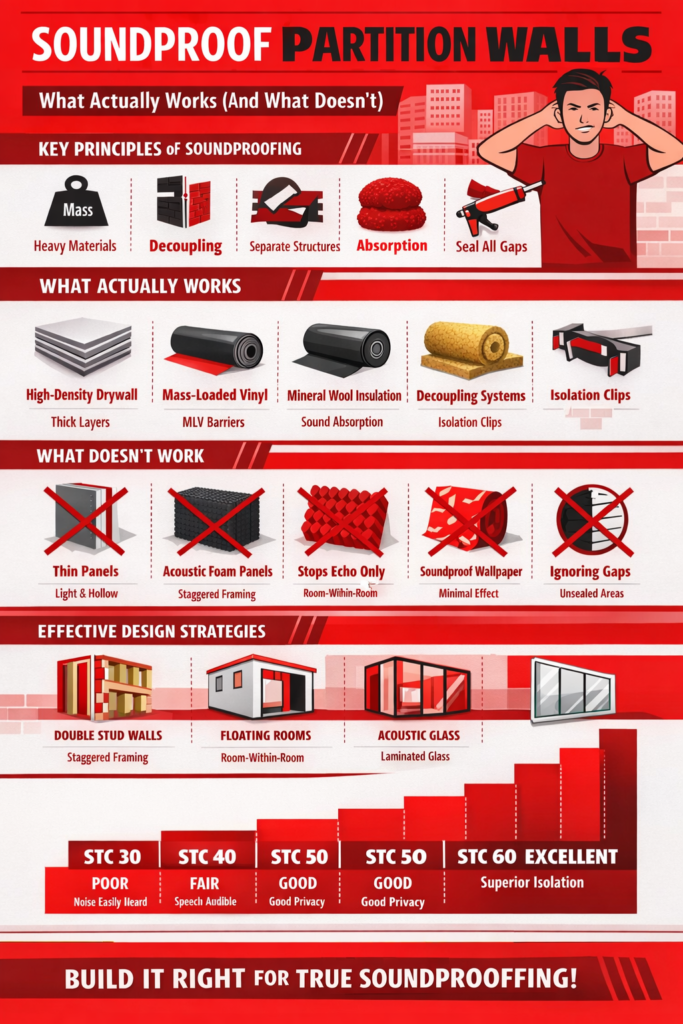
But with countless products and construction methods being marketed, how do you separate what actually works from what’s merely hype? This comprehensive guide explains the acoustic principles behind effective soundproofing, reveals the best materials and construction strategies, and highlights common mistakes to avoid.
Understanding Sound Transmission
Before diving into solutions, it helps to understand how sound travels and why some walls fail to block it.
Sound moves through two main paths:
- Airborne noise — voices, music, or traffic sound transmitted through air gaps.
- Structure‑borne noise — vibrations traveling through solids, like the studs and framing of a wall.
The Sound Transmission Class (STC) rating quantifies how well a wall blocks airborne sound: the higher the STC, the better the performance. Typical occupiable spaces aim for STC 45 or higher to significantly reduce audible noise between rooms. Malrox
Core Principles of Effective Soundproofing
Achieving good sound reduction isn’t about one single trick — it’s about combining multiple acoustic strategies effectively:
🧱 Mass
Heavier walls block sound more effectively because dense materials resist the passage of sound waves. Adding extra layers of dense drywall increases mass and improves acoustic performance. Coohom
🔗 Decoupling
If two sides of a wall are rigidly connected, vibration easily transfers through. Techniques like resilient channels, isolation clips, or double‑stud walls break that path, reducing vibration transmission. Interior GLOBAL
🧠 Absorption
Filling wall cavities with materials such as mineral wool or fiberglass absorbs sound energy and limits resonance inside the wall. Coohom
🪟 Sealing Gaps
Sound leaks through even tiny gaps at outlets, around doors, and at seams. Sealing with dedicated acoustic sealants around all penetrations creates a continuous barrier. Interior GLOBAL
Materials That Actually Work
The following materials and methods are widely validated as effective in real‑world soundproofing:
✔️ High‑Density Drywall
Also known as acoustic gypsum board, it is denser than standard drywall and provides improved sound blocking, especially when used in multiple layers. Ikoustic Soundproofing
✔️ Mineral Wool or Fiberglass Insulation
These materials fill wall cavities and trap sound waves. Mineral wool provides excellent acoustic performance and fire resistance, making it a top choice for partition walls. Coohom
✔️ Mass‑Loaded Vinyl (MLV)
A flexible but dense membrane that adds significant mass to a partition. MLV can be installed between drywall layers to enhance sound blocking without increasing wall thickness drastically. MQ Acoustics
✔️ Decoupling Systems
Resilient channels and sound isolation clips reduce structural vibration transfer by breaking direct contact between drywall and framing. Interior GLOBAL
✔️ Acoustic Glass Options
For spaces where transparency matters — like offices or lounges — acoustic laminated glass provides much better sound isolation than ordinary glass. To explore stylish and functional choices, check out this guide on glass partition walls which balances aesthetic needs with acoustic performance.
What Doesn’t Actually Work (Or Works Poorly)
There are plenty of products and methods marketed as “soundproofing” that offer limited real benefit:
❌ Acoustic Foam Panels (as Soundproofing)
While effective at reducing echo inside a room, foam panels do not meaningfully block sound transmission through the wall itself. They address reverberation, not sound insulation. Wikipedia
❌ Lightweight Single Panels
Cheap or thin partition boards that lack mass will fail to stop noise effectively, especially at lower frequencies.
❌ Decorative “Soundproof Wallpaper”
Despite claims, these typically add minimal mass or damping and therefore have negligible impact on actual sound transmission.
❌ Ignoring Small Openings
Great materials can be undermined by unchecked gaps around fixtures, conduits, and doors. Always ensure continuous sealing to prevent sound leaks. Interior GLOBAL
Design Strategies That Deliver Results
Here are practical construction approaches that have proven acoustic performance:
🔹 Staggered or Double Stud Walls
These wall assemblies separate the two faces of the partition, creating an air gap that significantly reduces structure‑borne noise. Interior GLOBAL
🔹 Floating Walls
For extreme noise control (e.g., recording studios or high‑privacy spaces), building a floating or room‑within‑a‑room structure provides excellent isolation by fully decoupling surfaces.
🔹 High‑Performance Sliding or Modular Partitions
Partitions with core materials like rock wool or polyurethane foam, combined with tight seals, offer superior STC ratings for office or event spaces. Malrox
🔹 Careful Edge Detailing
Make sure that all edges, electrical boxes, and service penetrations are sealed with acoustical sealant. This single step often improves measured sound performance by several decibels.
Practical Soundproofing Tips (By Space)
🏢 Office Environments
Modular, insulated partitions with high STC ratings and seals around doors create privacy without heavy construction. Consider laminated acoustic glass in collaborative areas.
🏠 Shared Homes & Apartments
If bedrooms or living areas share walls, a retrofit using insulation, extra drywall, and MLV can dramatically reduce noise transfer.
🎙️ Studios & Creative Spaces
Combine decoupling, damping compounds, and layered assemblies to control both airborne and structure‑borne noise.
Typical STC Ratings & What They Mean
| STC Rating | Typical Performance |
|---|---|
| 25–35 | Low — voices easily heard |
| 35–45 | Moderate — loud speech less clear |
| 45–55 | High — good privacy |
| 55+ | Excellent — very effective separation |
Conclusion
Effective soundproof partition walls don’t come from fancy labels — they come from proven acoustic principles applied with the right materials and craftsmanship. Successful strategies combine mass, decoupling, absorption, damping, and airtight sealing. Conversely, solutions that rely on superficial products or ignore structural design offer minimal results.
Whether you’re upgrading an office, managing noise in a residential property, or creating a studio space, understanding what works and what doesn’t helps you invest wisely and achieve the quiet, comfortable environments you want.