
Movable vs Fixed Partition Walls: Flexibility vs Stability Compared
Introduction: What Are Partition Walls?
Partition walls are internal, non-load-bearing walls used to divide or organise space within homes, offices, schools, and commercial environments. Whether you’re redesigning an open-plan office or splitting a large room into functional zones, choosing the right partition system is essential for aesthetics, performance, and long-term satisfaction.
There are two primary approaches to space division:
- Fixed partition walls — permanent, stable, hard-wired installations
- Movable partition walls — flexible, reconfigurable systems
This guide explores movable vs fixed partition walls, comparing their advantages, drawbacks, costs, use cases, and how to decide which solution best suits your needs.
Understanding Fixed Partition Walls
What Are Fixed Partitions?
Fixed partition walls are permanent or semi-permanent structures that remain in place once constructed. They are typically built from traditional materials like timber studs and plasterboard, masonry block, or bespoke glazed systems.
These walls are ideal when you want long-lasting, uncompromising separation between spaces — for example, turning a studio apartment into two rooms or dividing offices permanently.
Key Characteristics of Fixed Partition Walls
✔ Stable and durable – Once installed, fixed partitions remain solid and secure.
✔ High sound insulation potential – Especially when combined with insulation and plaster finishes.
✔ Custom finishes – Can integrate doors, shelving, or built-in lighting.
✔ Longer installation time – Requires more extensive construction work.
Example uses: Bedroom creation, permanent office segmentation, bathrooms and utility rooms.
According to interior design cost guides, a simple stud partition wall typically costs £55–£65 per m² for materials and labour, though this varies with finishes and insulation levels. Checkatrade
Understanding Movable Partition Walls
What Are Movable Partitions?
Movable partition walls — also known as operable, reconfigurable, or operable walls — are systems of panels that can be moved, folded, or stacked to change the layout of a space quickly and efficiently. Unlike fixed walls, they are designed for flexibility and adaptability. Avant
Movable systems are particularly popular in conference centres, offices, classrooms, and open-plan homes where space use changes over time. They can be simple sliding panels, acoustic operable walls, or sophisticated track-mounted partitions.
Key Characteristics of Movable Partition Walls
✔ Highly flexible and adaptive – Reconfigure rooms in minutes.
✔ Quick installation – Minimal disruption and shorter setup.
✔ Range of finishes and materials – Including wood veneer, acoustic panels, glass, and metal.
✔ Scalable design – Easy to add or remove panels over time. midlandmovablewalls.co.uk
Example uses: Changing office layouts, multifunctional event spaces, home offices and play areas.
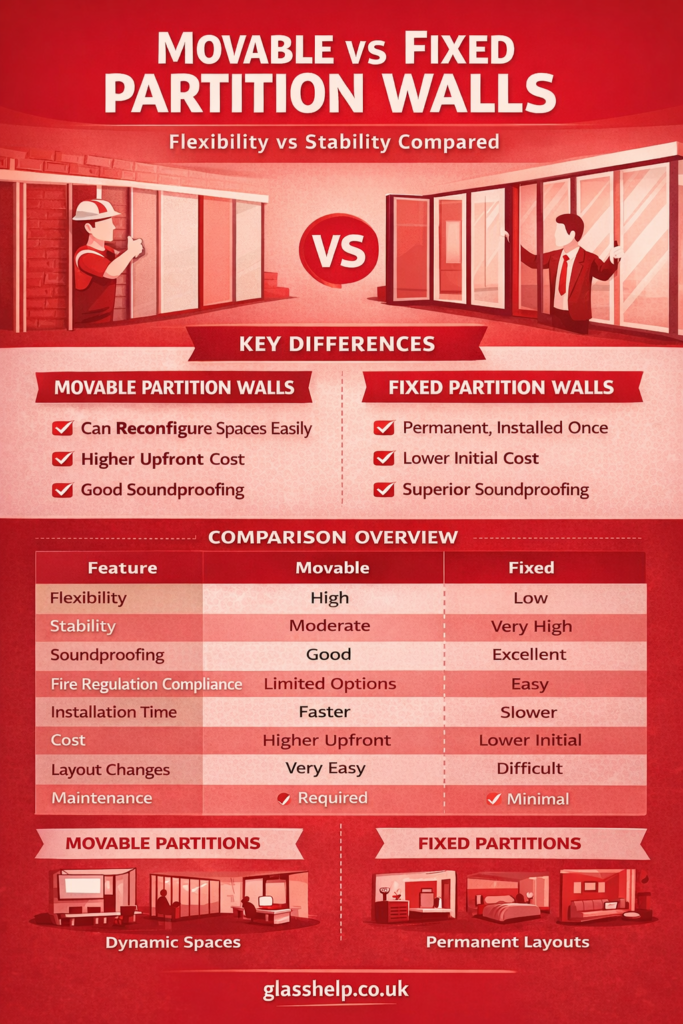
Movable vs Fixed: Side-by-Side Comparison
| Feature | Fixed Partition Walls | Movable Partition Walls |
|---|---|---|
| Flexibility | ❌ Low | ✔ High |
| Space adaptability | ❌ Limited | ✔ Excellent |
| Acoustic insulation | ✔ Superior (with insulation) | ✔ Good to high (depends on system) |
| Installation time | Longer | Shorter |
| Initial cost | Lower for simple systems | Often higher |
| Aesthetic options | Traditional finishes | Wide variety (including modern glass panels) |
| Future layout changes | Harder and costly | Easy and cost-effective |
Advantages of Fixed Partition Walls
Stability and Durability
Fixed partitions are constructed to last. They resist wear and tear from impact, temperature fluctuations, and everyday use.
Superior Sound Performance
When properly insulated and sealed, fixed walls can significantly reduce sound transmission, making them ideal for private offices, bedrooms, meeting rooms, and media rooms.
Better Regulatory Compliance
For areas requiring fire ratings or building regulation certification, fixed walls are often simpler to engineer into compliance — particularly where doorways, wiring, and services are integrated.
Disadvantages of Fixed Partition Walls
❌ Inflexible layouts — Permanent separation limits adaptability.
❌ Longer disruption — Installation often involves dust, noise, and extended labour.
❌ Future renovation costs — Removing or altering a fixed wall is costly and time-consuming.
Advantages of Movable Partition Walls
Space Flexibility and Efficiency
Movable walls allow you to reconfigure spaces whenever needed, adapting to daily, weekly, or seasonal changes in use — such as opening up meeting rooms for events or downsizing workspace zones.
Minimal Disruption
Most systems install faster than traditional walls and cause little disruption. They can often be installed without heavy construction tools or wet trades like plastering.
Design Variety & Aesthetics
Modern movable partitions come in a range of finishes, including glass, wood, metal, and acoustic textiles — enabling aesthetics that complement interiors while providing functional separation.
Scalability and Long-Term Value
Because panels can be added or removed, movable systems are future-proof. They allow your space to evolve without major renovation costs. midlandmovablewalls.co.uk
Disadvantages of Movable Partition Walls
❌ Higher initial cost — Particularly for premium acoustic or automated systems.
❌ Potentially lower sound insulation — Unless optimised for acoustic performance.
❌ Maintenance needs — Tracks and moving parts may require upkeep if used frequently.
Where Does Glass Fit In?
For a modern, light-filled space that enhances aesthetics while maintaining separation, glass partition walls are an excellent choice — and they can be either fixed or movable. These systems allow natural light to penetrate deep into interior zones, promote visual connectivity, and give spaces a sophisticated feel.
Explore options and inspiration here: glass partition walls — a stylish and practical solution for both residential and commercial projects.
The sleek transparency of glass partitions has made them increasingly popular in contemporary homes and offices, balancing openness with functional zones. ccl-interiors.com
Which Should You Choose? Key Decision Factors
1. Purpose of the Space
- Private, permanent rooms: Go with fixed partitions (e.g., bedrooms, consultation rooms).
- Dynamic or collaborative areas: Movable partitions offer flexibility (e.g., offices, event spaces).
2. Budget and Long-Term Costs
Fixed walls are typically cheaper upfront, but ongoing renovation and demolition costs can add up. Movable systems may cost more initially but provide greater adaptability and future savings.
3. Acoustic Needs
For spaces where privacy and quiet are essential (like therapy rooms or recording studios), fixed walls with proper insulation often outperform movable systems — unless high-end acoustic operable walls are selected.
4. Aesthetics and Vision
If you want a modern, fluid interior where areas transition seamlessly, movable systems or office-grade glass panels bring design flexibility unmatched by traditional walls.
Practical Examples & Use Cases
Office Environments
- Movable walls allow flexible meeting rooms, quiet zones, and partitioned work areas without permanent construction. midlandmovablewalls.co.uk
- Fixed walls are more appropriate for private executive offices or secure spaces.
Home Renovations
- Fixed partitions divide bedrooms, create en-suite bathrooms, or dens.
- Movable partitions adapt living spaces for remote work, playrooms, and entertaining without compromising light.
Hospitality & Events
Large ballrooms or training facilities benefit from operable partitions to shift between open event space and breakout rooms.
Installation & Cost Considerations
A basic stud partition — including materials and labour — is often more economical (£55–£65 per m²) compared to high-end movable systems. Checkatrade However, costs depend on:
- Materials (glass, timber, metal, acoustic panels)
- Panel quality and thickness
- Installation complexity
- Acoustic and fire ratings
- Automation and hardware systems
Conclusion: Flexibility vs Stability
There’s no one-size-fits-all answer. Your choice should reflect how you’ll use the space now — and in the future.
- Choose fixed partitions for permanence, strong acoustic control, and structural simplicity.
- Choose movable partitions when adaptability, aesthetics, and dynamic use are priorities.
In modern design, many spaces blend both approaches — using fixed walls for core zones and operable or modular systems where flexibility adds value.
If you’re considering a contemporary, light-filled space, glass partition solutions — including both fixed and movable styles — offer a compelling balance of form and function as you customise your interiors.