
Kitchen Glass Partition Walls: Open Plan vs Semi-Open Layouts
When planning a kitchen remodel or redesign, one of the most transformative decisions is how your kitchen connects with the rest of your home. Kitchen layout isn’t just about cabinets and appliances — how you divide or unite your space affects light, sociability, smell control, privacy, and value.
In recent years, designers and homeowners have begun to favor glass partition solutions to strike a balance between open connectivity and defined space. This article explores the key differences between open plan and semi-open (broken plan) kitchen layouts, why glass partitions are increasingly used, and how to choose the right approach for your lifestyle and property.
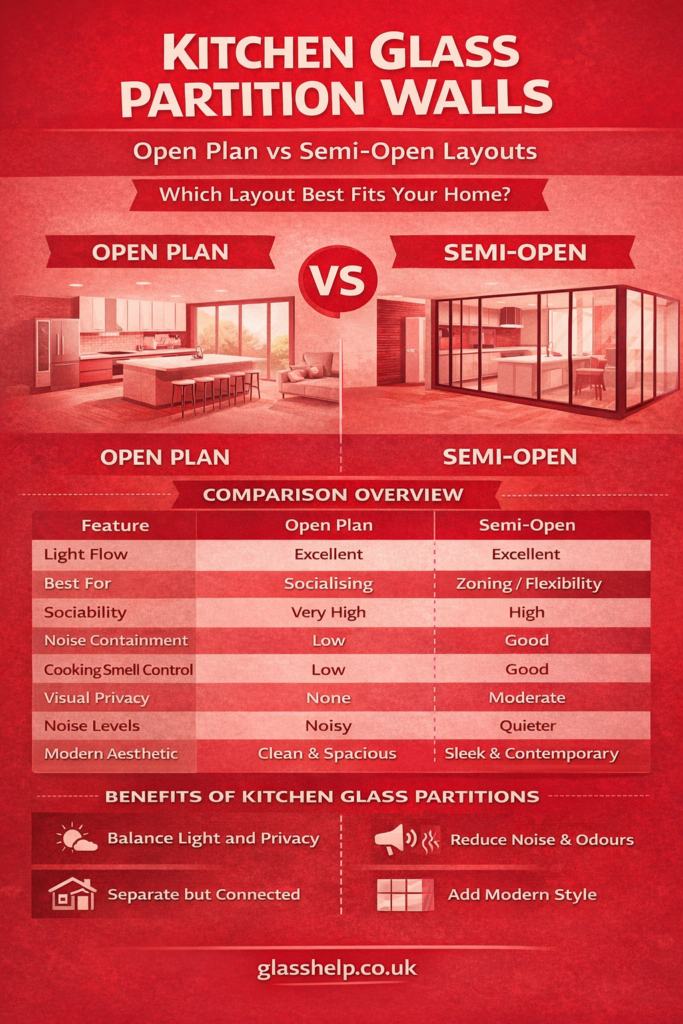
What Is an Open Plan Kitchen?
An open plan kitchen removes barriers between the kitchen, dining, and living areas, creating one unified, flexible space. Walls and doors are minimized or eliminated, allowing light and movement to flow freely throughout.
Open plan living first gained popularity in the late 20th century and has remained a dominant trend due to its sociable and spacious feel. Homes with open plan layouts feel larger and brighter because removing physical barriers maximizes natural light and sightlines. The Conversion Guy
Benefits of Open Plan Kitchens
1. Enhanced Social Interaction:
An open space encourages conversation between the cook and housemates or guests. Whether hosting dinner parties or keeping an eye on children while preparing meals, open plans foster togetherness. The Conversion Guy
2. Better Natural Light:
Without internal dividing walls, sunlight can brighten deeper sections of your home, creating a sense of airiness and wellbeing. All Well Property Services
3. Flexibility and Flow:
Open layouts are flexible — perfect for multifunctional use like cooking, dining, working, and lounging without feeling constrained. The Conversion Guy
4. Resale Appeal:
Many buyers and renters are drawn to open, uninterrupted spaces that feel modern and convenient.
Drawbacks of Open Plan Kitchens
Despite their benefits, open plan layouts have downsides:
- Noise carries easily: Sound from appliances, conversations, or TV can travel across the space. The Conversion Guy
- Smell and mess are visible: Cooking aromas and mess don’t stay contained. AIS
- Less distinct home “rooms”: Some people miss the psychological comfort of compartmentalized living.
What Is a Semi-Open (Broken Plan) Kitchen?
The semi-open or broken plan concept sits between open and closed layouts. Instead of open expanses or full walls, this layout uses partial dividers, screens, or glass partitions to delineate space while still maintaining visual and light connectivity.
Traditionally, “broken plan” meant retaining some structural separation — half walls or changes in ceiling or floor levels — but modern interior design often substitutes glass partitions to achieve the same effect without blocking light. Homebuilding
Why use a broken plan?
Semi-open layouts attempt to give the best of both worlds:
- Defined zones: Kitchen, dining, and living areas feel separate while still connected.
- Light flow: Partial dividers, especially glass, do not restrict daylight the way solid walls do. House & Garden
- Flexibility: Semi-open spaces often adapt better for work, dining, relaxing, or entertaining.
Glass Partitions: Bridging Open and Semi-Open Layouts
Glass partitions have emerged as a popular architectural feature to support semi-open kitchens. They allow homeowners to enjoy the sociability and brightness of an open plan, while also incorporating functional separation, smell containment, or acoustic zoning.
If you’re exploring options and inspiration, check out this guide to glass partition walls, which showcases how glazed solutions can redefine interior zones without closing them off.
Glass partitions come in many styles:
- Frameless clear glass: For maximum light and view continuity
- Crittall-style framed glass: Classic industrial look with architectural character
- Frosted or patterned glass: For privacy and visual softness
According to interior design professionals, glazed partitions are increasingly used to create visual connection without sacrificing separation — a trend especially popular in urban homes and contemporary renovations. Glass Interiors
Open Plan vs Semi-Open: A Comparative Look
| Aspect | Open Plan | Semi-Open with Glass Partitions |
|---|---|---|
| Light Flow | Excellent | Excellent |
| Sociability | High | High when partitions are open or transparent |
| Privacy/Containment | Low | Moderate to High |
| Noise Control | Low | Better with glazed barriers |
| Odor Control | Poor | Better than open plan |
| Visual Space | Very Open | Slightly defined but still airy |
| Zoning | None | Partial to strong depending on design |
Practical Considerations for Your Kitchen
1. How Do You Use Your Kitchen Day-to-Day?
- If you love entertaining and conversation flows easily around cooking and dining, open plan may suit your lifestyle.
- If noise and cooking smells are concerns, consider semi-open layouts with glazed partitions that offer separation while preserving connection.
2. Light and Orientation Matter
Open plan spaces excel in bright homes with large windows or extensions. Semi-open designs are ideal where light is limited or needs to be directed cleverly between zones.
3. Acoustics and Smell Control
Glass partitions provide an elegant way to reduce noise transmission and slow the spread of cooking odors without losing natural light — something fully open plans struggle to manage.
4. Privacy Without Isolation
A kitchen that’s fully open to living spaces can feel exposed. Strategically placed glass walls or sliding glazed doors let you “close” the kitchen visually while feeling connected. Houzz
Design Tips for Using Glass in Kitchen Layouts
Choose the Right Frame and Finish
Crittall-style black metal frames are classic and add character, while frameless glass creates a seamless, minimalist appeal. The frame finish should harmonies with your kitchen cabinetry and fixtures.
Consider Sliding or Folding Glass Panels
If flexibility is important, sliding or folding glass partitions let you open the kitchen fully when you want, then close it off when cooking odors or noise needs containment.
Use Frosted or Textured Glass for Partial Privacy
In busy households, you may want glass partitions that obscure detailed views while still admitting light. Frosted, patterned, or textured glass achieves this balance.
Costs & Practical Installation
Glass partition walls vary in price based on size, glass thickness, framing, and hardware. Compared to full wall rebuilds, glass systems can be a cost-effective compromise that delivers both form and function.
Professional installation is recommended to ensure structural stability, proper sealing (especially if condensation is a concern), and smooth operation of any moving parts like sliders.
Which Layout Is Right for You?
There’s no universally right answer — your choice depends on priorities:
Choose Open Plan If:
- You prioritise sociability and light
- You entertain frequently
- You want a visually expansive layout
Choose Semi-Open with Glass Partitions If:
- You want zoned spaces without blocking light
- Noise and odors are considerations
- You prefer a balance of privacy and connection
- You want a contemporary design feature
Many designers now advocate hybrid approaches — open layouts softened with strategic zones and glazed boundaries that parcel space effectively without shutting it away completely. Harvey Jones
Conclusion — Balance Over Extremes
Open plan and semi-open kitchen layouts each have compelling benefits. The trend in modern interiors is less about rigid zoning or completely unobstructed spaces, and more about fluid, adaptable design that respects light, activity flow, privacy, and aesthetic coherence.
Glass partitions are one of the most effective ways to achieve this — offering separation where it matters while preserving light, view, and connection. Used thoughtfully, they make kitchens feel more functional, stylish, and enjoyable for everyday life.
Whether you choose full openness or a refined semi-open approach, start with how you live in your space, and let design and lifestyle guide the rest.