
How to Choose the Glass Right Partition Wall for Your Space (Step-by-Step Guide)
Glass partition walls are one of the most stylish and effective ways to divide interior spaces while maintaining light, openness, and visual connection. But choosing the right glass partition wall for your specific room — whether it’s a home office, living space, commercial area, or studio — requires careful planning and informed decisions.
This step-by-step guide will walk you through every important factor to consider, helping you select a glass partition solution that delivers on functionality, aesthetics, acoustics, safety, and budget.
Why Glass Partitions Are Popular
Glass partition walls have become increasingly popular due to their ability to:
- Maximise natural light — transparent or translucent panels let sunshine penetrate deep into interiors, reducing reliance on artificial lighting. Heritage Window Company
- Improve sense of space — glass creates the illusion of openness even while defining zones. Vision Glass Doors
- Blend style and function — they work in minimal, industrial, contemporary, and traditional settings. Kova
If you’re considering installing one, explore detailed design and installation options at this guide to glass partition walls, which showcases different systems and applications.
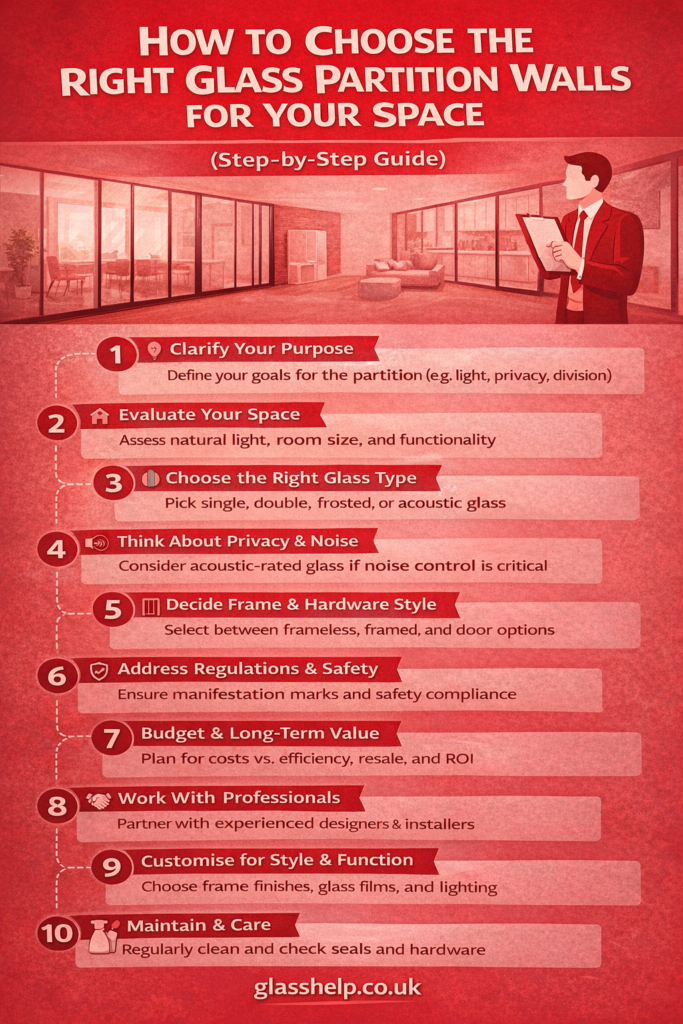
1. Clarify Your Purpose
Before diving into styles and specifications, identify why you want a glass partition:
A. Light & Visual Openness
Glass partitions let you visually connect rooms while still delineating spaces. This is ideal for dividing living areas, hallways, or studios without blocking light. Vision Glass Doors
B. Noise Control & Privacy
If you need acoustic separation — such as for a home office, bedroom divide, or meeting space — prioritising thicker or acoustic-rated glass is key. KCC Group
C. Functional Division
Glass works well where you want defined zones for activities (e.g., study areas, kitchen zones, entrance vestibules) without sacrificing openness or style. Kova
2. Evaluate Your Space
Assess your room’s layout, lighting, and structural features:
A. Natural Light Availability
If your space suffers from low light, fully transparent glass or even low-iron glass can help maximise brightness. Glass partitions outperform solid walls because they allow light to pass through and illuminate adjacent areas. Heritage Window Company
B. Room Usage
Consider how the space will be used:
- High-traffic / multi-purpose areas: require tough, easy-to-maintain partitions.
- Quiet zones / work areas: need acoustic considerations.
- Moisture-prone areas: kitchens or bathroom adjacency may need tempered or laminated glass.
This upfront evaluation ensures that your glass partition is functional as well as stylish.
3. Choose the Right Glass Type
Glass partitions vary in terms of thickness, finish, and performance features. Here’s what to consider:
A. Single vs Double Glazed
- Single-glazed glass is thinner, lighter, and generally more affordable — suitable for light division and open feel. Glass Partitioning UK
- Double-glazed glass offers better acoustic performance and insulation, making it ideal for workspaces or bedroom divisions.
Double glazing also helps regulate temperatures between zones, which can be beneficial in both homes and offices. SunSeeker Doors
B. Safety & Tempered Glass
All interior glass partitions should use toughened or safety glass to reduce risk of injury if broken. Safety glass complies with building standards and is especially important in homes with children or in commercial settings.
C. Frosted, Textured, or Patterned Glass
Not every glass wall needs to be completely transparent. Frosted or patterned glass enhances privacy while preserving light flow, and is ideal for bathrooms, study zones, or bedroom enclosures. Glass Partitioning UK
4. Think About Acoustics and Privacy
Glass on its own does not block sound as effectively as solid walls. If you’re installing partitions between noisy zones or spaces where privacy matters, this step is critical:
A. Acoustic Glass Options
Acoustic-rated glass — such as laminated panels with a noise-reducing core — can help significantly reduce sound transmission. Some systems achieve advanced decibel reduction levels while remaining sleek. KCC Group
B. Double-Layer Systems
A double-layer approach — combining double glazing with acoustic seals — often delivers the best privacy without heavy solid walls.
5. Decide Frame & Hardware Style
The visual impact of your glass partition depends as much on the framing and hardware as the glass itself.
A. Frameless Glass
Frameless partitions offer a minimalist, uninterrupted look. They give the sharpest sense of openness but generally cost more and require careful installation.
B. Framed Glass
Framed systems — whether slim black metal, aluminium, or coloured frames — add architectural character. These are especially popular in industrial, contemporary, and heritage-inspired interiors.
C. Door Styles & Mobility
Consider how you’ll move between divided areas:
- Sliding glass doors save space and maintain continuity.
- Pivot or hinged doors feel more traditional and solid.
- Folding / bi-fold systems maximise opening width.
Door choice impacts both functionality and cost — so plan early in the design process. prismglass
6. Address Building Regulations & Safety
Even internal partitions can trigger certain requirements:
A. Manifestation & Safety Markings
UK building standards often require visual markers (dots, bands, or patterns) on large glass surfaces to prevent people walking into them. Don’t skip this — it’s both a safety feature and a compliance requirement. prismglass
B. Load & Structural Considerations
Glass walls that span floor-to-ceiling, or contribute to structural movement control, may require professional input to ensure safety and durability.
Working with experienced suppliers and installers ensures compliance with local codes and reduces risk during installation.
7. Budget & Long-Term Value
Glass partitions vary widely in cost, and better planning means better value:
A. Base Costs
Basic single glazed systems are more affordable, while double-glazed, acoustic, or bespoke systems increase cost. Glass Partitioning UK
B. Installation Complexity
Site conditions, ceiling and floor finishes, and size all influence installation costs — often as much as the materials themselves. Glass Partitioning UK
C. ROI & Functional Benefits
Glass partitions often add perceived space, light, and modern appeal — all factors that can improve resale or rental value. Optima United Kingdom
Budget realistically for the entire project: materials, installation, hardware, and finishing touches like manifestations or privacy films.
8. Work With Professionals
Glass partition walls may look simple, but they require precise planning, measuring, and installation. Partnering with qualified designers and installers helps you:
- Avoid measurement errors
- Comply with regulations
- Select the right glass performance
- Get expert installation and aftercare
Most reputable companies will conduct a site survey and provide guided recommendations based on your goals.
9. Customise for Style & Function
Once you’ve chosen the fundamentals (glass type, frame, acoustics), it’s time to refine the design:
A. Colour & Finish Choices
Frames can be powder-coated to match your interior palette. Doors and fittings come in finishes from matte black to brushed steel.
B. Glass Films & Decals
Adding subtle films or patterns can enhance privacy or branding while complementing decor.
C. Integration With Lighting
Glass works beautifully with lighting — edge lighting, pendant fixtures, or integrated LEDs can create dramatic visual interest.
10. Maintenance and Care
Glass walls are easy to clean but benefit from routine care:
- Use non-abrasive cleaners to avoid scratches.
- Regularly inspect seals and hardware.
- Clean frames and tracks to ensure smooth operation.
Proper care extends durability and keeps partitions clear and beautiful.
Conclusion — Choose with Purpose
Selecting the right glass partition wall means balancing light, privacy, acoustics, budget, and style. By clearly defining your goals, evaluating space conditions, selecting the right glass type and framing, and working with professionals, you ensure a design that enhances both function and aesthetics.
Glass partitions can redefine interiors — whether you want a luminous home office, a stylish kitchen divide, or modern commercial zones. Thoughtful planning makes all the difference.