
Common Mistakes to Avoid When Installing Glass Partition Walls
Glass partition walls are a powerful design feature. They allow light to flow, create modern zoning, and elevate both residential and commercial interiors. However, poor planning or incorrect installation can quickly turn a premium feature into an expensive problem.
This guide highlights the most common mistakes people make when installing glass partition walls, explains why they happen, and shows you exactly how to avoid them — saving you money, time, and frustration.
Whether you’re a homeowner, landlord, designer, or business owner, this article will help you get it right the first time.
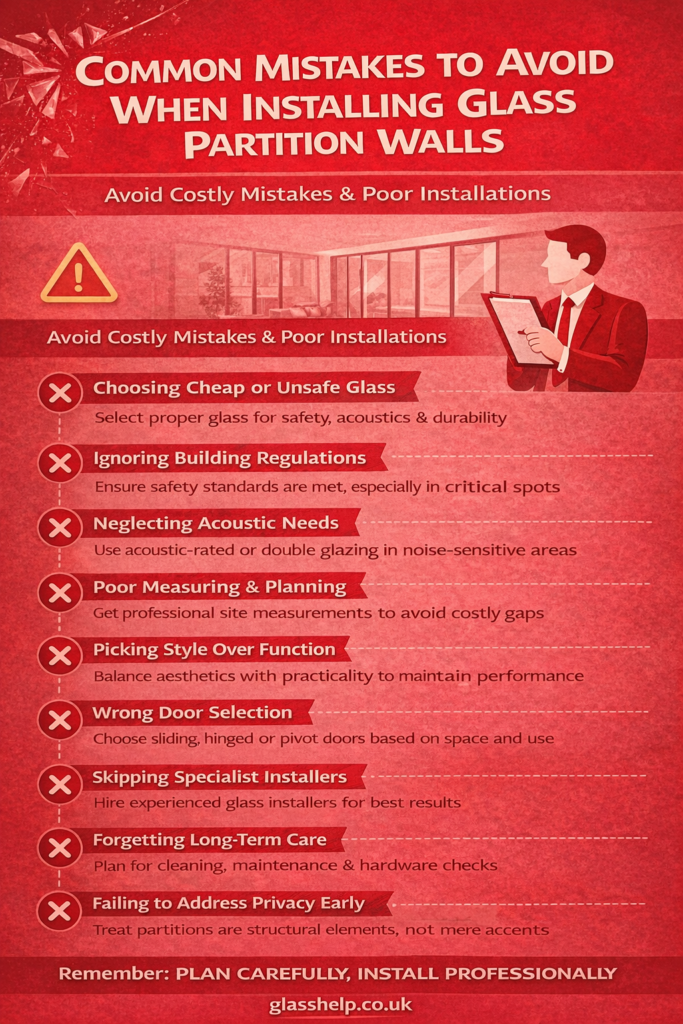
Why Glass Partition Installations Go Wrong
Glass partitions look simple, but they are precision systems. They involve:
- Structural tolerances
- Safety regulations
- Acoustic performance
- Door mechanics
- Visual alignment
Most issues arise when glass walls are treated like decorative features instead of engineered building elements.
Let’s break down the mistakes — and how to avoid each one.
Mistake #1: Choosing the Wrong Type of Glass
Why it happens
Many people assume “glass is glass” and select panels based on appearance alone.
The problem
Using incorrect glass can lead to:
- Poor sound insulation
- Safety risks
- Regulatory non-compliance
- Cracks or breakage over time
What to do instead
Always choose glass based on function, not just aesthetics:
- Toughened (tempered) glass for safety
- Laminated glass for higher impact resistance and acoustic control
- Acoustic laminated glass for offices, meeting rooms, and bedrooms
According to specialist glass installers, acoustic and safety performance should be considered before visual finish, not after.
(visionglassdoors.co.uk)
Mistake #2: Ignoring Building Regulations & Safety Requirements
Why it happens
Internal partitions are often assumed to be exempt from regulations.
The problem
In the UK, internal glass walls must still meet safety standards, especially in:
- Critical locations
- High-traffic areas
- Door and walkway zones
Failing to comply can create:
- Injury risk
- Insurance issues
- Costly rework after inspection
What to do instead
Ensure your glass partition:
- Uses safety glazing where required
- Includes manifestation markings (visual bands or dots) to prevent walk-through accidents
- Is installed by professionals familiar with UK regulations
Building compliance isn’t optional — even for interior features.
Mistake #3: Underestimating Acoustic Needs
Why it happens
Glass looks solid, so people expect it to block sound like a wall.
The problem
Standard single-glazed glass offers limited sound insulation. This leads to:
- Noisy offices
- Distracting home workspaces
- Reduced privacy
What to do instead
If sound control matters:
- Use acoustic laminated glass
- Consider double-glazed partition systems
- Ensure perimeter seals are specified correctly
Acoustic performance depends on the entire system, not just the glass thickness.
(thekccgroup.com)
Mistake #4: Poor Measurement & Tolerance Planning
Why it happens
Walls, floors, and ceilings are rarely perfectly level — especially in older buildings.
The problem
Incorrect measurements can result in:
- Gaps at the ceiling or floor
- Stress fractures in glass
- Doors that don’t align or close properly
Glass cannot be “trimmed” on site like timber or plasterboard.
What to do instead
- Always allow for structural movement and tolerance
- Use professional site surveys
- Avoid DIY measuring for custom glass
Precision at this stage prevents costly remakes later.
Mistake #5: Choosing Style Over Practicality
Why it happens
Frameless glass and ultra-minimal designs look stunning in photos.
The problem
Purely aesthetic choices can lead to:
- Poor door sealing
- Limited acoustic control
- Difficult maintenance
What to do instead
Balance aesthetics with performance:
- Slim framed systems often outperform frameless ones acoustically
- Framed glass allows better alignment and durability
- Hardware choice affects long-term usability
Modern glass partition walls come in many configurations — the best choice depends on how the space will actually be used.
Mistake #6: Incorrect Door Selection
Why it happens
Doors are often chosen last — or treated as an afterthought.
The problem
The wrong door can cause:
- Awkward traffic flow
- Reduced accessibility
- Noise leakage
- Mechanical failure over time
What to do instead
Choose doors based on:
- Swing space availability
- Frequency of use
- Accessibility requirements
Options include:
- Sliding glass doors (space-saving)
- Hinged doors (traditional feel)
- Pivot doors (design-led spaces)
Door hardware quality is just as important as glass quality.
(prismglass.co)
Mistake #7: Skipping Professional Installation
Why it happens
Glass partitions look simple, leading some to attempt DIY or use non-specialist installers.
The problem
Improper installation can result in:
- Glass stress points
- Poor alignment
- Safety hazards
- Voided warranties
Glass is unforgiving — small installation errors can cause major issues.
What to do instead
Use experienced glass partition installers who:
- Understand load distribution
- Use correct fixings and seals
- Follow manufacturer guidelines
Professional installation protects both safety and investment.
Mistake #8: Forgetting Long-Term Maintenance
Why it happens
Glass partitions are often seen as “fit and forget”.
The problem
Without maintenance:
- Tracks clog with debris
- Hinges loosen
- Seals degrade
- Doors lose alignment
What to do instead
Plan for:
- Easy-clean glass finishes
- Accessible hardware
- Occasional seal checks
Well-maintained glass partitions can last decades with minimal intervention.
Mistake #9: Not Considering Privacy Early Enough
Why it happens
Clear glass is chosen by default, with privacy addressed later.
The problem
Retro-fitting privacy solutions:
- Costs more
- Limits design options
- May reduce light effectiveness
What to do instead
Decide privacy needs upfront:
- Frosted glass
- Acid-etched finishes
- Decorative films or gradients
Privacy and light can coexist — if planned correctly.
(glassinteriors.co.uk)
Mistake #10: Treating Glass Partitions as “Just Dividers”
Why it happens
Glass partitions are sometimes seen as cosmetic add-ons.
The problem
This mindset leads to:
- Under-specification
- Budget shortcuts
- Poor integration with lighting, flooring, and ceilings
What to do instead
Think of glass partitions as architectural systems, not accessories. When designed properly, they:
- Increase perceived space
- Improve property value
- Enhance functionality
- Future-proof interiors
High-quality systems pay for themselves in performance and longevity.
Quick Checklist: Avoid These Glass Partition Mistakes
✔ Choose the correct glass type
✔ Follow safety and building standards
✔ Plan for acoustics early
✔ Measure professionally
✔ Balance style with function
✔ Select the right doors
✔ Use experienced installers
✔ Plan for maintenance
✔ Address privacy from the start
✔ Treat glass as a structural feature
Conclusion: Plan Smart, Install Right
Glass partition walls can completely transform a space — but only when installed correctly. Most problems don’t come from the glass itself, but from poor decisions made early in the process.
By avoiding the mistakes outlined above, you’ll ensure your glass partitions are:
- Safe
- Functional
- Visually striking
- Built to last
If you’re planning a project and want expert guidance, explore modern glass partition walls solutions and specifications to ensure your installation is both beautiful and technically sound.