
What Type of Glass Is Used in Staircases? Tempered vs Laminated Explained
Glass staircases are one of the most striking architectural features in contemporary interiors — offering light, openness, and a sleek sense of modernity. But when it comes to safety, performance, and longevity, the type of glass you choose matters just as much as the design itself. Staircases aren’t just decorative; they’re structural and must meet strict safety criteria. Selecting the right glass — especially between tempered and laminated options — ensures both beauty and peace of mind.
In this comprehensive guide, we explore what glass types are most commonly used in staircases, why they matter, how they differ, and when each is the best choice.
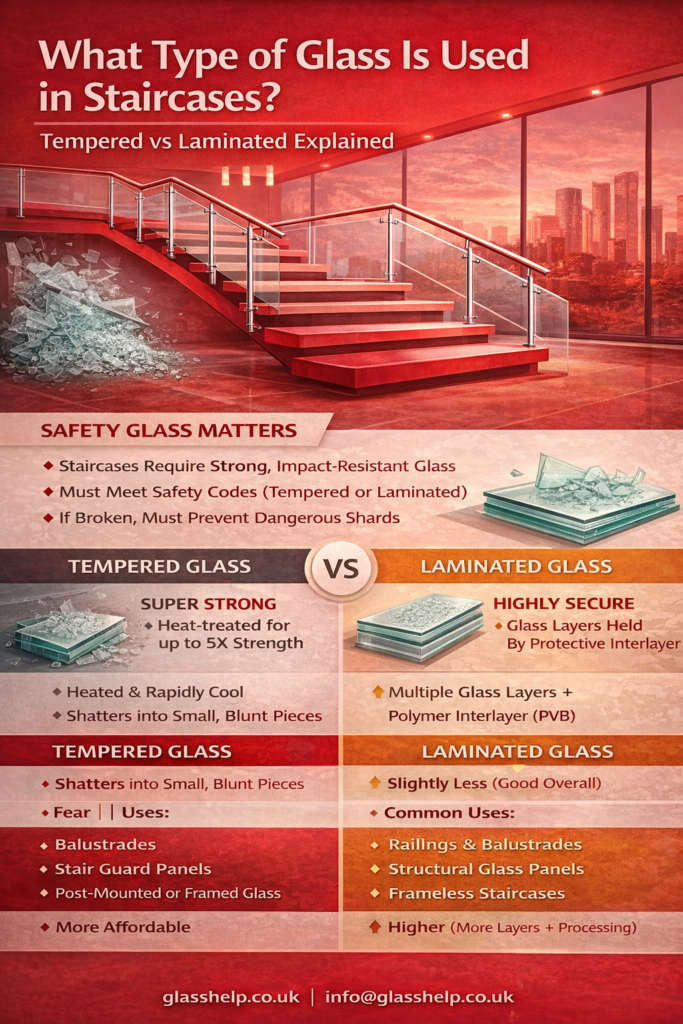
1. Why Safety Glass Is Essential in Staircases
Glass used in staircases isn’t regular glass. Regular annealed glass (the kind you find in picture frames or windows) can shatter into sharp shards that pose serious risk if broken. For staircases, safety glass is required by building codes because:
- It must withstand repeated impact and daily use
- It should resist cracking under stress
- If it breaks, it must fail in a way that minimizes injury risk
The two main safety glass types used in staircases are tempered glass and laminated glass — both engineered to be far safer than ordinary glass. Wikipedia
2. Tempered Glass: Strength and Break-Safety
Tempered glass — also known as toughened glass — is a form of safety glass that has been heat-treated to increase its strength significantly compared to regular glass. Wikipedia
How Tempered Glass Is Made
Tempered glass is manufactured by:
- Heating annealed (standard) glass to about 600–650 °C
- Rapidly cooling it with blasts of air
This process creates compressive stress on the surface and tensile stress inside, dramatically increasing its strength. Wikipedia
Key Characteristics
- Up to 4–5× stronger than standard glass of the same thickness
- If broken, shatters into small blunt pieces, significantly reducing injury risk compared with sharp shards
- Ideal for high-impact applications such as stair railings and balustrades
- Cannot be cut or re-worked after tempering
These attributes make tempered glass a robust, widely used choice in staircases — particularly where strength and resistance to impact matter most. Wikipedia
Common Uses in Staircases
- Balustrades and guard panels
- Stair railing infills
- Frameless or post-mounted stair panels
Most modern glass stair installations start with tempered glass as the baseline. The Glass Railing Store
3. Laminated Glass: Safety and Structural Integrity
Laminated glass is another type of safety glass, but instead of relying solely on heat treatment, it is made by sandwiching multiple glass layers together with one or more polymer interlayers, typically polyvinyl butyral (PVB). Wikipedia
How Laminated Glass Is Made
Laminated glass panels are formed by:
- Placing two (or more) sheets of glass together
- Inserting plastic interlayer(s) between them
- Applying heat and pressure to bond the layers into a single panel
When laminated glass breaks, the interlayer holds the fragments in place — preventing dangerous shards from falling away. Wikipedia
Key Advantages
- Retains overall structure even when cracked, which reduces the risk of falls or penetration
- Offers improved sound insulation
- Can be combined with tempered glass layers to maximize both strength and holding power
For staircases — especially where the glass might be used for treads, major walkable components, or unframed panels — laminated glass provides a second line of safety. GlassWalk
4. Tempered vs Laminated Glass: Direct Comparison
Both tempered and laminated glass are categories of safety glass, but they serve different purposes depending on how the staircase is constructed.
| Feature | Tempered Glass | Laminated Glass |
|---|---|---|
| Break Behavior | Shatters into small blunt pieces | Pieces stick to interlayer |
| Impact Resistance | Higher | Good, slightly less than tempered alone |
| Safety After Breakage | Panel fails and loses support | Remains intact as a barrier |
| Typical Use | Railings, balustrades | Structural panels, stair treads, high-safety areas |
| Cost | More affordable | Higher due to extra materials & processing |
✔ Quick rule: Tempered glass excels at resisting impact, while laminated glass excels at maintaining enclosure and preventing pieces from falling away.
5. When Should You Use Each Type in Staircases?
A. Tempered Glass — Best For
- Balustrade panels with posts or handrails
- Panels not intended to be walked on
- Areas where strength and resistance to knocks are key
Most designers choose tempered glass for railing balustrades because it balances safety, strength, and cost effectively. The Glass Railing Store
B. Laminated Glass — Best For
- Glass treads or steps
- Frameless installations where there’s no metal structure to catch broken glass
- High-use areas where broken glass should remain intact rather than releasing pieces
Architectural glass stair treads and high-risk zones often use tempered laminated constructions — where tempered glass sheets are laminated together — providing the best of both worlds. GlassWalk
This “hybrid” approach is especially common for invisible stringer or frameless systems, where safety and continuous surface performance are paramount.
6. Other Glass Variants That May Be Used
While tempered and laminated glass dominate staircase applications, here are some additional variants worth knowing:
Low-Iron Glass
Often used for luxury staircases where clarity is paramount. It has less of the greenish tint seen in standard glass, offering ultra-clear views. kavifencing.com
Frosted or Etched Glass
Used where privacy or decorative aesthetics are desired without compromising safety. in.saint-gobain-glass.com
Tinted or Coloured Glass
Adds style and reduces glare — though it behaves as tempered or laminated safety glass at its core. in.saint-gobain-glass.com
7. Glass Thickness and Building Codes
Building codes generally require safety glass for stairs and set minimum thicknesses depending on panel size and application. For example, many frameless balustrade systems start at 10–12 mm minimum thickness. Mannlee –
For stair treads and heavier structural panels, thicker laminated safety glass (often with a combined thickness of 21.5 mm or more) is common in residential and commercial builds. Grand Design Stairs
Always check with your local codes and a structural engineer before specifying glass — it not only impacts safety, but affects long-term performance and liability.
8. Practical Considerations for Buyers and Designers
When selecting glass for your staircase, here are some practical questions to guide your choice:
✔ How will the glass be supported?
- With posts or a metal frame → Tempered glass may suffice
- Frameless or structural glass treads → Laminated (often tempered laminated)
✔ Is the glass likely to experience high impact?
- Choose tempered glass for impact resistance
- Choose laminated glass for post-break safety
✔ What is your aesthetic preference?
- Clear and minimalist → Low-iron tempereds
- Decorative or privacy → Frosted/etched laminates
✔ What’s your budget?
- Pure tempered glass tends to cost less
- Laminated — especially thicker panels — cost more but offer safety value
Professional installers and designers always balance code, budget, and aesthetics — and most modern projects mix tempered and laminated in different parts of the same staircase.
9. Glass Staircases in Context
Glass doesn’t just serve a functional purpose in stairs — it becomes a defining design element. Whether it’s a frameless floating staircase, a sleek glass balustrade, or a fully transparent stair structure paired with metal or timber, glass choices directly impact the look, feel, and performance of your staircase project.
👉 If you want examples or inspiration on how different glass types come together in stunning staircase designs, check out this comprehensive guide to glass staircases for insights on materials, styles, and specifications.
🔗 Glass staircase design and glass selections explained — https://www.glasshelp.co.uk/glass-staircase/
Conclusion
When it comes to staircases, no ordinary glass will do. Tempered and laminated glass are both engineered safety options that offer strength, durability, and peace of mind — but they behave differently:
- Tempered glass is highly impact-resistant and shatters into small safe pieces — great for balustrades.
- Laminated glass holds together when broken — ideal for structural panels and high-safety areas.
By understanding the strengths of each, you can make smart design and specification decisions that satisfy both safety standards and your visual goals.