
Are Glass Juliet Balconies Safe? Load Ratings, Building Regulations & Real-World Testing
Glass Juliet balconies often divide opinion. Some homeowners love their clean, modern look, while others pause and ask the most important question of all:
“Are glass Juliet balconies actually safe?”
It’s a fair concern. After all, you’re talking about a glass barrier installed at height, protecting open doors or windows. This article takes a deep, practical dive into how glass Juliet balconies are designed for safety — covering load ratings, safety glass types, fixing methods, UK regulations, and real-world performance — so you can make a confident, informed decision.
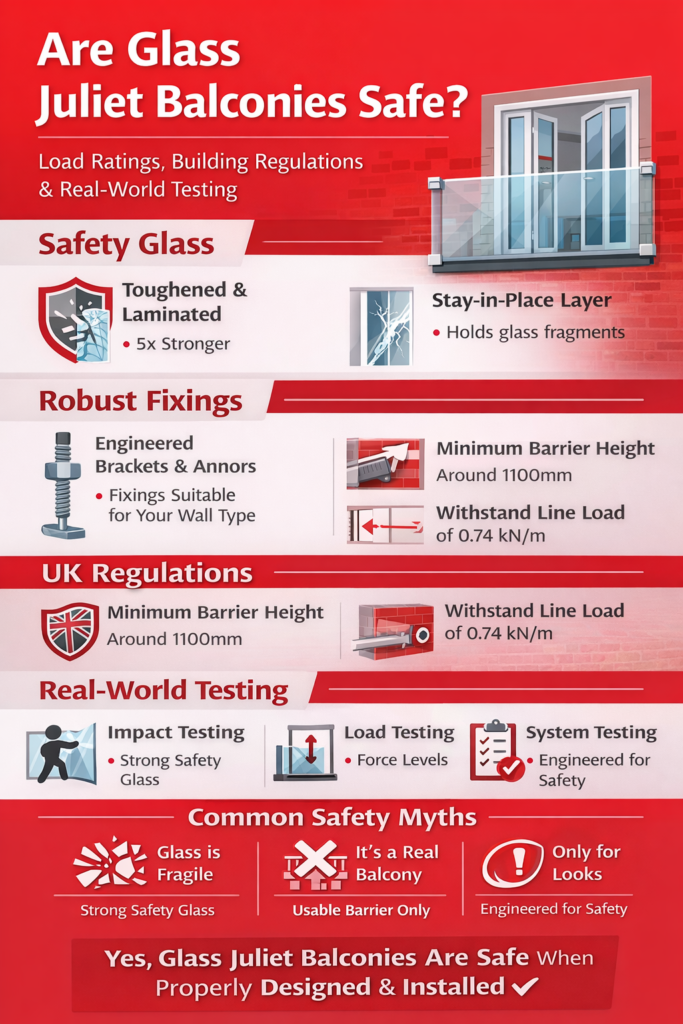
What “Safety” Really Means for a Glass Juliet Balcony
A glass Juliet balcony is not a walk-on balcony. It is a protective barrier installed outside full-height windows or French doors to prevent falls while allowing ventilation and natural light.
When professionals assess safety, they look at four main areas:
- Fall prevention – barrier height, gaps, and climb resistance
- Structural strength – resistance to horizontal forces (people leaning or pushing)
- Glass performance – what happens if glass breaks
- Fixings and installation – how loads transfer into the building
A Juliet balcony that meets these requirements is designed to be predictable, tested, and compliant, not decorative guesswork.
Understanding Load Ratings (Explained Simply)
You may see figures like 0.74 kN/m mentioned in specifications. While that looks technical, the concept is straightforward.
What is a line load?
A line load measures how much horizontal force the balcony can resist along its top edge. It simulates real-world situations such as:
- Someone leaning against the glass
- Multiple people pushing during a gathering
- Accidental impact from doors opening suddenly
Typical residential benchmark
For external residential guarding, many Juliet balcony systems are designed around a 0.74 kN/m horizontal line load. This is widely referenced in UK residential applications for external barriers.
What this means for homeowners:
A compliant glass Juliet balcony is engineered to withstand significant lateral pressure, not just gentle contact.
Safety Glass: Why Juliet Balconies Aren’t Made from “Normal” Glass
One of the biggest misconceptions is that Juliet balconies use ordinary window glass. They don’t.
Toughened (Tempered) Glass
- Heat-treated for strength
- Typically 4–5× stronger than standard glass
- Breaks into small, blunt fragments if shattered
Laminated Glass
- Two or more glass layers bonded with an interlayer
- If broken, fragments remain attached to the interlayer
- Maintains a barrier even after cracking
Toughened Laminated Glass (Common Choice)
Most high-quality glass Juliet balconies use toughened laminated glass, combining:
- High impact resistance
- Post-breakage safety
- Reduced risk of sudden failure
Why this matters:
Even in the unlikely event of breakage, laminated glass helps prevent a fall by staying in place rather than collapsing.
Fixing Methods: Where Most Safety Depends
The glass itself is only part of the system. Fixings and structural support are equally critical.
Common fixing methods
1. Side-Fixed (Jamb-Mounted)
- Brackets fixed into the side walls of the opening
- Clean, minimalist appearance
- Requires strong masonry or structural backing
2. Face-Fixed
- Fixed to the front face of the building
- Often used where side fixing isn’t possible
- Slightly more visible but highly secure
3. Framed or Post-Supported
- Uses vertical posts or frames
- Distributes loads more evenly
- Often chosen for older buildings or uneven substrates
Why professional assessment matters
A proper installer evaluates:
- Wall material (brick, block, concrete, timber frame)
- Edge distances and anchor spacing
- Condition of mortar and lintels
- Door width and glass span
Poor fixing — not glass failure — is the most common cause of balcony issues.
UK Building Regulations (What Homeowners Need to Know)
In the UK, glass Juliet balconies fall under guarding and fall-protection requirements, particularly when installed at height.
Key safety expectations include:
- Minimum barrier height (commonly around 1100mm externally)
- No dangerous gaps
- Resistance to horizontal loads
- Secure anchoring to the structure
For homeowners wanting a clear, plain-English overview of balcony compliance and guarding expectations, this guide is helpful:
👉 Why Glass Juliet Balconies Are Safe and Compliant
(This explains safety, load performance, and compliance without diving into legal text.)
Real-World Testing: What Actually Gets Tested?
When manufacturers talk about “tested systems,” it doesn’t mean someone just leaned on the glass.
Real-world testing typically includes:
✔ Impact testing
Simulates accidental human impact to ensure the glass resists sudden force.
✔ Load simulation
Applies horizontal pressure to confirm the system meets required line-load performance.
✔ System testing
Evaluates the entire assembly — glass, brackets, fixings, and handrails — not just the glass panel alone.
This is why reputable suppliers test complete systems, not individual components.
Why Glass Juliet Balconies Are Often Safer Than Metal Railings
This may sound surprising, but glass Juliet balconies can outperform traditional railings in several ways:
- No large gaps children or pets can slip through
- No horizontal bars that encourage climbing
- Even load distribution across the panel
- Clear visibility, reducing accidental collisions
Metal railings may look robust, but poorly spaced bars or climbable designs can introduce risks that glass eliminates.
Common Safety Myths (Debunked)
❌ “Glass is fragile”
Safety glass used in Juliet balconies is engineered, tested, and load-rated — not decorative.
❌ “You can step onto it”
A Juliet balcony is a barrier, not a platform. It’s designed to protect open doors, not provide standing space.
❌ “It’s just for looks”
Glass Juliet balconies are functional safety installations that also happen to look modern.
Choosing a Safe System: A Homeowner Checklist
Before ordering or installing, ask these questions:
- What glass type is used (laminated or toughened laminated)?
- What load rating does the system meet?
- How is it fixed, and is that suitable for my wall type?
- Are structural calculations available for my opening size?
- What is the final installed height of the barrier?
- Who is responsible for compliance — supplier or installer?
If answers are vague, walk away.
Where to Explore Safe, Compliant Options
If you want to see how modern systems combine safety glass, fixing methods, and compliant design, this guide explains available configurations clearly and practically glass Juliet balconies.
It’s a useful reference when comparing systems or discussing requirements with installers.
Final Verdict: Are Glass Juliet Balconies Safe?
Yes — when properly designed and installed, glass Juliet balconies are extremely safe.
They:
- Meet defined load ratings
- Use engineered safety glass
- Rely on tested fixing systems
- Comply with UK guarding principles
Most safety concerns come from misunderstanding how they’re engineered, not from real-world performance.
If you priorities correct specification and professional installation, a glass Juliet balcony isn’t just safe — it’s one of the most elegant and reliable guarding solutions available for modern homes.