
Top-Mounted vs Side-Mounted Glass Balustrades Explained
When planning a glass balustrade for a staircase, balcony, terrace, or decking area, most homeowners focus on glass type and style. But there’s another decision that has just as much impact on safety, appearance, and installation complexity:
Should the glass balustrade be top-mounted or side-mounted?
At first glance, the difference might seem purely visual. In reality, the mounting method affects:
- structural performance
- usable floor space
- waterproofing
- installation cost
- long-term durability
This guide explains top-mounted vs side-mounted glass balustrades in plain English, so you can make a confident, informed decision.
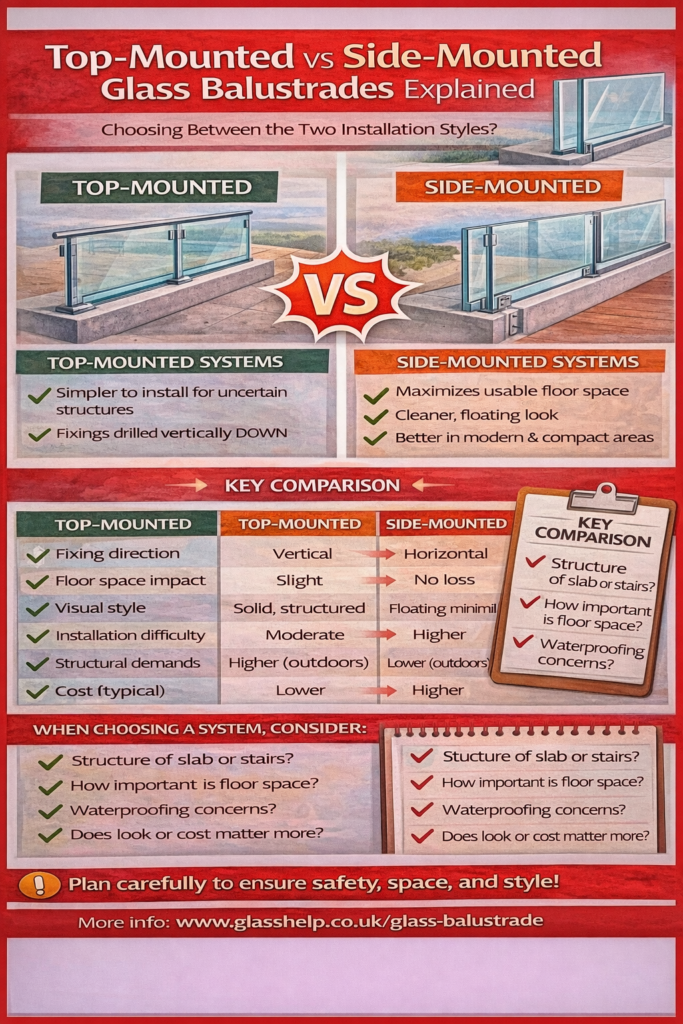
What Do “Top-Mounted” and “Side-Mounted” Mean?
Top-Mounted Glass Balustrades
A top-mounted balustrade is fixed directly onto the top surface of a floor, slab, stair tread, or balcony edge.
The glass (or its base channel/spigots) sits on the walking surface, with fixings drilled vertically down into the structure.
Side-Mounted Glass Balustrades
A side-mounted balustrade is fixed to the vertical face of a slab, stair string, or balcony edge.
The glass is cantilevered out from the side, meaning:
- fixings go horizontally into the structure
- the floor surface remains completely clear
Both systems are widely used in the UK — but they suit very different situations.
Top-Mounted Glass Balustrades Explained
How Top-Mounted Systems Work
Top-mounted balustrades are usually installed using:
- base channels
- spigots
- posts with infill glass
These components are anchored into structural concrete, steel, or timber, directly beneath the finished floor surface.
Advantages of Top-Mounted Glass Balustrades
✅ Simpler Structural Fixing
Fixing vertically into a slab is generally:
- easier to engineer
- easier to inspect
- easier to make compliant
This makes top-mounted systems a popular choice for:
- new builds
- refurbishments with unknown slab details
✅ More Forgiving Installation
Top-mounted systems typically allow:
- more adjustment tolerance
- easier levelling
- simpler alignment across long runs
This reduces the risk of visible alignment issues.
✅ Often More Cost-Effective
Because fixing is simpler, top-mounted balustrades often:
- require less specialist drilling
- need fewer bespoke brackets
- install faster
This can reduce labour costs.
Disadvantages of Top-Mounted Glass Balustrades
❌ Loss of Usable Floor Space
Top-mounted balustrades sit on the walking surface, which:
- slightly reduces balcony or stair width
- can feel intrusive on narrow areas
❌ Waterproofing Considerations
For outdoor areas, fixings penetrate the floor surface, meaning:
- waterproofing must be planned carefully
- poor detailing can lead to water ingress
Correct sequencing with membranes is essential.
❌ More Visible Hardware
Base channels or spigots are visible on the floor, which may not suit:
- ultra-minimal designs
- homeowners wanting a “floating glass” look
Side-Mounted Glass Balustrades Explained
How Side-Mounted Systems Work
Side-mounted balustrades are fixed into the vertical edge of:
- concrete slabs
- balcony edges
- stair strings
The glass panels extend upward from the side, leaving the floor completely clear.
Advantages of Side-Mounted Glass Balustrades
✅ Maximum Usable Space
Because nothing sits on the floor:
- balconies feel wider
- stairs feel more open
- edges look cleaner
This is a major reason side-mounted systems are popular in:
- small balconies
- modern apartments
✅ Cleaner Visual Finish
Side-mounted balustrades often achieve a:
- lighter, floating appearance
- minimal interruption to floor finishes
This suits contemporary architectural designs.
✅ Easier Floor Waterproofing
Because fixings don’t penetrate the walking surface:
- waterproofing layers remain uninterrupted
- long-term water resistance is often improved
Disadvantages of Side-Mounted Glass Balustrades
❌ More Demanding Structural Requirements
Side-mounted systems rely heavily on:
- slab edge strength
- correct edge distance
- accurate drilling
Weak or thin edges may require:
- structural assessment
- additional steel support
❌ Higher Installation Complexity
Horizontal drilling into slab edges:
- leaves less margin for error
- requires experienced installers
- can increase labour cost
❌ More Limited Adjustment
Once fixed, side-mounted systems allow less tolerance for correction, making precise measurement critical.
Safety and Compliance: Does Mounting Method Matter?
Yes — but not in the way many homeowners expect.
From a safety and regulatory perspective:
- both top-mounted and side-mounted balustrades can be compliant
- compliance depends on design, fixing strength, glass type, and height, not just mounting style
UK guidance focuses on:
- guarding height
- resistance to horizontal loads
- prevention of falls
A helpful overview of guarding expectations can be found on the UK Planning Portal, which outlines where guarding is required and why.
Regardless of mounting method, laminated glass is essential where the glass itself forms the primary guarding barrier.
Top-Mounted vs Side-Mounted: Key Comparison
| Feature | Top-Mounted | Side-Mounted |
|---|---|---|
| Fixing direction | Vertical | Horizontal |
| Floor space impact | Slight loss | No loss |
| Visual style | Solid, structured | Floating, minimal |
| Installation difficulty | Moderate | Higher |
| Structural demands | Lower | Higher |
| Waterproofing complexity | Higher (outdoors) | Lower (outdoors) |
| Cost (typical) | Lower | Higher |
Which Is Better for Staircases?
For staircases, the choice often depends on stair construction.
Top-Mounted Stair Balustrades
- Easier on concrete stairs
- More forgiving alignment
- Common for internal stairs
Side-Mounted Stair Balustrades
- Popular on timber or steel stairs
- Cleaner tread appearance
- Requires strong stair string structure
In tight staircases, side-mounted glass can make the space feel noticeably wider.
Which Is Better for Balconies and Terraces?
Top-Mounted Is Often Better When:
- slab edge strength is unknown
- budget is tighter
- installation speed matters
Side-Mounted Is Often Better When:
- balcony depth is limited
- clean floor lines are a priority
- slab edges are structurally sound
In premium apartment developments, side-mounted balustrades are often chosen for their visual lightness.
Common Homeowner Mistake: Choosing by Looks Alone
One of the most frequent mistakes is selecting a mounting style based only on appearance.
Before deciding, always ask:
- What is the slab or stair structure made of?
- Can the edge safely accept horizontal fixings?
- Will waterproofing be affected?
- Is there enough tolerance for installation accuracy?
Ignoring these questions can lead to:
- redesign costs
- delays
- compromised safety
How to Choose the Right System for Your Project
Choose top-mounted if:
- you want a simpler, more forgiving installation
- structural details are uncertain
- cost control is important
Choose side-mounted if:
- maximising space matters
- you want a floating, minimal look
- the structure has been confirmed as suitable
Reviewing properly engineered glass balustrade systems will help align design choice with real-world installation requirements
Final Thoughts
There is no universal “better” option between top-mounted and side-mounted glass balustrades — only the option that best suits your structure, space, and priorities.
- Top-mounted systems offer simplicity, adaptability, and cost efficiency
- Side-mounted systems deliver space, elegance, and architectural impact
When chosen correctly and installed properly, both systems are safe, compliant, and visually striking.