
Mirror Installation Options: Adhesive, Clips, Channels or Frameless Mounting
Choosing the right mirror is only half the job. How the mirror is installed plays an equally important role in safety, durability, and visual finish. A perfectly sized mirror can still look unfinished—or worse, become a hazard—if the wrong installation method is used.
Whether you’re installing a bathroom mirror, a wall-to-wall gym mirror, or a decorative feature panel, understanding the four main mirror installation options—adhesive, clips, channels, and frameless mounting—will help you make the right decision.
This guide explains how each method works, where it’s best used, and what to consider before choosing one.
Why Mirror Installation Method Matters
Mirrors are heavy, rigid, and unforgiving. Unlike pictures or lightweight wall décor, mirrors require:
- Secure load-bearing support
- Correct spacing and alignment
- Long-term resistance to moisture and movement
- A clean, intentional visual finish
According to building and interior safety guidance, incorrect mirror installation is one of the most common causes of mirror cracking or detachment—especially in bathrooms and high-traffic areas.
Choosing the right fixing method is therefore both a design and safety decision.
1. Adhesive Installation (Glue-Mounted Mirrors)
What Is Adhesive Mirror Installation?
Adhesive installation uses specialist mirror adhesive to bond the mirror directly to the wall without visible fixings.
Where Adhesive Works Best
- Bathroom vanity mirrors
- Decorative wall mirrors
- Hallways and bedrooms
- Lightweight to medium-sized mirrors
Advantages
- Clean, minimalist appearance
- No visible hardware
- Fast installation
- Cost-effective
Important Considerations
- Only mirror-safe adhesive should be used
- Wall surface must be flat, clean, and sound
- Not suitable for very large or heavy mirrors
- Removal usually damages the wall
The NHBC (National House Building Council) advises that adhesives should always be compatible with mirror backing to prevent long-term degradation.
Authority reference:
👉 https://www.nhbc.co.uk/binaries/content/assets/nhbc/tech-guidance/tech-guidance-notes/tgn-adhesives.pdf
2. Mirror Clips (Mechanical Fixings)
What Are Mirror Clips?
Mirror clips are visible mechanical fixings—usually placed at the top and bottom or corners of the mirror—to physically hold it in place.
Where Mirror Clips Are Commonly Used
- Bathrooms
- Utility rooms
- Commercial spaces
- Rental properties
Advantages
- Strong mechanical support
- Easier removal or replacement
- Suitable for heavier mirrors
- Compatible with most wall types
Drawbacks
- Visible hardware affects aesthetics
- Requires accurate drilling
- Incorrect placement can stress the glass
Mirror clips are often chosen when safety and removability are more important than a seamless look.
According to This Old House, mechanical fixings remain one of the safest options for mirrors in moisture-prone or high-use areas.
Authority reference:
👉 https://www.thisoldhouse.com/
3. Channel Systems (Bottom Rail or Full Channel)
What Is Channel Mounting?
Channel installation uses a metal or aluminium channel fixed to the wall. The mirror sits inside the channel, often supported at the bottom and stabilised at the top.
Where Channel Systems Excel
- Large bathroom mirrors
- Wall-to-wall gym mirrors
- Commercial installations
- Feature wall panels
Advantages
- Excellent load distribution
- Clean, professional appearance
- Ideal for large mirrors
- Allows small expansion tolerances
Things to Watch
- Requires precise measurements
- Slightly more complex installation
- Visible channel edges (though minimal)
Channel mounting is widely used in gyms and commercial interiors because it balances safety, alignment, and aesthetics.
Many professional installers prefer channels for large mirrors because they reduce stress points compared to adhesive alone.
4. Frameless Mounting Systems (Floating Mirrors)
What Is Frameless or Floating Mounting?
Frameless mounting creates the illusion that the mirror is floating slightly away from the wall, often using hidden brackets, stand-offs, or rear mounting systems.
Where Frameless Mounting Works Best
- Luxury bathrooms
- Modern interiors
- Feature mirrors
- Back-lit or LED mirrors
Advantages
- Premium, high-end appearance
- Allows space for lighting or ventilation
- No visible fixings on the face
- Works well with thick mirrors
Considerations
- Higher installation cost
- Requires accurate planning
- Best installed by professionals
- Wall condition must be excellent
Frameless mounting is often paired with LED lighting to create dramatic visual effects and depth.
Interior design publications frequently highlight floating mirrors as a defining feature of modern, minimalist bathrooms.
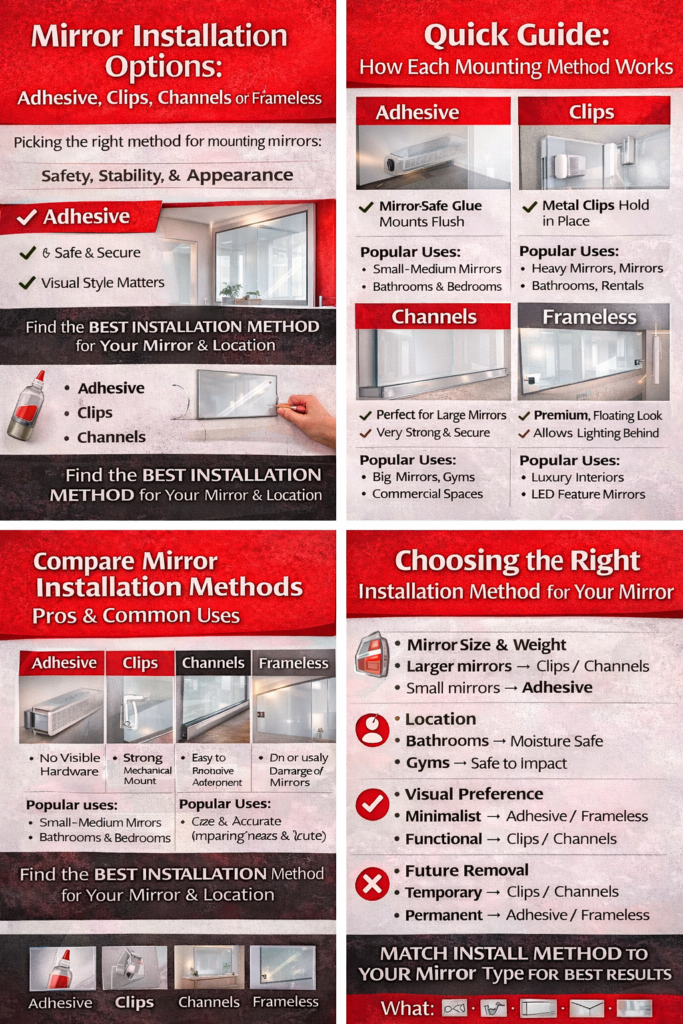
Comparing the Installation Methods
| Installation Method | Best For | Visual Look | Strength |
|---|---|---|---|
| Adhesive | Small–medium mirrors | Seamless | Medium |
| Clips | Bathrooms, rentals | Visible fixings | High |
| Channels | Large mirrors, gyms | Clean, professional | Very high |
| Frameless | Luxury interiors | Premium | High |
Choosing the Right Method for Your Mirror
Before deciding, ask yourself:
✔ Mirror Size & Weight
- Larger mirrors need mechanical support
- Small mirrors may suit adhesive
✔ Location
- Bathrooms require moisture resistance
- Gyms need impact-safe mounting
✔ Visual Preference
- Minimalist → adhesive or frameless
- Functional → clips or channels
✔ Future Removal
- Planning renovations? Choose clips or channels
Safety & Compliance Considerations
In the UK, mirrors used in certain locations may need to comply with safety glazing standards such as BS EN 12600, particularly in areas where impact risk exists.
While not all mirrors require safety backing, installation method plays a key role in reducing risk.
The British Standards Institution outlines guidance on glazing safety and impact resistance.
Authority reference:
👉 https://www.bsigroup.com/en-GB/standards/bs-en-12600/
Common Installation Mistakes to Avoid
- Using general construction adhesive instead of mirror adhesive
- Relying on adhesive alone for large mirrors
- Poor wall preparation
- Misaligned clips causing stress points
- Ignoring wall moisture levels
Most installation failures are due to method mismatch, not poor mirrors.
Choosing the Right Mirror Before Installation
Regardless of how you install it, the mirror itself must be correctly specified.
If you’re planning a project, explore made-to-measure mirrors that allow control over size, thickness, and edge finish:
Custom sizing ensures compatibility with any installation method, reducing stress and improving results.
Final Thoughts
There is no single “best” mirror installation method—only the right method for your mirror, wall, and space.
- Adhesive suits clean, minimalist designs
- Clips prioritise safety and removability
- Channels excel for large or commercial mirrors
- Frameless mounting delivers premium aesthetics
When installation method, mirror size, and environment are aligned, the result is safe, durable, and visually flawless.