
Safety Checklist Before Installing Large Cut-to-Size Mirrors
Large cut-to-size mirrors can transform a space—adding light, depth, and a clean, architectural look. But they also introduce real safety risks if installed incorrectly. Unlike small decorative mirrors, large mirrors are heavy, rigid, and unforgiving. A single mistake during installation can lead to glass failure, wall damage, or serious injury.
This safety checklist walks you through everything you should verify before installing a large custom mirror, whether it’s for a bathroom, home gym, hallway, or feature wall.
If you follow every step in this guide, you significantly reduce installation risks and ensure long-term stability.
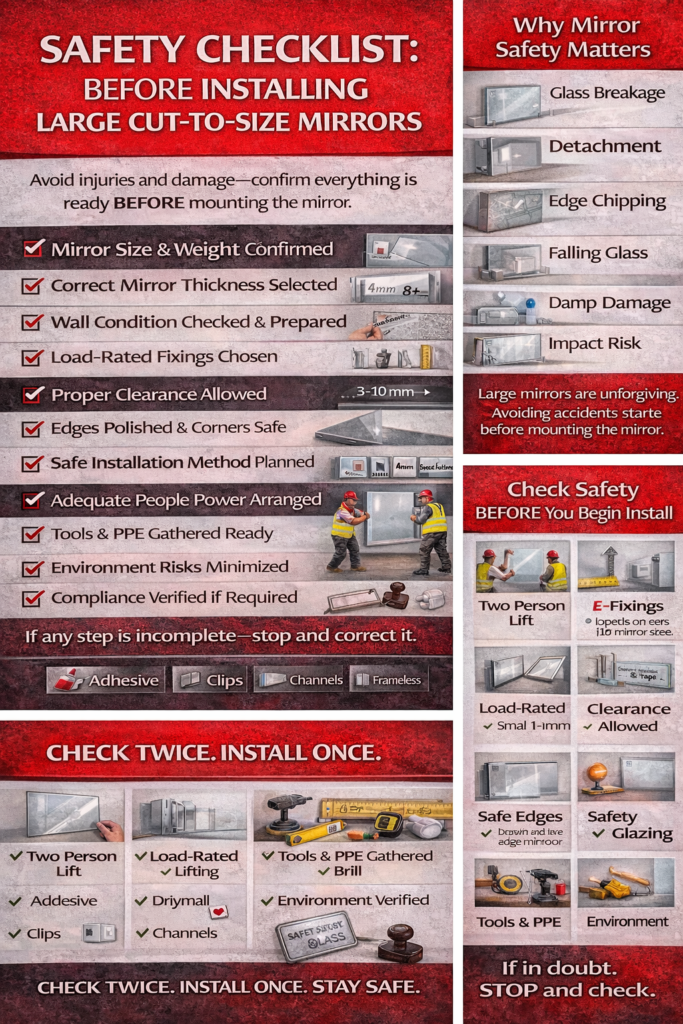
Why Safety Matters with Large Mirrors
Large mirrors are not just oversized décor items—they are structural glass elements.
Key risks include:
- Breakage due to uneven stress
- Detachment from walls
- Edge chipping or cracking
- Injury from falling glass
- Long-term degradation in damp environments
Industry guidance repeatedly highlights that mirror failures almost always stem from poor planning or incorrect fixing, not manufacturing defects.
1. Confirm the Mirror Size and Weight
Before anything else, understand exactly what you’re working with.
Checklist
- Confirm final mirror dimensions (width × height)
- Confirm thickness
- Estimate total weight
As mirror size increases, weight increases rapidly. Even a modest-looking mirror can weigh far more than expected.
Safety Tip
Larger mirrors usually require mechanical support (clips, channels, or rails). Adhesive alone is rarely sufficient for large formats.
2. Choose the Correct Mirror Thickness
Thickness is a major safety factor.
General Guidance
- 6 mm → Medium-sized bathroom mirrors
- 8 mm or thicker → Large mirrors, gyms, feature walls
Thin mirrors are more prone to:
- Flexing
- Stress cracking
- Uneven load distribution
Thicker mirrors sit flatter, feel more stable, and tolerate minor wall irregularities better.
3. Inspect the Wall Condition Carefully
Never assume a wall is suitable just because it “looks fine.”
Check for:
- Uneven or bowed surfaces
- Crumbling plaster or weak drywall
- Moisture damage
- Loose tiles
- Hollow cavities
Why This Matters
Uneven walls create pressure points in the glass. Over time, this can lead to cracks—even if the mirror initially installs without issue.
Professional installation guidance consistently recommends correcting wall defects before mounting large mirrors.
4. Verify the Installation Method Matches the Mirror Size
Not all fixing methods are equal.
Safer Options for Large Mirrors
- Bottom channel systems
- Full rail systems
- Mechanical clips with load distribution
- Frameless floating systems (professionally installed)
High-Risk Choices
- Adhesive-only mounting for heavy mirrors
- Inadequate fixings into plasterboard
- Fixings placed too close to mirror edges
According to This Old House, heavy mirrors should always have positive mechanical support, especially in bathrooms or high-traffic areas.
Authority reference:
👉 https://www.thisoldhouse.com/
5. Confirm Wall Fixings Are Load-Rated
Wall fixings must be appropriate for:
- Mirror weight
- Wall material (plasterboard, masonry, tile)
- Installation method
Checklist
- Use fixings rated for more than the mirror’s weight
- Never rely on drywall anchors alone for heavy mirrors
- Locate wall studs or solid masonry where possible
Insufficient fixings are one of the most common causes of mirror detachment.
6. Ensure Adequate Clearance & Tolerance
Large mirrors should never be forced into position.
Safe Tolerance
- 3–5 mm total clearance for medium mirrors
- Up to 10 mm for large mirrors or tiled walls
Why this matters:
- Walls expand and contract slightly
- Adhesives need space
- Glass must not be under compression
A mirror installed under tension is a failure waiting to happen.
7. Check Edge Finish and Corner Safety
Edges are one of the most dangerous parts of a mirror.
Safety Checklist
- Polished edges for all exposed sides
- No sharp corners near traffic areas
- Rounded corners for mirrors near doors or walkways
Unfinished edges increase both injury risk and glass failure risk.
8. Confirm Compliance with Safety Glazing Guidance (Where Relevant)
While mirrors are not always legally required to meet safety glass standards, impact-risk areas should follow safety guidance.
Examples include:
- Gyms
- Children’s areas
- Low-mounted mirrors
- High-traffic corridors
The British Standards Institution outlines impact-safety considerations under BS EN 12600, which is widely referenced in glazing safety contexts.
Authority reference:
👉 https://www.bsigroup.com/en-GB/standards/bs-en-12600/
9. Plan the Installation Process (Never Rush)
Large mirrors should never be installed alone or rushed.
Best Practice
- Two or more people for lifting
- Protective gloves and footwear
- Clear working area
- Temporary supports or spacers
- Pre-marked fixing points
Accidents most often occur during lifting and alignment—not after installation.
10. Consider the Room Environment
Environmental factors affect long-term safety.
Bathroom & Damp Areas
- Use moisture-resistant adhesive
- Allow ventilation space where needed
- Avoid trapping moisture behind the mirror
Gyms & Activity Areas
- Prefer mechanical fixings or channels
- Avoid adhesive-only mounting
- Choose thicker mirrors
Humidity and temperature changes can weaken adhesive bonds over time.
11. Confirm You Can Remove or Replace the Mirror Safely (If Needed)
Future removal matters.
Questions to Ask
- Will the mirror ever need replacing?
- Is wall damage acceptable?
- Are fixings accessible?
Channels and clips allow safer removal than adhesive-only methods.
12. Final Pre-Installation Safety Checklist
Before installation begins, confirm:
- ✅ Mirror size and weight verified
- ✅ Correct thickness selected
- ✅ Wall inspected and prepared
- ✅ Fixings load-rated and suitable
- ✅ Installation method planned
- ✅ Clearance allowed
- ✅ Edges polished and safe
- ✅ Two-person lift arranged
- ✅ Tools and PPE ready
If any item is unchecked—pause and correct it.
Choosing the Right Mirror Before Installation
Safe installation starts with the right mirror specification.
If you’re planning a large mirror project, choose a supplier that allows full control over:
- Size
- Thickness
- Edge finish
- Application guidance
You can explore made-to-measure mirrors suitable for large installations here:
Final Thoughts
Large mirrors are visually powerful—but only when installed safely.
Most mirror accidents are preventable. They happen because of:
- Poor planning
- Incorrect fixings
- Rushed installation
- Underestimating mirror weight
By following this checklist, you protect:
- Your walls
- Your investment
- Your safety
A properly installed large mirror should feel solid, secure, and worry-free for years to come.