Comparison

Comparison

Custom Cut Mirrors vs Acrylic Mirrors: Pros, Cons & Lifespan

Dec 26, 2025

Custom cut mirrors and acrylic mirrors can both look great on day one — but they behave very differently over time. If you’re deciding between the two for a bathroom, gym, wardrobe, retail space, or a DIY feature wall, the “best” option depends less on looks and more on where it will be installed, how it will be cleaned, and what kind of wear it will face.

This guide breaks down the real-world pros, cons, typical lifespan, and the situations where each mirror type makes the most sense — so you can choose once and avoid regret later.


Quick definition: what are these mirrors, really?

Custom cut glass mirrors (made-to-measure)

A custom cut mirror is a real glass mirror cut to your exact dimensions (often with options like polished edges, safety backing, cut-outs, or corner radius). Because it’s glass, it delivers the best reflection quality and stays stable over many years when installed correctly.

If you want a made-to-measure option with a premium finish, explore custom cut mirrors made to your exact size for bathrooms, gyms, bedrooms and feature walls.

Acrylic mirrors

An acrylic mirror is a plastic mirror sheet (commonly acrylic/PMMA) with a reflective coating. It’s lightweight and far more impact-resistant than glass, which is why it’s popular for kids’ areas, portable setups, and certain gym or studio applications. The trade-off is that acrylic scratches more easily and can show distortion, especially on larger panels or uneven walls.


At-a-glance comparison table

Feature Custom Cut Glass Mirror Acrylic Mirror
Reflection quality Excellent clarity, minimal distortion Good on small panels; can distort on larger sheets
Scratch resistance Better resistance; still needs proper cleaning Scratches easily; requires gentle care
Impact safety Can break if impacted; safety backing helps Much more shatter-resistant; safer for high-contact zones
Weight Heavier; needs proper fixings/wall support Very lightweight; easier handling and mounting
Moisture & bathrooms Very good if edges are protected and installed correctly Can be fine, but needs careful sealing/adhesive choice
Long-term stability High stability; stays flat and true May warp slightly with heat/uneven mounting
Best use-cases Bathrooms, feature walls, wardrobes, premium interiors Kids areas, portable mirrors, impact-prone spaces

Pros and cons (the real-life version)

Custom cut glass mirrors — pros

  • Best reflection quality: crisp, true reflection that makes rooms look bigger and brighter.
  • Long-lasting finish: glass resists everyday micro-scratches far better than acrylic when cleaned correctly.
  • Premium look: polished edges, clean lines, and a solid “architectural” feel.
  • Stays flat: once installed on a properly prepared wall, it doesn’t flex or ripple.
  • Custom options: cut-outs, sockets, corner radius, bevels, edge finishes, safety backing, etc.

Custom cut glass mirrors — cons

  • Heavier: needs correct fixings and a wall that can support the load.
  • Break risk: impact can crack or shatter (safety backing reduces risk of shards spreading).
  • Installation must be right: uneven walls, wrong adhesive, or rushed mounting can cause stress points.

Acrylic mirrors — pros

  • Lightweight: easier to transport, lift, and fit — especially on large panels.
  • Shatter-resistant: a strong choice for spaces where impacts are likely (kids, busy studios, some gyms).
  • Flexible for certain setups: can work in temporary installations or where weight is the main issue.
  • Often lower upfront cost: particularly for small-to-medium DIY applications.

Acrylic mirrors — cons

  • Scratch-prone: even paper towels and the wrong cloth can leave swirls over time.
  • Can distort: larger sheets may show “funhouse” effects if the wall isn’t perfectly flat or the sheet isn’t mounted evenly.
  • Heat and expansion: acrylic can expand/contract more than glass; poor mounting can lead to subtle warping.
  • Cleaning is less forgiving: you must use gentle, acrylic-safe methods to keep it looking new.

Which lasts longer? A realistic lifespan breakdown

Important: lifespan isn’t only about the material — it’s also about the environment (bathroom humidity, direct sunlight, temperature swings), cleaning habits, and installation quality.

Typical lifespan: custom cut glass mirrors

  • Indoors, normal residential use: often 10–20+ years with correct installation and sensible cleaning.
  • Bathrooms: longevity depends heavily on ventilation and edge protection. Persistent moisture and poor edge sealing can cause “black edge” corrosion over time.
  • High-traffic commercial spaces: still long-lasting, but the risk is mainly impact damage rather than wear.

Typical lifespan: acrylic mirrors

  • Low-contact areas (decor panels, careful cleaning): commonly 3–8 years before visible swirls/scratches become noticeable.
  • Gyms/studios with frequent cleaning: can look tired sooner if wiped daily with the wrong products.
  • Kids rooms / high-touch zones: may need replacement earlier due to scratches and scuffs.

The key takeaway: If you want a “fit it once and forget it” mirror that stays crisp for years, glass usually wins. If safety and weight matter most — and you’re okay with extra care and possible replacement later — acrylic can be the smarter trade.


Clarity and distortion: why acrylic sometimes looks “wavy”

Many people love acrylic mirrors until they stand at an angle or step back and notice subtle distortion. This doesn’t always mean the acrylic is “bad quality.” Common causes include:

  • Wall unevenness: acrylic follows the wall’s shape more than glass does.
  • Mounting method: spot adhesive blobs, uneven tape pressure, or unsupported sections create ripples.
  • Panel size: the larger the sheet, the harder it is to keep perfectly flat.

Pro tip: If you’re set on acrylic, prioritize proper backing support and a perfectly flat substrate. For large wall panels where reflection quality really matters (dressing areas, salons, feature walls), glass is typically the safer bet visually.


Safety: which is safer in a home or gym?

Safety depends on risk type:

  • Impact risk (contact, falls, equipment knocks): acrylic is generally safer because it’s far less likely to shatter.
  • Cut risk from edges: both materials should have safe edge finishing and correct mounting. Glass can be ordered with polished edges; acrylic edges should be finished to remove sharpness.
  • Large glass panels: consider safety backing and correct fixings. Safety-backed glass helps hold fragments together if damaged.

If you’re choosing mirrors for gym-style environments, this read may help: Acrylic gym mirrors: everything you need to know.


Cleaning & maintenance: how to keep each mirror looking new

Cleaning glass mirrors (custom cut)

  • Use a microfibre cloth for a streak-free finish.
  • Spray cleaner onto the cloth (not the mirror) to reduce edge seepage.
  • Avoid soaking the edges — edge moisture is a common cause of long-term backing corrosion.

Cleaning acrylic mirrors (must-do rules)

  • No abrasives: avoid scouring pads, rough cloths, and paper towels.
  • No harsh chemicals: avoid strong solvents or aggressive cleaners that can damage the reflective backing.
  • Use mild soap + water and a clean microfibre cloth, then gently blot dry.

Thickness, weight, and “feel”: why this matters for custom cut mirrors

With glass mirrors, thickness affects rigidity, handling, and overall quality feel — especially for larger panels. If you’re deciding what thickness you need, this guide is useful: Mirror thickness guide (4mm vs 6mm vs 8mm).

In simple terms: thinner glass can be fine for small mirrors, but as mirrors get larger, extra thickness improves stability and reduces the chance of flexing or visual distortion.


Best use-cases: which one should you choose?

Choose a custom cut glass mirror if you want:

  • The clearest reflection (bedroom dressing areas, salons, feature walls)
  • Long-term durability without scratching easily
  • A premium built-in look (wardrobes, alcoves, wall panels)
  • Bathroom reliability (when installed correctly with good ventilation)

Choose an acrylic mirror if you need:

  • Lower weight for easier handling or lighter partition walls
  • Higher impact resistance (kids zones, certain gyms, portable setups)
  • A temporary or budget-led solution where replacement later is acceptable

A simple decision checklist (fast and practical)

  • If reflection quality is top priority: choose glass.
  • If safety from impacts is top priority: consider acrylic (or safety-backed glass if you still want clarity).
  • If it’s a humid bathroom: choose glass, install properly, and protect edges from constant moisture.
  • If it’s a high-touch, frequent-cleaning area: choose glass unless weight/safety rules it out.
  • If the wall is uneven: glass usually hides it better; acrylic can “telegraph” the bumps.

Final verdict

Custom cut glass mirrors are the best all-round choice for most homes and premium interiors: they look better, last longer, and stay clearer over time. Acrylic mirrors are a smart alternative when weight and impact safety are the main constraints — but they demand gentler cleaning and more realistic expectations about long-term appearance.

If you’re aiming for a clean, made-to-measure finish that will still look excellent years from now, start with made-to-measure custom cut mirrors and choose thickness/installation methods that match your space.
Comparison

Custom Cut Mirrors vs Standard Mirrors: Which Is Better for Your Space?

Dec 26, 2025

Mirrors aren’t just “décor.” They change how a room feels, how bright it looks, and even how big it appears. The real question isn’t only which mirror looks nicer—it’s which option fits your wall, your layout, your lifestyle, and your budget with the least compromise.

In this guide, we’ll compare custom cut (made-to-measure) mirrors vs standard off-the-shelf mirrors, with practical examples so you can choose confidently.


1) What’s the difference?

Standard mirrors (off-the-shelf)

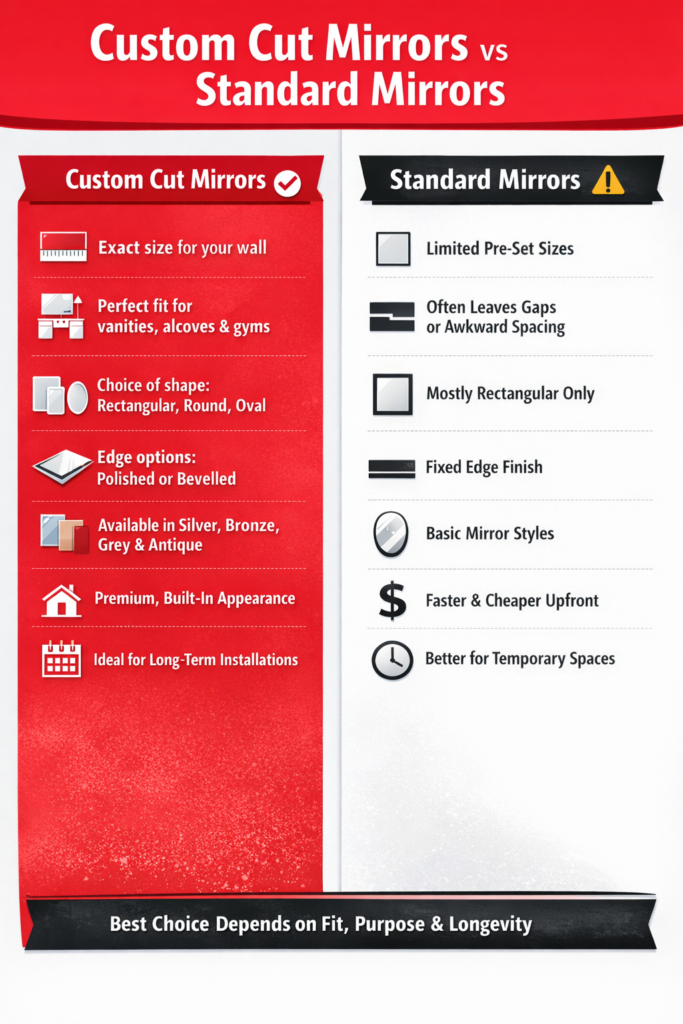
These are the ready-made mirrors you buy in common sizes (for example 60×80 cm, 70×100 cm, 90×60 cm). They’re fast and convenient, but you’re limited to what’s available.

Best for: quick upgrades, rentals, low-effort styling, common wall sizes.

Custom cut mirrors (made-to-measure)

Custom mirrors are cut to the exact size and shape you need—often with options like polished or bevelled edges, different tints, and specific thickness choices. Glass Help Ltd

Best for: awkward wall sizes, full-width vanity runs, alcoves, made-to-fit gym walls, premium “built-in” looks.


2) The biggest deciding factor: fit (and how “intentional” the room looks)

If your space has any of these, custom usually wins:

  • A wall that’s not a standard width
  • Furniture that needs a mirror two-thirds to three-quarters of its width for good proportion
  • A vanity area where you want the mirror to line up perfectly with taps/lights/cabinets
  • A narrow hallway where the wrong size mirror looks “floating” or off-centre

A well-sized mirror makes a room feel designed—while a “close enough” mirror can look like an afterthought (even if it’s expensive). For sizing guidance and proportions, this mirror size and shape guide is genuinely useful.


3) Cost: what you’re actually paying for

Standard mirror costs tend to be lower upfront

Because they’re mass-produced, standard mirrors often look like a bargain.

But watch the “hidden extras”:

  • You may need to buy a second mirror to “make it work”
  • You might pay more for a special frame to distract from awkward sizing
  • You may compromise on style (and end up replacing it sooner)

Custom mirrors cost more—but reduce compromise

With custom cut mirrors, you pay for:

  • Precise cutting to your measurements
  • Edge finishing (flat polish or bevel)
  • Shape options (including circles/ovals/irregular)
  • Potential thickness upgrades and safer installation planning Glass Help Ltd

If you’re planning a long-term room (your “main bathroom,” your home gym, a salon corner, a feature hallway), custom often has better value because you don’t have to “design around” an imperfect fit.


4) Design freedom: shape, tint, edge finish

Standard mirrors usually come in limited styles. Custom mirrors give you control over:

Shapes

  • Rectangle, square, round, oval—and sometimes more bespoke shapes Glass Help Ltd

Mirror types (the “look” of the reflection)

Different mirror finishes change the mood of a room:

  • Silver = crisp, bright reflection
  • Bronze = warm, softer ambience
  • Grey/smoked = modern, muted reflection
  • Antique = decorative, vintage character Glass Help Ltd+1

If you’re unsure which tint suits your room style, this breakdown helps: Common mirror types: silver, bronze, grey and antique. Glass Helper

Edge finish

Custom mirrors often let you choose:

  • Flat polished edge (clean, modern)
  • Bevelled edge (more decorative/premium look) Glass Help Ltd

5) Safety & practicality: when the “cheap” option can be a bad idea

This matters most in:

  • Bathrooms (humidity)
  • Gyms (impact risk)
  • Family homes (kids, high traffic areas)
  • Commercial spaces (public use)

A mirror is glass. If the mirror is too thin for its size, poorly mounted, or installed in the wrong place, it can become a safety risk.

A good rule of thumb:

  • The bigger the mirror, and the more “active” the room, the more you should care about proper spec + proper fixing.

Some guidance sources reference standards like BS EN 1036 for mirror quality and EN 12600 for impact considerations in safety glazing contexts (especially useful when you’re choosing mirrors for high-risk areas). Glass Helper
(If you’re not sure what’s appropriate for your room, ask the supplier what they recommend for that application.)


6) Room-by-room: which one is better?

Bathroom

Custom is usually better if:

  • You want a mirror that spans a vanity width neatly
  • You have wall lights/sconces that must align
  • You’re working around tiles, niches, or sloped ceilings

Standard is fine if:

  • It’s a small cloakroom
  • You’re replacing quickly on a budget

Bedroom / dressing area

Custom wins for:

  • Full-length mirrors on wardrobe doors
  • Alcove fits (between walls)
  • “Built-in” dressing table layouts

Standard wins if:

  • You want a framed decorative statement mirror and the proportions already work

Hallway / landing

Custom is often best because hallways are narrow, and sizing matters to avoid awkward reflection angles. A well-placed mirror can double brightness by bouncing natural light deeper into the home. Glass Helper

Home gym

Custom is strongly recommended for wall-to-wall mirror runs, cleaner joins, and a more professional finish. It also reduces “gaps” that make alignment and sightlines annoying during training. Glass Help Ltd

Living room feature wall

It depends:

  • If you want symmetry, precision, or a large “architectural” mirror look → custom
  • If you want a designer frame and the size works → standard

7) The decision checklist (use this and you’ll pick right 90% of the time)

Choose custom cut if you answer “yes” to any of these:

  • Do I need an exact width/height (no gaps, no “almost” fit)?
  • Is this a “main” room where the mirror should look built-in?
  • Do I want a specific shape (round/oval/custom)?
  • Do I want a specific tint (grey/bronze/antique)?
  • Is this a high-humidity or higher-risk area (bathroom/gym)?
  • Do I want a premium edge finish?

Choose standard if:

  • I need it quickly and the standard size looks correct on the wall
  • I’m styling a temporary space (rental / staging / short-term update)
  • The mirror is mostly decorative and will be framed anyway
  • My budget is tight and I’m comfortable compromising slightly on size

8) Common mistakes to avoid (especially when ordering custom)

  1. Measuring only the wall, not the “visual space.”
    Consider furniture width, wall lights, and where the reflection will land.
  2. Forgetting installation clearance.
    Sockets, switches, skirting boards, and tile edges can affect mounting.
  3. Choosing a mirror that’s “too small” above furniture.
    A mirror that’s undersized can look lost—better to match proportions deliberately. Glass Helper
  4. Not planning edge finishing.
    Exposed edges usually look best polished (especially for frameless designs). Glass Help Ltd

9) So… which is better for your space?

If your space is simple and standard sizes look right, a standard mirror can be the perfect choice—fast, affordable, and stylish.

But if your room has any “constraints” (tight width, alcoves, full runs, symmetry needs, premium finish goals), custom cut mirrors are usually the better long-term decision because they solve the real problem: fit and intention.

Comparison

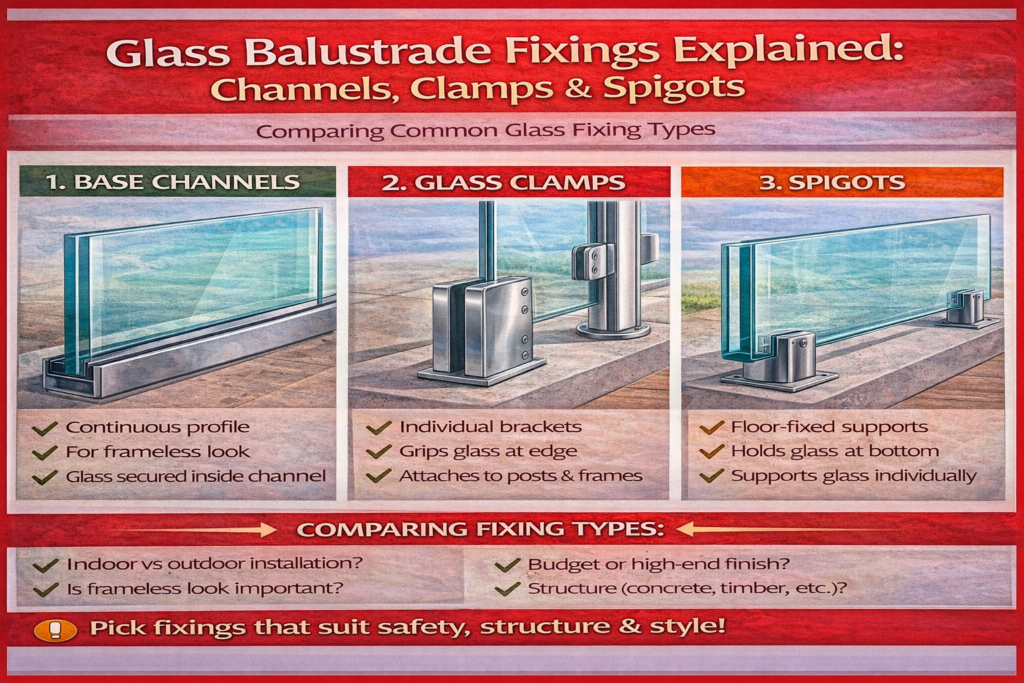
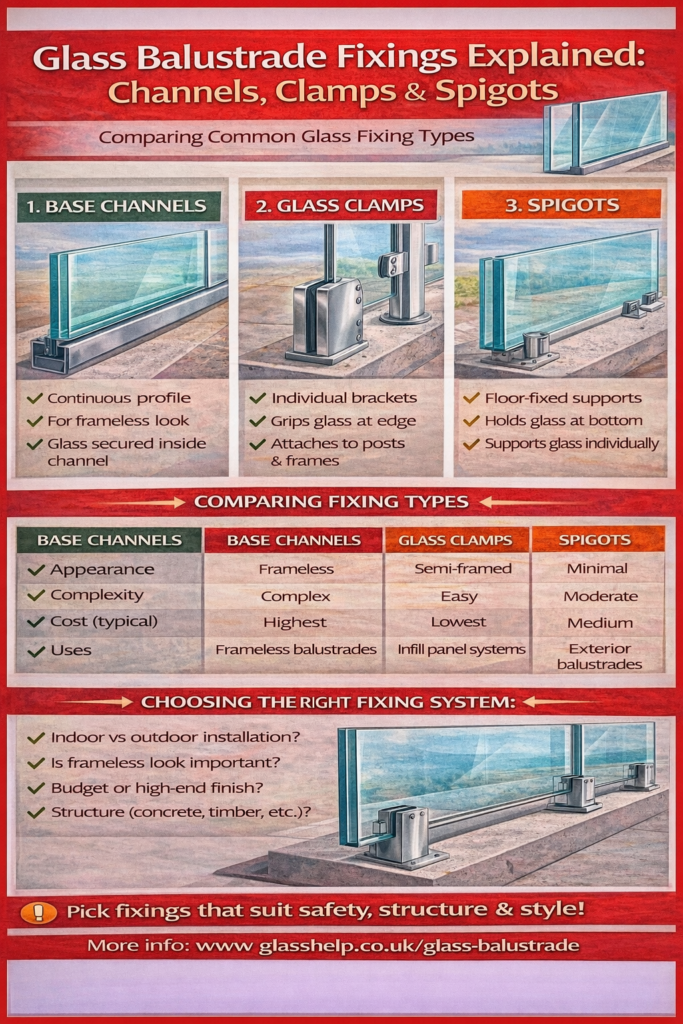
Glass Balustrade Fixings Explained: Channels, Clamps & Spigots

Dec 23, 2025

When choosing a glass balustrade, most homeowners focus on the glass itself — thickness, transparency, and style. But one equally important decision often gets overlooked:

How will the glass be fixed in place?

The fixing method is not just a design choice. It directly affects:

  • safety and compliance
  • structural strength
  • appearance
  • installation complexity
  • long-term durability

In the UK, glass balustrades are commonly installed using three main fixing systems:

  1. Base channels
  2. Glass clamps
  3. Spigots

Each has its own advantages, limitations, and ideal use cases. This guide explains how each fixing system works, where it performs best, and how to choose the right option for your home.


Why Glass Balustrade Fixings Matter

A glass balustrade is a guarding system, not a decorative feature. The fixings must:

  • resist horizontal loads
  • secure the glass without stress
  • perform safely if the glass breaks
  • suit the structure they’re attached to

Choosing the wrong fixing type can lead to:

  • visible movement
  • failed inspections
  • poor aesthetics
  • expensive retrofits

Understanding fixing systems before ordering glass avoids most common mistakes.


1. Glass Balustrade Base Channels (Continuous Channels)

What Is a Base Channel?

A base channel is a continuous aluminium or steel profile fixed to the floor or slab. The glass panel sits inside the channel and is secured using:

  • wedges
  • dry-glaze systems
  • pressure plates

This system is most commonly used for frameless glass balustrades.


Where Base Channels Are Commonly Used

  • Frameless balconies
  • Roof terraces
  • Mezzanine edges
  • Modern staircases
  • High-end residential and commercial projects

Advantages of Base Channel Systems

Clean, Frameless Appearance

Base channels allow the glass to rise directly from the floor, creating:

  • uninterrupted sightlines
  • a premium, architectural look

This is the closest option to a “fully frameless” balustrade.

Excellent Structural Performance

Because the channel runs continuously:

  • loads are distributed evenly
  • glass is supported along its full length
  • movement is minimised

Ideal for Laminated Glass

Base channels are designed to work with laminated glass, which is essential where glass is the primary safety barrier.


Disadvantages of Base Channel Systems

More Complex Installation

Base channels require:

  • precise alignment
  • accurate drilling
  • careful waterproofing (outdoors)

Higher Cost

Channels are usually more expensive than spigots or clamps due to:

  • material cost
  • labour time
  • precision requirements

Less Forgiving of Measurement Errors

Because the channel is continuous, small measurement mistakes can affect the entire run.


2. Glass Balustrade Clamps

What Are Glass Clamps?

Glass clamps are individual metal brackets that grip the glass panel and attach it to:

  • posts
  • walls
  • stair strings
  • structural frames

They are typically made from stainless steel or aluminium.


Where Glass Clamps Are Commonly Used

  • Semi-framed balustrades
  • Staircases with posts
  • Internal balustrades
  • Installations where glass is an infill panel

Advantages of Glass Clamps

Versatile and Adaptable

Clamps can be used in many configurations and are suitable where:

  • posts already exist
  • the glass is not the sole barrier

Easier to Install

Compared to base channels, clamps:

  • require less precision
  • allow more adjustment on site
  • are quicker to install

Cost-Effective

Clamps are generally cheaper than full channel systems, making them popular for:

  • internal staircases
  • budget-controlled projects

Disadvantages of Glass Clamps

More Visible Hardware

Clamps are intentionally visible, which may not suit:

  • ultra-minimal designs
  • modern frameless aesthetics

Not Suitable for Fully Frameless Systems

Because clamps hold glass at specific points:

  • they rely on posts or frames
  • they are not ideal where glass is the only barrier

Higher Stress Concentration

Loads are transferred at specific points rather than evenly along the glass, so correct spacing and specification are critical.


3. Glass Balustrade Spigots

What Are Spigots?

Spigots are individual floor-mounted supports that hold the bottom edge of a glass panel. The glass sits between two plates inside the spigot and is secured mechanically.

Spigots are typically:

  • stainless steel
  • surface-mounted
  • spaced at regular intervals

Where Spigots Are Commonly Used

  • Balconies
  • Decking areas
  • Pool surrounds
  • Outdoor terraces

Advantages of Spigot Systems

Modern Look with Minimal Hardware

Spigots provide:

  • a light, open appearance
  • less visible metal than posts
  • easier visual integration with outdoor spaces

Simpler Installation Than Channels

Spigots:

  • are individually fixed
  • allow tolerance adjustments
  • are forgiving on uneven surfaces

Good for Retrofit Projects

Spigots work well where:

  • continuous channels are impractical
  • drilling depth is limited

Disadvantages of Spigot Systems

Less Rigid Than Channels

Because support is at intervals:

  • slight movement is more noticeable
  • precise spacing is essential

Floor Space Impact

Spigots sit on the walking surface, which:

  • reduces usable width slightly
  • can interfere with furniture placement

Glass Specification Is Critical

Spigot systems usually require thicker laminated glass to compensate for point loading.


Channels vs Clamps vs Spigots: Key Comparison

FeatureBase ChannelsClampsSpigots
AppearanceFrameless, premiumSemi-framedMinimal, modern
Structural rigidityExcellentModerateModerate
Visible hardwareVery lowHighMedium
Installation complexityHighLow–MediumMedium
Cost (typical)HighestLowestMedium
Best forFrameless balustradesInfill panelsOutdoor balustrades

Safety & Compliance Considerations

Regardless of fixing type:

  • the balustrade must meet minimum height requirements
  • fixings must resist horizontal loads
  • laminated glass is required where glass is the primary guard

UK guidance focuses on preventing falls, not just holding glass in place. A useful overview of guarding requirements can be found via the Planning Portal.


Common Homeowner Mistakes with Fixings

❌ Choosing fixings based on looks alone
❌ Using clamps where glass should be structural
❌ Under-specifying glass thickness for spigots
❌ Ignoring waterproofing with base channels
❌ Mixing incompatible metals outdoors

Most issues arise from mismatch between fixing type and structural role.


How to Choose the Right Fixing System

Ask these questions:

  1. Is the glass the main safety barrier?
  2. Is the installation indoor or outdoor?
  3. How important is a frameless appearance?
  4. What is the structural substrate?
  5. Is budget or aesthetics the priority?

Answering these honestly usually makes the correct fixing choice clear.

To see how fixing systems integrate into properly engineered designs, review compliant glass balustrade systems here:


Final Thoughts

There is no single “best” glass balustrade fixing — only the one that best suits your structure, safety requirements, and design goals.

  • Base channels deliver the cleanest, most rigid frameless look
  • Clamps offer flexibility and affordability for infill designs
  • Spigots balance modern aesthetics with installation practicality

When chosen and installed correctly, all three systems can deliver a safe, durable, and visually striking glass balustrade.

Comparison

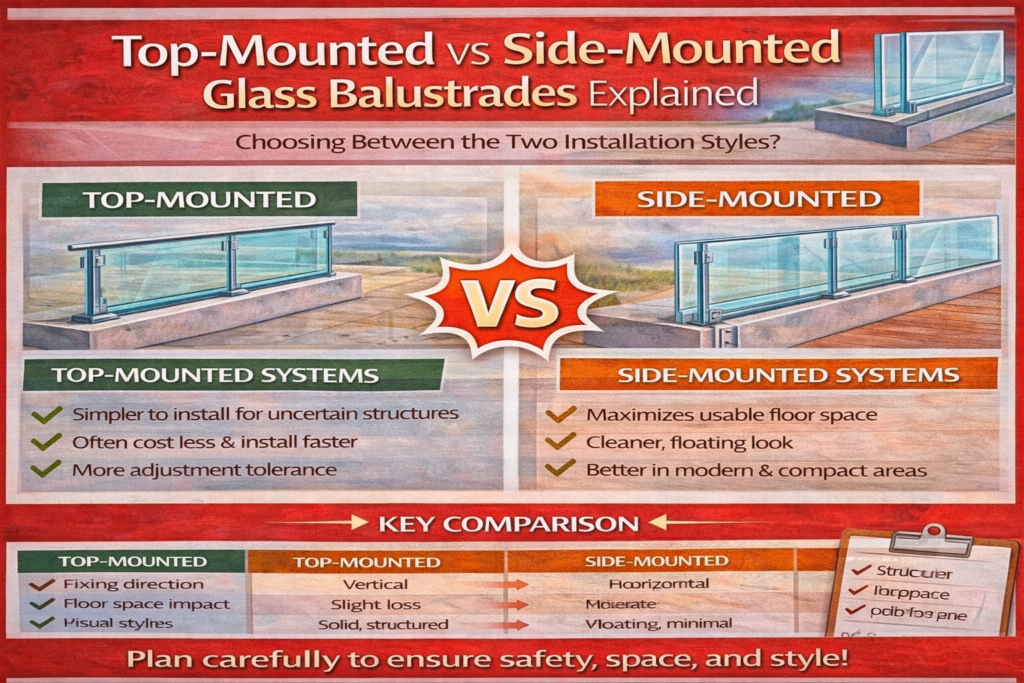
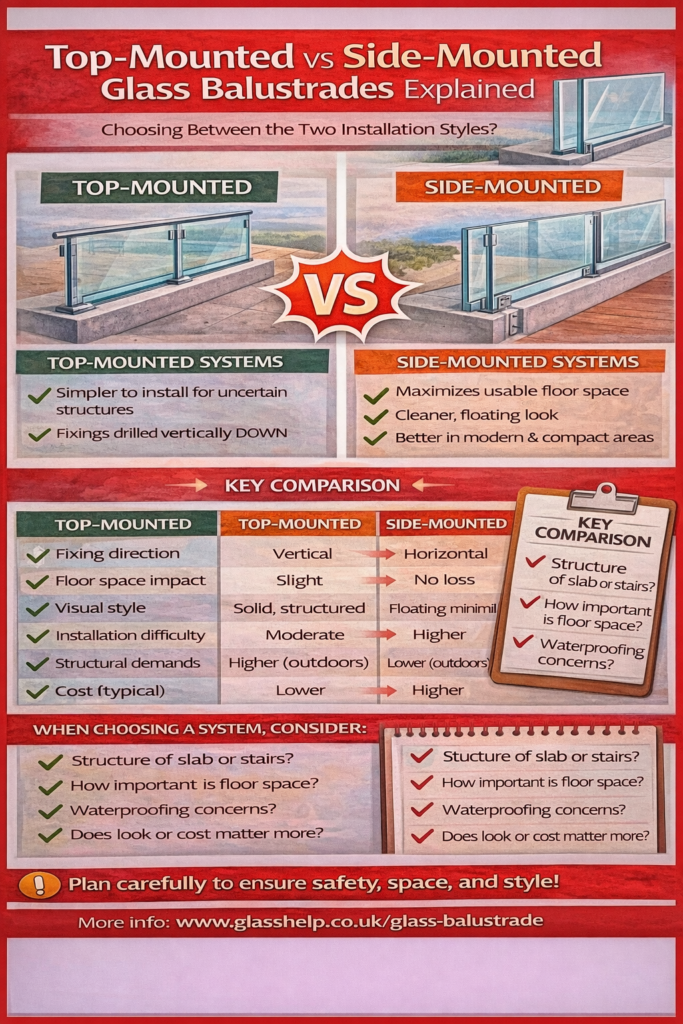
Top-Mounted vs Side-Mounted Glass Balustrades Explained

Dec 23, 2025

When planning a glass balustrade for a staircase, balcony, terrace, or decking area, most homeowners focus on glass type and style. But there’s another decision that has just as much impact on safety, appearance, and installation complexity:

Should the glass balustrade be top-mounted or side-mounted?

At first glance, the difference might seem purely visual. In reality, the mounting method affects:

  • structural performance
  • usable floor space
  • waterproofing
  • installation cost
  • long-term durability

This guide explains top-mounted vs side-mounted glass balustrades in plain English, so you can make a confident, informed decision.


What Do “Top-Mounted” and “Side-Mounted” Mean?

Top-Mounted Glass Balustrades

A top-mounted balustrade is fixed directly onto the top surface of a floor, slab, stair tread, or balcony edge.

The glass (or its base channel/spigots) sits on the walking surface, with fixings drilled vertically down into the structure.

Side-Mounted Glass Balustrades

A side-mounted balustrade is fixed to the vertical face of a slab, stair string, or balcony edge.

The glass is cantilevered out from the side, meaning:

  • fixings go horizontally into the structure
  • the floor surface remains completely clear

Both systems are widely used in the UK — but they suit very different situations.


Top-Mounted Glass Balustrades Explained

How Top-Mounted Systems Work

Top-mounted balustrades are usually installed using:

  • base channels
  • spigots
  • posts with infill glass

These components are anchored into structural concrete, steel, or timber, directly beneath the finished floor surface.


Advantages of Top-Mounted Glass Balustrades

Simpler Structural Fixing

Fixing vertically into a slab is generally:

  • easier to engineer
  • easier to inspect
  • easier to make compliant

This makes top-mounted systems a popular choice for:

  • new builds
  • refurbishments with unknown slab details

More Forgiving Installation

Top-mounted systems typically allow:

  • more adjustment tolerance
  • easier levelling
  • simpler alignment across long runs

This reduces the risk of visible alignment issues.

Often More Cost-Effective

Because fixing is simpler, top-mounted balustrades often:

  • require less specialist drilling
  • need fewer bespoke brackets
  • install faster

This can reduce labour costs.


Disadvantages of Top-Mounted Glass Balustrades

Loss of Usable Floor Space

Top-mounted balustrades sit on the walking surface, which:

  • slightly reduces balcony or stair width
  • can feel intrusive on narrow areas

Waterproofing Considerations

For outdoor areas, fixings penetrate the floor surface, meaning:

  • waterproofing must be planned carefully
  • poor detailing can lead to water ingress

Correct sequencing with membranes is essential.

More Visible Hardware

Base channels or spigots are visible on the floor, which may not suit:

  • ultra-minimal designs
  • homeowners wanting a “floating glass” look

Side-Mounted Glass Balustrades Explained

How Side-Mounted Systems Work

Side-mounted balustrades are fixed into the vertical edge of:

  • concrete slabs
  • balcony edges
  • stair strings

The glass panels extend upward from the side, leaving the floor completely clear.


Advantages of Side-Mounted Glass Balustrades

Maximum Usable Space

Because nothing sits on the floor:

  • balconies feel wider
  • stairs feel more open
  • edges look cleaner

This is a major reason side-mounted systems are popular in:

  • small balconies
  • modern apartments

Cleaner Visual Finish

Side-mounted balustrades often achieve a:

  • lighter, floating appearance
  • minimal interruption to floor finishes

This suits contemporary architectural designs.

Easier Floor Waterproofing

Because fixings don’t penetrate the walking surface:

  • waterproofing layers remain uninterrupted
  • long-term water resistance is often improved

Disadvantages of Side-Mounted Glass Balustrades

More Demanding Structural Requirements

Side-mounted systems rely heavily on:

  • slab edge strength
  • correct edge distance
  • accurate drilling

Weak or thin edges may require:

  • structural assessment
  • additional steel support

Higher Installation Complexity

Horizontal drilling into slab edges:

  • leaves less margin for error
  • requires experienced installers
  • can increase labour cost

More Limited Adjustment

Once fixed, side-mounted systems allow less tolerance for correction, making precise measurement critical.


Safety and Compliance: Does Mounting Method Matter?

Yes — but not in the way many homeowners expect.

From a safety and regulatory perspective:

  • both top-mounted and side-mounted balustrades can be compliant
  • compliance depends on design, fixing strength, glass type, and height, not just mounting style

UK guidance focuses on:

  • guarding height
  • resistance to horizontal loads
  • prevention of falls

A helpful overview of guarding expectations can be found on the UK Planning Portal, which outlines where guarding is required and why.

Regardless of mounting method, laminated glass is essential where the glass itself forms the primary guarding barrier.


Top-Mounted vs Side-Mounted: Key Comparison

FeatureTop-MountedSide-Mounted
Fixing directionVerticalHorizontal
Floor space impactSlight lossNo loss
Visual styleSolid, structuredFloating, minimal
Installation difficultyModerateHigher
Structural demandsLowerHigher
Waterproofing complexityHigher (outdoors)Lower (outdoors)
Cost (typical)LowerHigher

Which Is Better for Staircases?

For staircases, the choice often depends on stair construction.

Top-Mounted Stair Balustrades

  • Easier on concrete stairs
  • More forgiving alignment
  • Common for internal stairs

Side-Mounted Stair Balustrades

  • Popular on timber or steel stairs
  • Cleaner tread appearance
  • Requires strong stair string structure

In tight staircases, side-mounted glass can make the space feel noticeably wider.


Which Is Better for Balconies and Terraces?

Top-Mounted Is Often Better When:

  • slab edge strength is unknown
  • budget is tighter
  • installation speed matters

Side-Mounted Is Often Better When:

  • balcony depth is limited
  • clean floor lines are a priority
  • slab edges are structurally sound

In premium apartment developments, side-mounted balustrades are often chosen for their visual lightness.


Common Homeowner Mistake: Choosing by Looks Alone

One of the most frequent mistakes is selecting a mounting style based only on appearance.

Before deciding, always ask:

  1. What is the slab or stair structure made of?
  2. Can the edge safely accept horizontal fixings?
  3. Will waterproofing be affected?
  4. Is there enough tolerance for installation accuracy?

Ignoring these questions can lead to:

  • redesign costs
  • delays
  • compromised safety

How to Choose the Right System for Your Project

Choose top-mounted if:

  • you want a simpler, more forgiving installation
  • structural details are uncertain
  • cost control is important

Choose side-mounted if:

  • maximising space matters
  • you want a floating, minimal look
  • the structure has been confirmed as suitable

Reviewing properly engineered glass balustrade systems will help align design choice with real-world installation requirements

Final Thoughts

There is no universal “better” option between top-mounted and side-mounted glass balustrades — only the option that best suits your structure, space, and priorities.

  • Top-mounted systems offer simplicity, adaptability, and cost efficiency
  • Side-mounted systems deliver space, elegance, and architectural impact

When chosen correctly and installed properly, both systems are safe, compliant, and visually striking.

Comparison

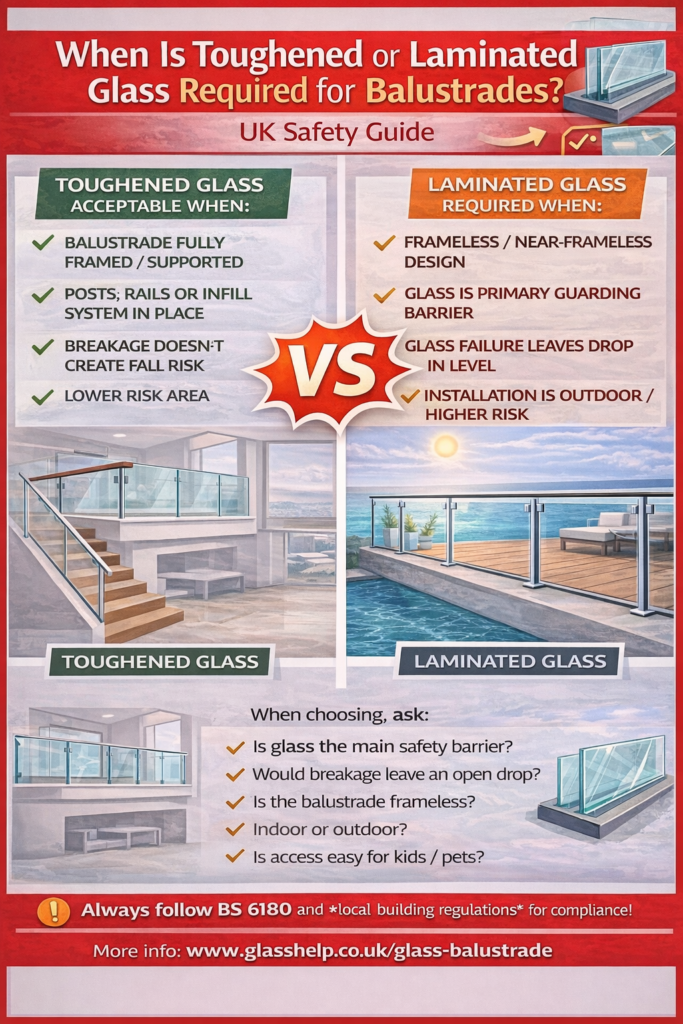
When Is Toughened or Laminated Glass Required for Balustrades?

Dec 23, 2025

Choosing the right glass for a balustrade is not just a design decision — it is a safety and compliance requirement. One of the most common (and most important) questions homeowners ask is:

“Do I need toughened glass or laminated glass for my balustrade?”

The short answer is: it depends on where the balustrade is installed, how it’s fixed, and what risk exists if the glass breaks. Using the wrong type of glass can lead to non-compliance with UK building standards, safety hazards, and costly replacements later.

This guide explains:

  • The difference between toughened and laminated glass
  • When each type is required for balustrades
  • How UK regulations influence the choice
  • Indoor vs outdoor considerations
  • Common mistakes homeowners make
  • How to choose the correct glass for your project

What Is the Difference Between Toughened and Laminated Glass?

Before we discuss when each is required, it’s essential to understand how these two glass types behave differently.

Toughened Glass (Tempered Glass)

Toughened glass is heat-treated to make it much stronger than standard float glass.

Key characteristics:

  • Around 4–5 times stronger than ordinary glass
  • When broken, it shatters into small, blunt fragments
  • Reduces the risk of serious cuts
  • Widely used for doors, shower screens, and some balustrades

However, once toughened glass breaks, it completely fails and falls away.


Laminated Glass

Laminated glass is made from two or more layers of glass bonded together with a plastic interlayer (usually PVB or similar).

Key characteristics:

  • If broken, the glass stays bonded to the interlayer
  • Maintains a physical barrier even after breakage
  • Provides higher fall protection
  • Often thicker and heavier than toughened glass

This difference — remaining in place when broken — is the single most important factor in balustrade safety.


Why Glass Type Matters for Balustrades

A balustrade is not decorative glass. It is a guarding system designed to:

  • Prevent falls from height
  • Resist horizontal loads
  • Remain safe in accidental impact situations

Because of this, the type of glass used must account for what happens if the glass breaks.

If glass shatters and disappears, the balustrade no longer functions as a guard — which is why laminated glass is required in many situations.


When Is Toughened Glass Acceptable for Balustrades?

Toughened glass can be used for balustrades in certain controlled situations.

Toughened Glass Is Typically Acceptable When:

✔ The balustrade is fully framed or supported
✔ There are posts, rails, or infill systems that prevent a full opening if glass breaks
✔ The glass is not the sole structural barrier
✔ The fall risk is lower or secondary protection exists

Common Examples

  • Semi-framed balustrades with metal posts
  • Internal stair balustrades where glass is an infill panel
  • Systems where a continuous handrail and post structure remains even if glass fails

In these cases, the structure continues to provide some level of guarding even if the glass panel breaks.


When Is Laminated Glass Required for Balustrades?

Laminated glass is required whenever the glass itself forms the primary barrier and loss of the glass would create a fall risk.

Laminated Glass Is Required When:

✔ The balustrade is frameless or near-frameless
✔ The glass panel is the main or only guarding element
✔ The balustrade protects a drop in level
✔ The installation is external or exposed
✔ The balustrade is on a balcony, terrace, or mezzanine

Why Laminated Glass Is Essential in These Cases

If toughened glass shatters in a frameless balustrade:

  • The entire panel can disappear instantly
  • The opening is left unprotected
  • There is a serious fall hazard

Laminated glass avoids this by remaining intact even after breakage, maintaining a physical barrier until replacement.


Frameless Glass Balustrades: Laminated Glass Is Essential

Frameless balustrades rely on glass as:

  • The structural barrier
  • The fall protection element
  • The visual boundary

Because there are no posts or rails to act as backup, laminated glass is the correct and expected choice.

If you’re considering frameless designs, it’s important to review systems specifically designed for laminated glass. A clear overview of compliant glass balustrade systems can be found here:


Indoor vs Outdoor Balustrades: Does Location Matter?

Yes — location plays a major role in glass selection.

Indoor Balustrades

  • Lower exposure to impact, weather, and temperature change
  • Toughened glass may be acceptable in framed systems
  • Laminated glass is still preferred where glass is load-bearing

Outdoor Balustrades

  • Higher exposure to wind loads
  • Greater consequences if glass fails
  • More likely to protect significant drops

For outdoor balustrades, laminated glass is strongly recommended and often expected, especially for balconies and terraces.


Staircases: Toughened or Laminated?

Stair balustrades sit in a grey area, and the correct choice depends on design.

Toughened Glass May Be Acceptable If:

  • The staircase has posts and rails
  • The glass is only an infill panel
  • There is no direct fall through if the glass breaks

Laminated Glass Is Preferred If:

  • The staircase uses large glass panels
  • The design is minimal or frameless
  • The glass provides primary guarding

Many designers now default to laminated glass for staircases to future-proof compliance and safety.


What About Handrails and Top Rails?

A common misconception is that adding a handrail makes toughened glass acceptable everywhere.

This is not always true.

If:

  • The glass panel below the handrail is large
  • There are no vertical posts
  • The glass still acts as the main barrier

Then laminated glass is still required, even with a handrail.


Common Homeowner Mistakes to Avoid

❌ Assuming toughened glass is always enough

❌ Choosing glass based on price alone

❌ Using indoor-rated glass outdoors

❌ Installing frameless balustrades with toughened glass

❌ Relying on handrails instead of proper glass specification

These mistakes often lead to non-compliance, failed inspections, or forced replacements.


Cost Considerations: Is Laminated Glass Worth It?

Yes — for balustrades, laminated glass is almost always worth the extra cost.

While laminated glass:

  • Costs more than toughened glass
  • Is heavier and slightly more complex to install

It also:

  • Provides superior safety
  • Meets expectations for modern balustrade systems
  • Reduces liability risk
  • Increases long-term durability

In most balustrade projects, the difference in glass cost is small compared to total installation cost — but the safety benefit is significant.


How to Choose the Right Glass for Your Balustrade

Ask these key questions:

  1. Is the glass the main fall protection?
  2. Would a broken panel leave an open drop?
  3. Is the balustrade framed or frameless?
  4. Is the installation indoor or outdoor?
  5. Is the area accessible to children or pets?

If the answer to any of these points increases risk — laminated glass is the correct choice.


Final Thoughts

Understanding when toughened or laminated glass is required for balustrades is critical for safety, compliance, and peace of mind.

In simple terms:

  • Toughened glass can be acceptable in framed or secondary-infill situations
  • Laminated glass is required when the glass is the primary guarding element
  • Frameless and outdoor balustrades should always use laminated glass

If you’re planning a balustrade and want to ensure the correct glass type is used from the start, reviewing compliant glass balustrade systems is the safest approach

Comparison

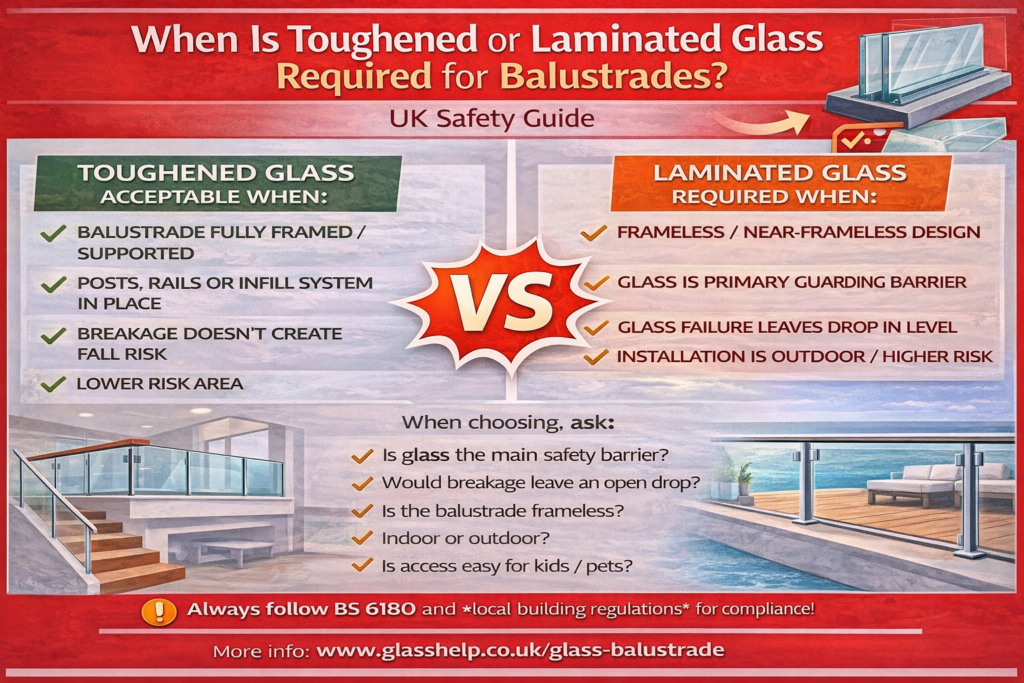
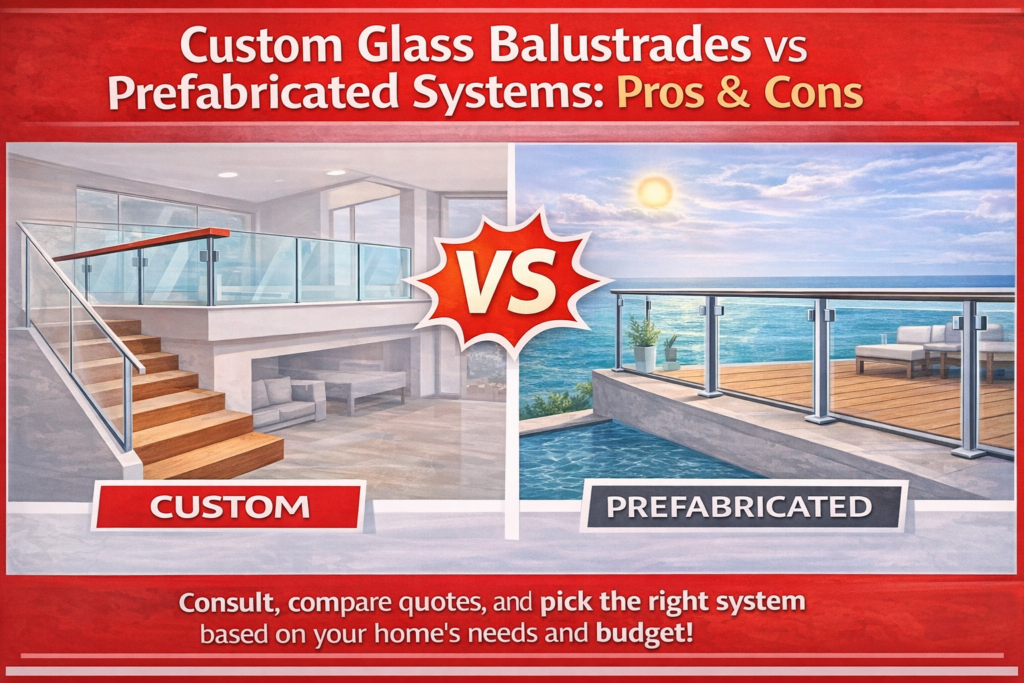
Custom Glass Balustrades vs Prefabricated Systems: Pros & Cons (UK Homeowner Guide)

Dec 23, 2025

If you’re planning a glass balustrade for a staircase, landing, balcony, terrace, or decking, you’ll usually face one big decision early on:

Do you go fully custom — or choose a prefabricated (off-the-shelf) system?

Both can look stunning and both can be safe — but they differ hugely in fit, finish, compliance flexibility, lead times, total cost, and long-term satisfaction. This guide breaks it all down in plain English so you can choose confidently.


1) What “Custom” and “Prefabricated” Actually Mean

Custom glass balustrade (made-to-measure)

A custom system is designed around your exact site conditions:

  • exact run lengths (including awkward corners)
  • precise heights, step geometry, slopes, and landings
  • custom panel sizes, cut-outs/notches, and fixing positions
  • glass type choices (clear, frosted, tinted, low-iron, laminated/toughened — depending on need)

It’s typically built from a measured survey and drawings, then manufactured specifically for your project.

Prefabricated (off-the-shelf / kit) balustrade system

A prefabricated system is sold as:

  • standard panel sizes
  • standard posts/spigots/base channel lengths
  • standard handrail options
  • “trim to fit” approach on site (within limits)

These can be brilliant for straightforward layouts — but can struggle when a property isn’t perfectly square, level, or predictable (which is most UK homes).


2) The Biggest Differences at a Glance

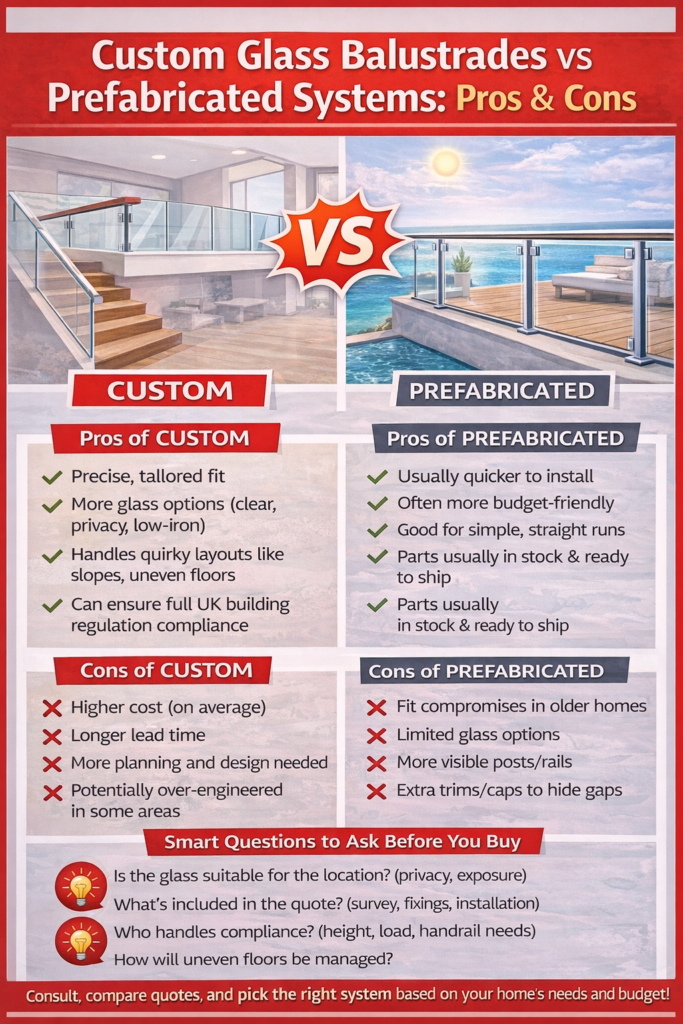
Custom is best when…

  • Your space is non-standard (older homes, uneven floors, quirky stair geometry)
  • You want a premium frameless look with tight sightlines and minimal hardware
  • You need specific glass types (privacy, low-iron clarity, tint matching, laminated safety needs)
  • You want predictable finished aesthetics (no “awkward filler pieces”)

Prefabricated is best when…

  • Your layout is simple and straight
  • Budget is tight and you need a fast solution
  • You’re comfortable with slight compromises to fit and finish
  • You’re using a contractor who installs this kit system regularly

3) Pros of Custom Glass Balustrades

✅ Perfect fit and cleaner final look

Custom panels are built for your exact measurements, so you avoid:

  • odd micro-gaps
  • “patch” panels at the end of a run
  • awkward cuts around newel posts, stair trims, or return walls

This is where custom often looks noticeably more “architect-designed.”

✅ Freedom to choose the glass that suits the space

A major advantage is choosing glass based on real function, not just what comes in the kit.

Example: low-iron glass is popular when you want the cleanest “crystal” look (less green edge tint), especially on thicker panels. Glass Help Ltd

✅ Better for tricky compliance situations

In the UK, balustrade design must consider height, loads, and whether a handrail is needed in certain conditions. A custom approach makes it easier to engineer around real constraints and achieve a compliant design. Glass Helper+1

✅ Higher-end customisation options

Custom makes it easier to specify details that elevate the build:

  • top cap vs no cap
  • satin vs mirror-polished hardware
  • marine-grade fixings for harsh outdoor environments
  • privacy frosting or tinting for overlooked areas
  • exact alignment with door frames, window mullions, or stair nosings

4) Cons of Custom Glass Balustrades

❌ Higher upfront cost (usually)

Custom typically costs more because you’re paying for:

  • survey/measure
  • drawings and engineering checks (as needed)
  • made-to-order manufacturing
  • higher precision installation

However: custom can save money if it avoids rework, returns, and “making a kit fit” for a non-standard site.

❌ Longer lead times

Because the system is manufactured after final measurements, lead times can be longer than buying a kit.

❌ More planning required

Custom is not “buy and install tomorrow.” You’ll usually go through:

  1. site measure
  2. spec choices (glass type, thickness, edges, fixings)
  3. manufacture
  4. install

5) Pros of Prefabricated (Off-the-Shelf) Systems

✅ Often cheaper for simple layouts

If your run is straight and your floor is level, kits can be a cost-effective way to get a modern glass look.

✅ Faster to purchase

You can often buy components quickly and start installation sooner.

✅ Predictable components (good for installers)

Contractors familiar with a particular kit system often install them efficiently because the parts and steps are familiar.


6) Cons of Prefabricated Systems

❌ Fit compromises are common in real homes

UK homes (especially older ones) often have:

  • floors slightly out of level
  • walls not perfectly straight
  • stair strings that vary subtly
  • corners not exactly 90°

Kits usually have tolerances — but too many “workarounds” can lead to a finish that looks less premium.

❌ Limited glass options

Many kits restrict you to what’s standard:

  • standard clear toughened in fixed thickness
  • fewer options for low-iron clarity, special tint matching, or privacy finishes

❌ More “visual hardware”

Some prefabricated solutions rely more on posts/rails to make the system adaptable, which can slightly reduce the clean frameless effect.

❌ Higher risk of extra parts and hidden costs

Common surprise costs with kits:

  • extra posts/spigots because your run doesn’t match the standard module
  • extra trims/caps to hide imperfect cuts
  • more labour time because installers have to problem-solve on site

7) Safety and Compliance: The Non-Negotiables

A glass balustrade isn’t decorative — it’s a guarding system designed to prevent falls. In UK guidance, guarding is required in situations where there’s a meaningful drop, and design focuses on height, strength, and resilience. GOV.UK+1

Also, loads and design checks are commonly referenced against standards such as BS 6180 and Eurocodes (especially for public or higher-traffic settings). labc.co.uk+1

What this means for you as a homeowner:
Whether custom or prefabricated, don’t treat this like flat-pack furniture. Ensure the system is specified and installed for the real use case (indoor/outdoor, exposure, traffic levels, children/pets, etc.).


8) Which One Should You Choose? (Real-World Scenarios)

Choose custom if:

  • Your staircase has turns, winders, split landings, or unusual geometry
  • You want a true frameless look and tighter glass alignment
  • You want premium glass like low-iron for clarity Glass Help Ltd
  • You’re doing a high-value renovation and care about “architectural finish”

Choose prefabricated if:

  • Your run is short, straight, and level
  • You need a faster purchase and install
  • You’re okay with a little extra visible hardware
  • Budget is the #1 priority and you can keep the layout simple

9) Smart Questions to Ask Before You Buy (Custom or Kit)

Use these to avoid costly mistakes:

  1. Is the glass type right for the location? (indoor vs outdoor exposure, privacy needs, clarity expectations)
  2. What’s included in the quote? (survey, drawings, fixings, caps, delivery, installation, waste removal)
  3. What’s the warranty — and what voids it?
  4. How will uneven floors/walls be handled?
  5. Who is responsible for compliance checks?
  6. What’s the maintenance plan? (hardware corrosion, cleaning access, seal checks outdoors)

Final Takeaway

If you want the best fit and the most premium look, custom is usually the winner — especially in real UK homes where “standard sizes” rarely match reality perfectly.

If your project is simple, straight, and budget-driven, a prefabricated system can still look great — as long as you accept the limits and use an installer who knows the system well.

When you’re ready to explore styles, glass types, and specification options for your project, here’s the main reference page again:

Comparison

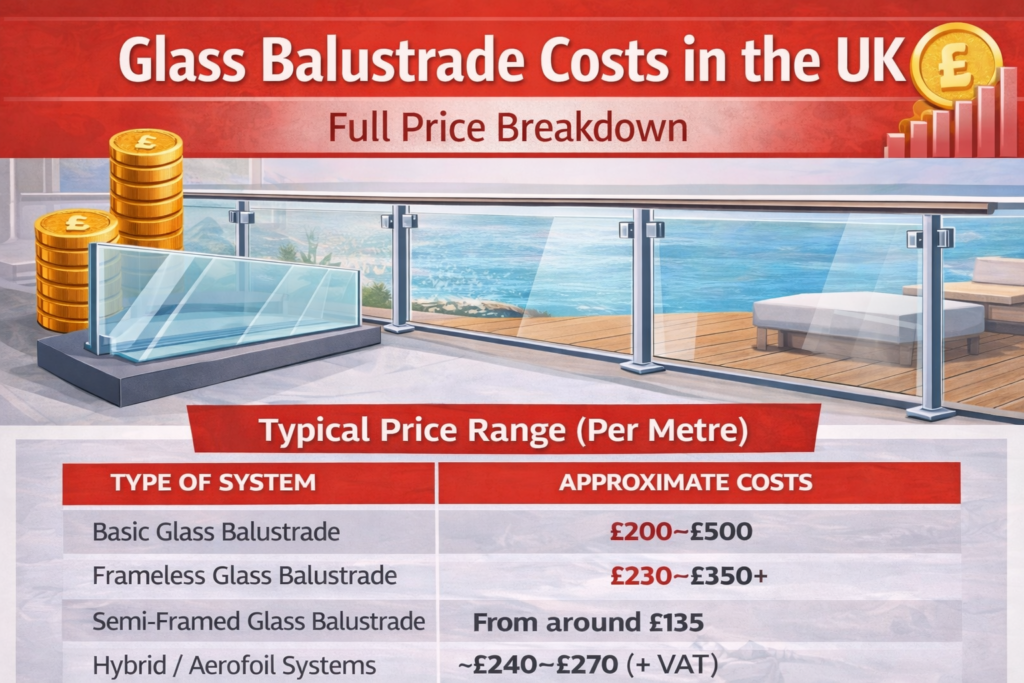
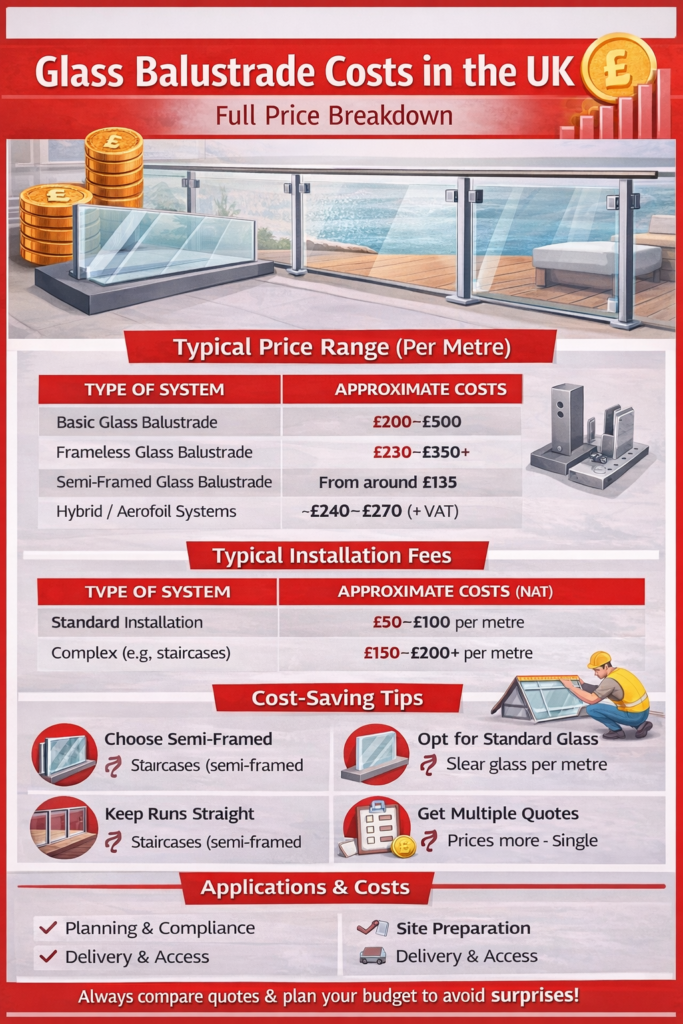
Glass Balustrade Costs in the UK: Full Price Breakdown

Dec 23, 2025

Glass balustrades are among the most stylish and modern upgrades that UK homeowners can make to a property — enhancing safety, increasing natural light, and adding contemporary flair. But if you’re considering installing one, the most common question is: “How much will it cost?”

In this comprehensive guide, we’ll walk you through everything you need to know about costs in the UK — from material prices and installation charges to key factors that influence your final budget. By the end, you’ll have a clear sense of what to expect and how to plan your project.


1. What Is a Glass Balustrade?

Before we look at costs, it’s important to understand what a glass balustrade actually is. Simply put, a glass balustrade is a protective barrier made with glass panels and supporting fixings that act as a safety barrier — commonly used for balconies, staircases, terraces, and decking areas.

These systems range from frameless (minimal hardware and unobstructed views) to semi-framed and more traditional framed variants. Each type impacts cost differently. If you’re new to this, here’s a full guide on glass balustrade systems to help you understand your options before breaking down the costs.
👉 glass balustrade systemshttps://www.glasshelp.co.uk/glass-balustrade/ Class Glass Limited


2. Typical Price Range per Metre in the UK

One of the most widely referenced measures for balustrade cost is the price per linear metre — useful when planning a balcony, terrace, or staircase run.

Average UK Costs (Per Linear Metre)

Type of SystemApproximate Price Range (UK)
Basic glass balustrade£200 – £500 per metre MyBuilder
Frameless glass balustrade£230 – £350+ per metre Balustrade UK
Semi-frameless glass balustradeFrom around £135 per metre Balustrade UK
Hybrid / Aerofoil systems~£240 – £270 per metre + VAT balconette.co.uk

💡 Note: These figures are typical ballpark ranges — final prices will vary based on material, glass thickness, fixing system, and the company you choose. Class Glass Limited

Why Costs Vary So Much

There are several reasons for price variation:

  • Glass thickness and type: Laminated or low-iron glass costs more than standard clear glass. balconette.co.uk
  • Frameless vs framed: Frameless designs generally cost more due to thicker panels and specialist installation. balconette.co.uk
  • Installation complexity: Staircases, curved sections, or uneven surfaces raise labour costs. Class Glass Limited
  • Location: London and high-demand areas often see higher installation fees.

3. Material Costs: What You’re Paying For

To understand the pricing better, let’s break down the materials typically involved in a glass balustrade project:

Glass Panels

Glass panels are the main component and vary depending on style, thickness, and type:

  • Standard toughened glass: Often starts around £80–£150 per linear metre for basic panels if bought supply-only. Express Glass Warehouse
  • Laminated glass: Usually £100 – £200+ per metre. Offers added safety due to the PVB or ionoplast interlayer. High Level Glazing
  • Patterned, tinted, or low-iron glass: Premium options costing £150 – £350+ per linear metre. balconette.co.uk

Fixings and Frames

Choosing between frameless systems (base channels, spigots) and semi-framed (posts, rails) affects cost:

Hardware Quality

Stainless steel (especially marine-grade 316) costs more but performs better outdoors and resists corrosion — useful for coastal homes.


4. Installation Costs

Material costs are only part of the equation. Installation — which includes labour, equipment, and sometimes scaffold or access gear — often makes up a significant portion.

Typical Installation Fees

Installation ItemTypical Price Range
Standard installation£50 – £100 per metre balconette.co.uk
Complex installation*£150 – £200+ per metre Class Glass Limited
Site preparation£100 – £200 total Class Glass Limited
Access equipment (e.g., cherry picker)£75 – £150 per day Class Glass Limited

*Complex installation includes staircases, curved runs, or difficult access.

💡 Even short runs incur minimum call-out and preparation fees, so very small projects may seem proportionally costly. balconette.co.uk


5. Applications & Cost Examples

Knowing where you’re installing the balustrade makes a big difference to overall cost.

Balconies

  • Balcony glass balustrades typically cost £250–£350 per metre, including basic installation. Class Glass Limited
  • Larger balconies with premium glass or frameless systems may reach £400+ per metre. High Level Glazing

Staircases

  • Internal staircase glass balustrade runs often cost £200–£500 per metre installed. MyBuilder
  • Spiral or split landing stairs add to labour costs. Class Glass Limited

Terraces & Decking

  • Outdoor terrace balustrades also fall within £250–£350 per metre but may need thicker glass or marine-grade fixings. Class Glass Limited

6. Hidden Costs You Need to Know

A few components homeowners often overlook:

Planning and Compliance

Most glass balustrades must meet UK building regulations (e.g., minimum height, glass safety standards). Compliance checks can add time and cost.

Site Preparation

Uneven surfaces, removal of old railings, or structural reinforcement increases costs. Class Glass Limited

Delivery and Access

Large glass panels may require specialized delivery, especially for upstairs installations.


7. Cost-Saving Tips

If you’re working with a tighter budget:

1. Choose Semi-Framed Over Frameless

Semi-framed systems are often cheaper because they reduce the need for very thick, high-grade glass. Balustrade UK

2. Opt for Standard Glass Options

Clear toughened glass is less expensive than laminated or tinted alternatives.

3. Keep Runs Straight

Complex curves and angles cost more. Simple linear runs are cheaper to manufacture and install.

4. Get Multiple Quotes

Prices can vary significantly between suppliers. Always compare at least 3 installers.


8. Value and ROI

For many UK homeowners, glass balustrades are more than just safety features — they add architectural value and improved property aesthetics. While precise return on investment (ROI) varies, modern glass installations can enhance online listings and support asking prices in competitive markets.


9. Final Thoughts

Understanding glass balustrade costs in the UK isn’t just about the price per metre — it’s about making informed decisions based on:

  • Your property type
  • Style preferences (frameless vs framed)
  • Installation complexity
  • Material quality and durability

With typical costs ranging between £200 and £500+ per metre, a bit of planning and comparison can help you choose a system that looks great, meets building standards, and fits your budget. MyBuilder

Comparison

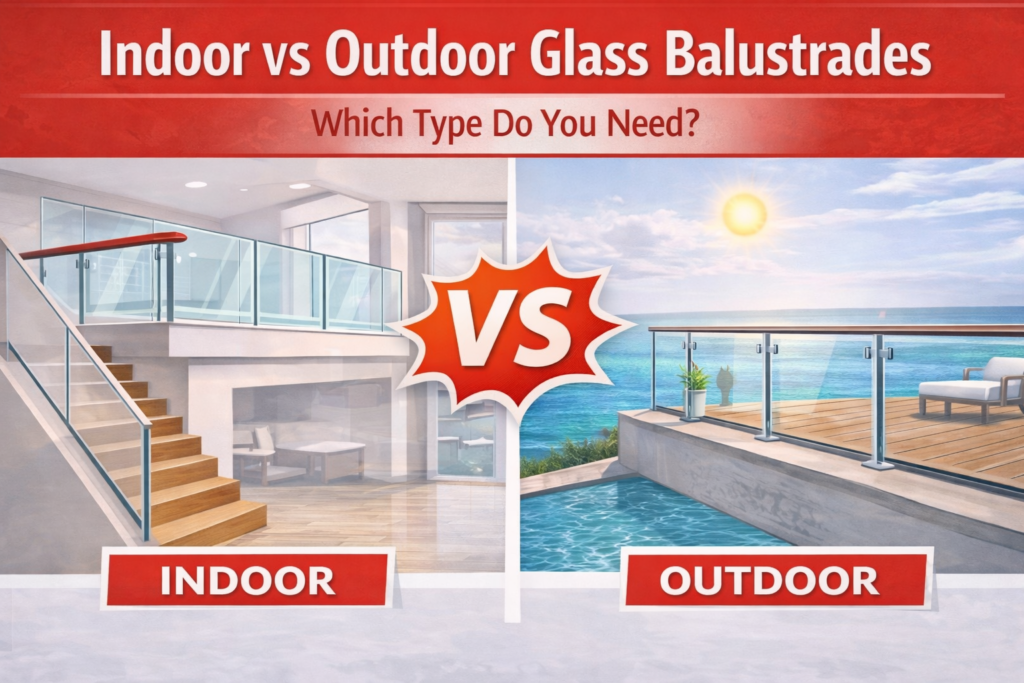
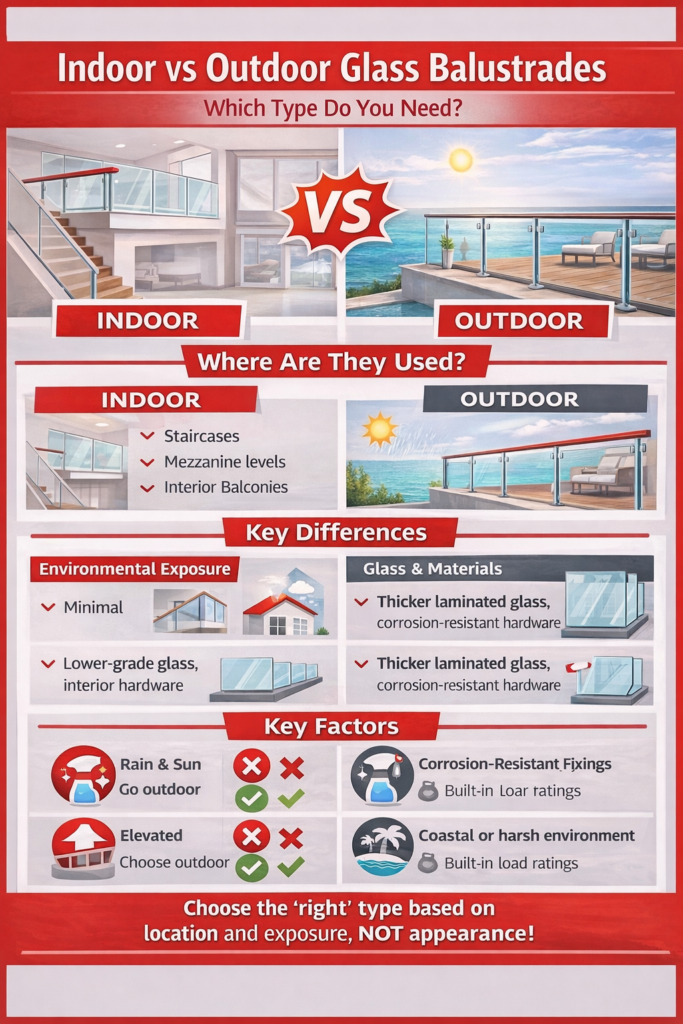
Indoor vs Outdoor Glass Balustrades: Which Type Do You Need?

Dec 23, 2025

Glass balustrades have become a defining feature of modern homes, valued for their ability to combine safety, openness, and contemporary design. However, not all glass balustrades are the same. One of the most common questions homeowners ask before ordering is:

“Do I need an indoor or an outdoor glass balustrade?”

While they may look similar at first glance, indoor and outdoor glass balustrades are designed for very different environments. Choosing the wrong type can affect durability, safety, maintenance, and long-term cost.

This guide will help you clearly understand:

  • The difference between indoor and outdoor glass balustrades
  • How materials and construction vary
  • Where each type works best
  • Safety, weather resistance, and maintenance considerations
  • How to choose the right option for your home

What Is a Glass Balustrade? (Quick Refresher)

A glass balustrade is a protective barrier made from safety glass, commonly installed along staircases, balconies, terraces, decking, and mezzanine levels. Instead of traditional wooden or metal railings, glass panels provide fall protection while maintaining light flow and visibility.

Modern glass balustrade systems use toughened or laminated safety glass, combined with metal fixings or base channels, to meet strict building regulations. If you want to explore available styles and configurations, this overview of glass balustrade systems provides a helpful starting point:
👉 glass balustrade systemshttps://www.glasshelp.co.uk/glass-balustrade/


What Are Indoor Glass Balustrades?

Indoor glass balustrades are designed specifically for internal environments where exposure to weather, moisture, and temperature extremes is minimal.

Common Indoor Applications

  • Staircases
  • Mezzanine floors
  • Landing edges
  • Split-level living areas
  • Interior balconies

Key Characteristics of Indoor Glass Balustrades

1. Focus on aesthetics
Indoor glass balustrades are often chosen primarily for their visual impact. Frameless or semi-framed designs are common, creating a clean, minimalist look that complements modern interiors.

2. Lighter environmental demands
Because indoor systems are not exposed to rain, UV radiation, or frost, the materials do not need the same level of weather protection as outdoor systems.

3. Glass types used
Indoor balustrades usually use:

  • Toughened glass
  • Laminated safety glass (especially for staircases)

The thickness may be slightly lower than outdoor balustrades, depending on height and fixing method.

4. Fixings and hardware
Internal balustrade fixings are typically:

  • Stainless steel or aluminium
  • Chosen more for appearance than corrosion resistance
  • Often polished or brushed for decorative appeal

What Are Outdoor Glass Balustrades?

Outdoor glass balustrades are engineered to withstand constant exposure to weather and environmental stress. They must meet stricter performance requirements than indoor systems.

Common Outdoor Applications

  • Balconies
  • Roof terraces
  • Garden decking
  • Pool surrounds
  • Juliet balconies

Key Characteristics of Outdoor Glass Balustrades

1. Weather resistance is critical
Outdoor balustrades must endure:

  • Rain and moisture
  • UV exposure
  • Wind load
  • Temperature changes
  • Airborne pollution or salt (in coastal areas)

Because of this, every component must be designed for long-term durability.

2. Stronger glass specifications
Outdoor balustrades typically require:

  • Thicker toughened or laminated glass
  • Laminated glass is often preferred, as it remains in place even if broken

This is especially important for elevated balconies or exposed locations.

3. Corrosion-resistant fixings
All fixings and handrails are usually made from:

  • Marine-grade stainless steel (e.g. 316 stainless)
  • Powder-coated aluminium

These materials resist rust and corrosion over time.

4. Higher structural demands
Outdoor systems must be designed to resist wind pressure and comply with stricter load requirements set by building regulations.


Key Differences Between Indoor and Outdoor Glass Balustrades

1. Environmental Exposure

FactorIndoorOutdoor
Rain & moisture❌ Minimal✅ Constant
UV exposure❌ None✅ High
Temperature changes❌ Stable✅ Extreme
Wind load❌ Low✅ High

Outdoor balustrades must be significantly more robust to handle these factors safely.


2. Glass Thickness and Type

Indoor balustrades may use thinner glass where permitted, while outdoor balustrades usually require thicker laminated glass for safety and durability.

Outdoor systems are often designed with the assumption that:

  • The glass may be the primary structural barrier
  • Failure is not acceptable due to height and exposure

3. Fixings and Materials

Indoor balustrades prioritise design and finish, while outdoor balustrades prioritise corrosion resistance and strength.

For example:

  • Indoor: decorative clamps, brushed steel
  • Outdoor: base channels, concealed drainage, weather-rated fixings

4. Maintenance Requirements

Indoor Glass Balustrades

  • Simple cleaning with glass cleaner
  • Minimal inspection needed
  • Rarely affected by staining or corrosion

Outdoor Glass Balustrades

  • Require regular cleaning to remove dirt, salt, or water marks
  • Periodic inspection of fixings recommended
  • May need more frequent maintenance in coastal or exposed locations

Which Type Is Safer?

Both indoor and outdoor glass balustrades are safe when correctly designed and installed. The difference lies in how they achieve safety.

  • Indoor systems rely on controlled conditions and regulated use
  • Outdoor systems rely on stronger materials and engineering

In practice, outdoor balustrades are built to higher performance thresholds, but both must comply with building regulations for height, load resistance, and glass type.


How to Choose the Right Type for Your Home

Ask yourself the following questions:

1. Where will the balustrade be installed?

If it’s exposed to weather, moisture, or wind — you need an outdoor-rated system, even if the area feels semi-covered.

2. Is the area elevated?

Balconies, roof terraces, and raised decking almost always require outdoor-grade glass balustrades due to fall risk and wind load.

3. Do you prioritise appearance or durability?

Indoor balustrades allow more freedom in styling. Outdoor balustrades must prioritise performance first, aesthetics second.

4. Are you near the coast or in a harsh environment?

Coastal homes should always use outdoor systems with marine-grade materials, even for partially sheltered areas.


Can the Same Design Be Used Indoors and Outdoors?

Visually, yes — technically, no.

You can achieve a consistent look throughout your home by using similar frameless or semi-framed designs, but:

  • The specification of glass and fixings must differ
  • Outdoor balustrades should never be replaced with indoor-rated systems

A professional supplier will match the appearance while upgrading the materials where required.


Cost Differences to Expect

While prices vary depending on size and design:

  • Indoor glass balustrades are generally more affordable
  • Outdoor glass balustrades cost more due to:
    • Thicker glass
    • Higher-grade fixings
    • More complex installation

However, choosing the correct system from the start avoids expensive replacements or safety issues later.


Final Thoughts: Which Type Do You Need?

If your balustrade is inside your home and protected from the elements, an indoor glass balustrade is usually sufficient and offers excellent design flexibility.

If your balustrade is outside, elevated, or exposed, you should always choose an outdoor glass balustrade system designed for weather resistance and structural safety.

The key is not how the balustrade looks — but where and how it will be used.

By understanding the differences between indoor and outdoor glass balustrades, you can make a confident, informed decision that delivers both style and long-term safety.

Comparison

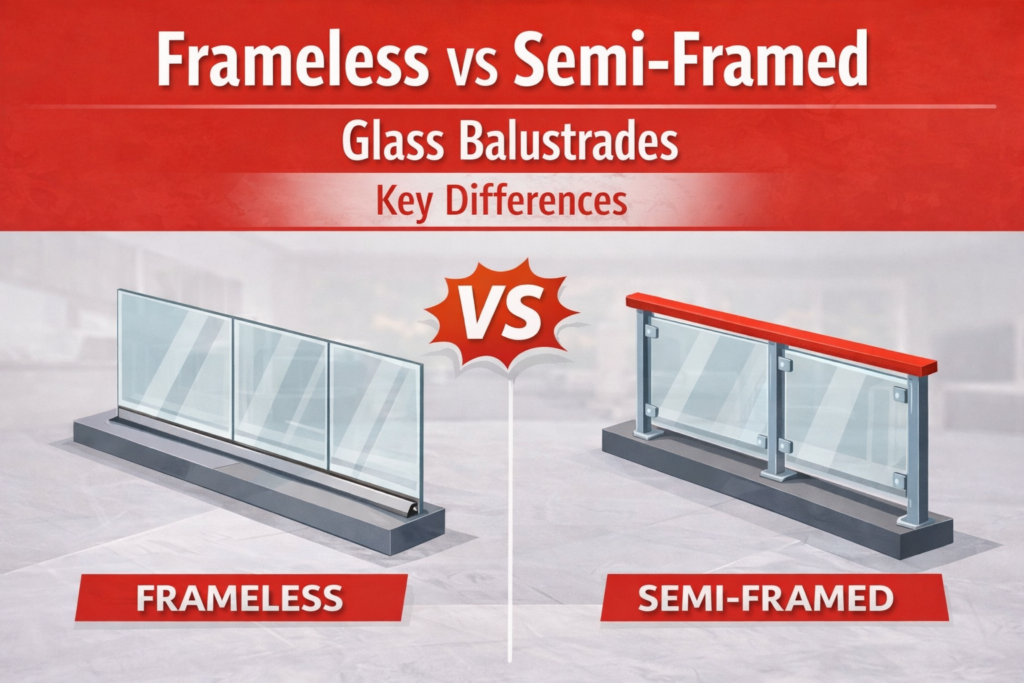
Frameless vs Semi-Framed Glass Balustrades: Key Differences

Dec 23, 2025

Glass balustrades are a hallmark of modern architecture — adding elegance, safety, and unobstructed views. But not all glass balustrades are created equal. Two of the most popular styles you’ll encounter are frameless and semi-framed glass balustrades. Choosing the right one can affect your home’s aesthetic, budget, safety, and long-term performance.

In this comprehensive guide for homeowners, we’ll explore:

  • What frameless and semi-framed glass balustrades are
  • How they differ
  • Pros and cons of each
  • Ideal applications
  • Cost, maintenance, and safety considerations
  • Practical tips for selecting the right option

By the end, you’ll have a clear picture of which style is best suited to your project.


1. Understanding Glass Balustrades

Before we compare styles, let’s briefly define a glass balustrade. A balustrade is a protective barrier typically installed along edges of staircases, balconies, terraces, and decking. When constructed with glass panels, it becomes a glass balustrade system — combining safety with transparency and modern aesthetics. For more about design options and applications, check out this introductory guide to glass balustrade systems.

Glass balustrades are engineered with safety glass (usually toughened or laminated) and specialised fixings to meet building regulations while providing visual continuity. Hals International Inc


2. What Are Frameless Glass Balustrades?

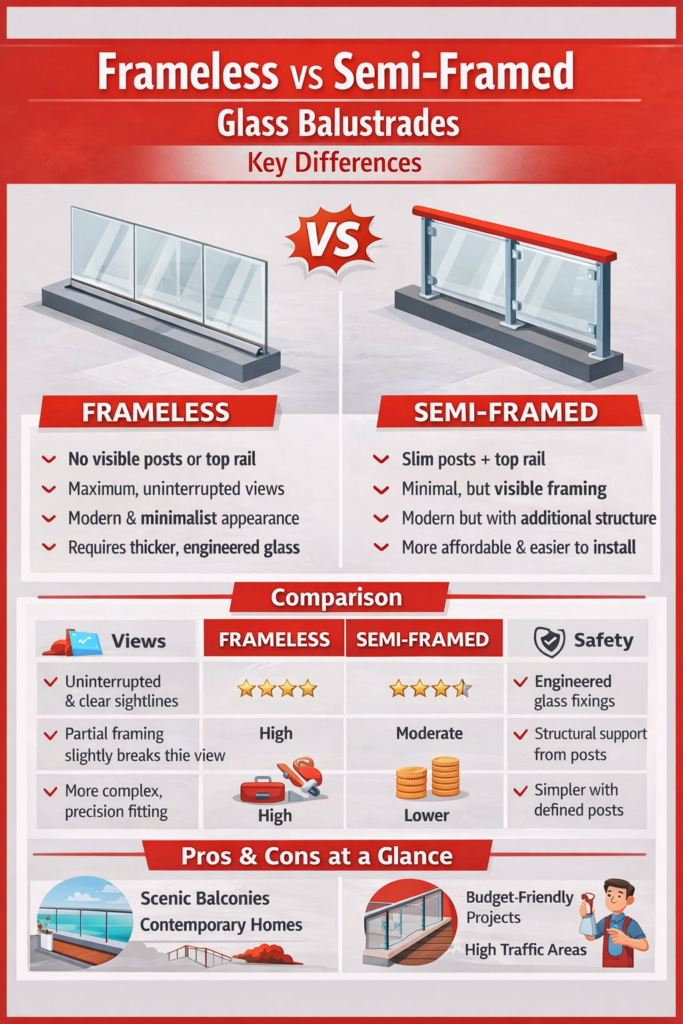
A frameless glass balustrade features glass panels secured with minimal hardware — typically mounted into a base channel or using discreet spigots/clamps so that no visible posts or frames interrupt the view. Balconette

Key Features

  • Minimal visual obstruction: The lack of visible frames creates ultra-clear sightlines and maximises light penetration. Balconette
  • Sleek, modern appearance: Ideal for contemporary homes and spaces prioritising clean design. Balconette
  • Higher glass thickness: Often utilises thicker glass (e.g., 10–15 mm) because the glass itself bears structural load. GTA Railings
  • Professional installation: Precision and specialist hardware are essential for safety and performance. dtbalustrade.com.au

Frameless systems are popular on balconies, rooftop terraces, and staircases where maximizing views is a priority. Deck Shoppe


3. What Are Semi-Framed Glass Balustrades?

A semi-framed glass balustrade has some visible framing elements — typically posts or a top rail — that support glass panels. Unlike fully framed systems, the frames are minimal, preserving much of the glass’s visual clarity while adding structure. Unique Balustrading

Key Features

  • Slim posts or partial framing: Less intrusive than fully framed systems, but more robust than frameless designs. Unique Balustrading
  • Handrail support: Often includes a minimal handrail that contributes to stability. WPS Handrails
  • Easier installation: Frames offer clear mounting points and can simplify fitting. The Glass Railing Store
  • Cost-effective: Generally cheaper than frameless systems due to lower glass thickness and hardware cost. dtbalustrade.com.au

This hybrid solution is great for homeowners seeking modern aesthetics without the premium cost of frameless systems.


4. Aesthetics: Views and Visual Impact

One of the biggest differences between frameless and semi-framed styles is how open your space feels.

Frameless Glass Balustrades

Frameless designs offer the clearest, least interrupted views. Since they eliminate posts and vertical frames, they’re perfect for scenic areas (e.g., overlooking gardens, pools, sea views). Balconette

Semi-Framed Glass Balustrades

Semi-framed systems still deliver great visibility, but the slim posts or top rails can slightly break the view — though often in a deliberately stylish way. Unique Balustrading

💡 Summary: If unobstructed views are your priority, frameless is usually superior. If you’re okay with subtle structural elements and want a balance of form and function, semi-framed is an excellent choice.


5. Cost Considerations

Cost can be a defining factor in your decision.

Frameless Systems

  • Higher upfront cost due to thicker glass panels, premium fixings, and specialist installation. dtbalustrade.com.au
  • May command higher property value due to premium aesthetics and perceived luxury.

Semi-Framed Systems

  • Lower material and installation cost because frames make the mounting process easier and allow thinner glass. dtbalustrade.com.au
  • Great option for projects with tighter budgets.

💡 Always request detailed quotes comparing materials, finishing, installation time, and warranties.


6. Installation and Maintenance

Installation

  • Frameless glass balustrades typically demand greater precision and professional expertise. Proper anchoring into floors or walls is crucial to safety and durability. dtbalustrade.com.au
  • Semi-framed systems are generally easier and quicker to install due to pre-defined posts and rails. The Glass Railing Store

Maintenance

  • Frameless designs are often easier to clean since there are fewer nooks where dirt collects. dtbalustrade.com.au
  • Semi-framed systems may require slightly more cleaning around the posts or rails, though still low-maintenance compared with wood or metal railings. The Glass Railing Store

Routine care usually involves cleaning glass panels with mild detergent and inspecting fixings periodically for outdoor installations.


7. Safety and Regulations

Both frameless and semi-framed glass balustrade systems are engineered to meet building safety standards when correctly designed and installed. The glass used is typically toughened or laminated safety glass, chosen to withstand impact and load. Hals International Inc

However:

  • Frameless systems rely on glass strength and precision fixings.
  • Semi-framed systems benefit from the additional reassurance of posts and rails for perceived structural support — an advantage in high-traffic areas or homes with children and pets.

Always consult local building regulations (e.g., UK building codes) and work with certified installers to ensure compliance.


8. Best Uses for Each Style

Understanding where each type shines can help you choose:

Best for Frameless Glass Balustrades

✔ High-end residential balconies
✔ Rooftop terraces with scenic views
✔ Modern open-plan interiors
✔ Pool edges where transparency is prioritized

Best for Semi-Framed Glass Balustrades

✔ Homes seeking a modern look on a budget
✔ Staircases or areas needing subtle structural elements
✔ Spaces where slight frame visibility isn’t an issue


9. Pros & Cons at a Glance

FeatureFramelessSemi-Framed
Visual Openness⭐⭐⭐⭐⭐⭐⭐
Installation DifficultyHighModerate
CostHighLower
MaintenanceEasyModerate
Safety PerceptionStrong (engineered)Strong (with frame)

10. Final Thoughts

Choosing between frameless vs semi-framed glass balustrades largely depends on your budget, aesthetic priorities, and functional needs. Frameless systems offer unrivalled clarity and modern appeal, while semi-framed designs deliver excellent value and easier installation without sacrificing style.

To explore specific designs and configurations that suit your home, browse real examples on reputable glass balustrade resources and suppliers. Wherever your project leads you, balancing beauty, performance, and safety will deliver both visual and resale value.

Comparison

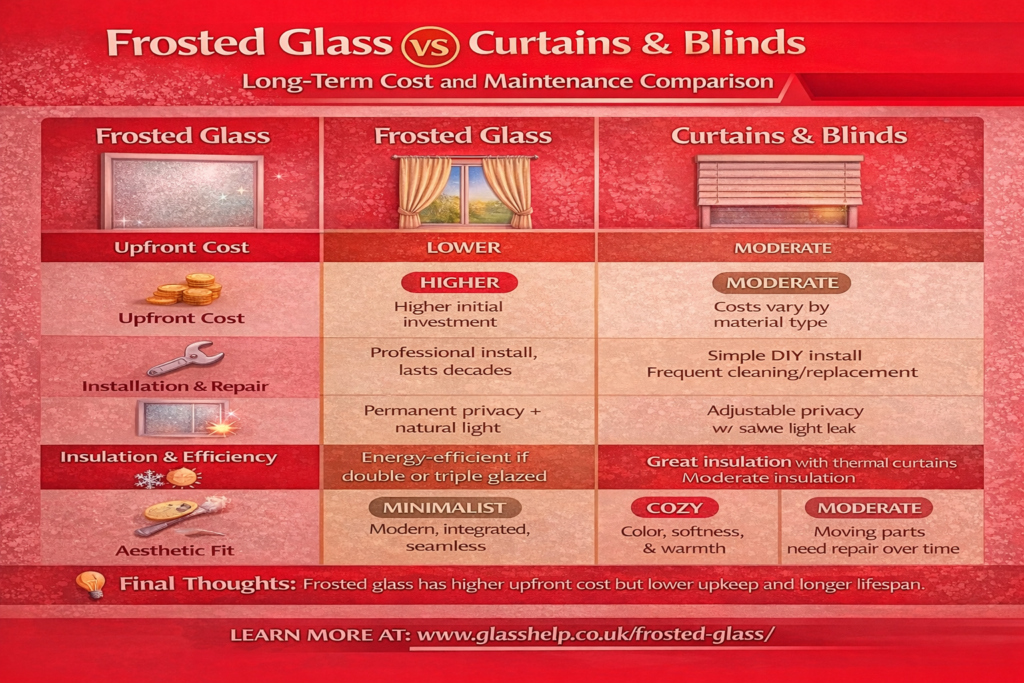
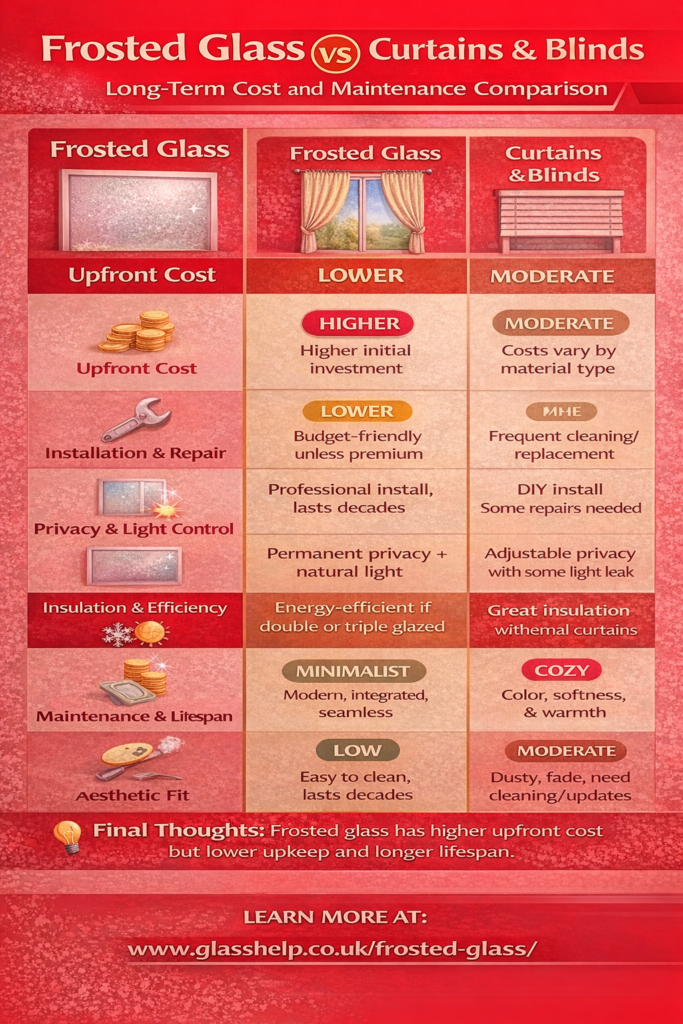
Frosted Glass vs Curtains & Blinds: Long-Term Cost and Maintenance Comparison

Dec 22, 2025

Choosing how to cover or treat your windows isn’t just about how it looks — it’s about long-term cost, maintenance, privacy, light control, and durability. Curtains and blinds have been traditional favorites for decades, but frosted glass is increasingly popular in modern homes for its sleek look and built-in privacy.

In this article, we’ll compare these three options side-by-side so you can make an informed decision based on real long-term considerations.


Why Frosted Glass Is on the Rise

Frosted glass isn’t just a stylistic choice. It’s privacy glazing — glass treated so it diffuses light and blurs visibility while still letting daylight through. Methods include acid-etching, sandblasting, or top-quality surface treatments. Vida Signs New York

To explore styles, finishes, uses, and technical details before you decide, check out this helpful resource:
👉 Your Frosted Glass Guide – Uses, Types & Options

Unlike curtains or blinds, which are separate products installed in front of the glass, frosted glass performs light filtering and privacy at the material level — with no fabric, slats, tracks, or mechanisms to wear out.


Upfront Costs: Frosted Glass vs Curtains vs Blinds

Frosted Glass

  • Higher initial cost than fabric curtains or basic blinds.
  • Price depends on glass thickness, type of frosting, size, and installation labour.
  • Considered an investment because it becomes part of the window structure.

Even though steel or acid-etched glass can be pricier up front, it often outlasts many traditional window treatments without needing replacement. Vida Signs New York


Curtains

  • Lower upfront cost than frosted glass — especially for basic curtains.
  • Prices range widely depending on fabric, lining, hardware, and custom sizes.
  • Thermal or blackout curtains (designed for insulation) can be more expensive.

Curtains can last several years but tend to wear out faster than glass because fabric fades, sags, and absorbs dust. theshadestore.com


Blinds

  • Cost depends on material: PVC, aluminium, wood, or premium designs.
  • Generally mid-range pricing between basic curtains and custom frosted glass.
  • Motorised or smart blinds increase cost significantly.

Blinds sometimes require repairs if slats warp, break, or mechanisms fail. velablinds.com


Long-Term Maintenance

Frosted Glass

Very low maintenance — regular glass cleaning with mild detergent and a soft cloth is all you need. There’s no fabric to wash and no moving parts to break.

Unlike blinds or curtains, frosted glass won’t fade, stretch, or collect dust in slats, and there’s no hardware to malfunction. Vida Signs New York


Curtains

  • Require frequent cleaning — especially in high-traffic areas.
  • Fabric attracts dust, pet hair, and cooking smells.
  • Dark or heavy curtains may need to be professionally cleaned periodically.
  • Fabric fades over time from sunlight.

Depending on the material, curtains may need to be replaced every few years. theshadestore.com


Blinds

  • Easier to clean than curtains (wipe down slats), but still collect dust.
  • Moving parts (cords, tilters, lift mechanisms) can jam or break.
  • Some materials (wood blinds) can warp in humid rooms like bathrooms or kitchens. theshadestore.com

Blinds often outlast curtains in durability but still require occasional repairs.


Privacy & Light Control

Frosted Glass

Frosted glass offers built-in privacy without blocking natural light. It diffuses sunlight, reducing glare while keeping interiors bright — a balance that curtains or blinds struggle to achieve without trade-offs. Express Windows Group


Curtains

  • Full coverage when closed, offering strong privacy and complete blackout (with blackout lining).
  • When open, offer no privacy and can block light entirely.

Curtains require you to open/close them manually and can make a room dark if drawn fully.


Blinds

  • Provide adjustable privacy — slats can tilt to let light in while obstructing direct visibility.
  • Still may allow light leaks through gaps and may not offer total privacy unless fully closed. theshadestore.com

Blinds give good control but can still let in heat and light through slat gaps unless paired with other treatments.


Insulation & Energy Efficiency

Frosted Glass

While frosted glass doesn’t inherently insulate more than clear glass, combined with double- or triple-glazing it contributes to reduced heat loss. Frosted surface doesn’t reduce energy efficiency but doesn’t harm it either.


Curtains

Curtains — especially thermal or heavy drapes — can significantly improve insulation:

  • Help reduce heat loss in winter.
  • Block solar gain in summer.
  • Provide noticeable comfort improvements. theshadestore.com

They can also help reduce HVAC usage when used thoughtfully.


Blinds

Blinds offer moderate insulation performance — better than plain glass, but usually less than heavy curtains. When combined with curtains, the effect is enhanced. theshadestore.com


Aesthetics & Design

Frosted Glass

  • Clean, minimalist, and integrated look.
  • Works seamlessly with modern, Scandinavian, industrial, or contemporary interiors.
  • Doesn’t interrupt architectural lines. Vida Signs New York

Frosted glass suits open spaces where you want privacy without visual clutter.


Curtains

  • Add softness, colour, texture, and style.
  • Can create a cozy, layered aesthetic.
  • Fabric choices are virtually limitless.

Curtains can complement decor well — but they’re a design feature, not a neutral element.


Blinds

  • Offer a neat, tailored look.
  • Minimal footprints on window frames.
  • Materials range from modern aluminium to classic wood.

Blinds can be sleek and contemporary, but some homeowners find the slat look less elegant than curtains or scenic glass.


Durability & Lifespan

Frosted Glass

One of the most durable options:

  • Does not fade, warp, or wear out.
  • Outlasts most fabrics or mechanical blinds.
  • Can last decades with basic cleaning. Vida Signs New York

Curtains

  • Lifespan depends on fabric quality and sunlight exposure.
  • Heavy fabrics can stretch or fade over time.
  • May need replacement more frequently than glass. theshadestore.com

Blinds

  • Durable overall, but moving parts are points of failure.
  • Higher-end blinds last longer; cheaper models can break sooner. velablinds.com

Overall Cost of Ownership

Frosted glass may be more expensive up front, but its low maintenance, long lifespan, and integrated privacy can make it more cost-effective over time — especially compared with curtains that need regular cleaning and blinds that might need repair or replacement.

Curtains often need multiple replacements and professional cleaning costs add up. Blinds sit somewhere in between — reasonable longevity but ongoing maintenance.

According to privacy and window treatment comparisons, glass-based privacy solutions often outperform curtains and blinds for durability and minimal upkeep. southmenarchitecturalfilms.com


Which Option Should You Choose?

Choose Frosted Glass If:

  • You want built-in privacy with natural light.
  • You prefer minimal upkeep.
  • You’re investing in a long-lasting architectural finish.

Choose Curtains If:

  • Style, texture, and softness matter most.
  • You want excellent insulation.
  • You’re happy with periodic cleaning or updates.

Choose Blinds If:

  • You want adjustable privacy and light control.
  • A sleek, minimal aesthetic fits your space.
  • You want a solution that’s easy to install and adjust.

Final Thoughts

There’s no one-size-fits-all answer — each option has its place. Curtains excel in cozy, layered interiors, blinds offer precise light control, and frosted glass delivers clean, maintenance-free privacy with long-term value.

For a modern, elegant approach to privacy that also maximises daylight and minimises upkeep, frosted glass stands out — especially in bathrooms, office spaces, and street-facing windows.

👉 To explore premium frosted glass solutions tailored for UK homes, see this comprehensive resource:
Frosted Glass Panels & Uses – UK Frosted Glass Guide