DIY Guide

DIY Guide

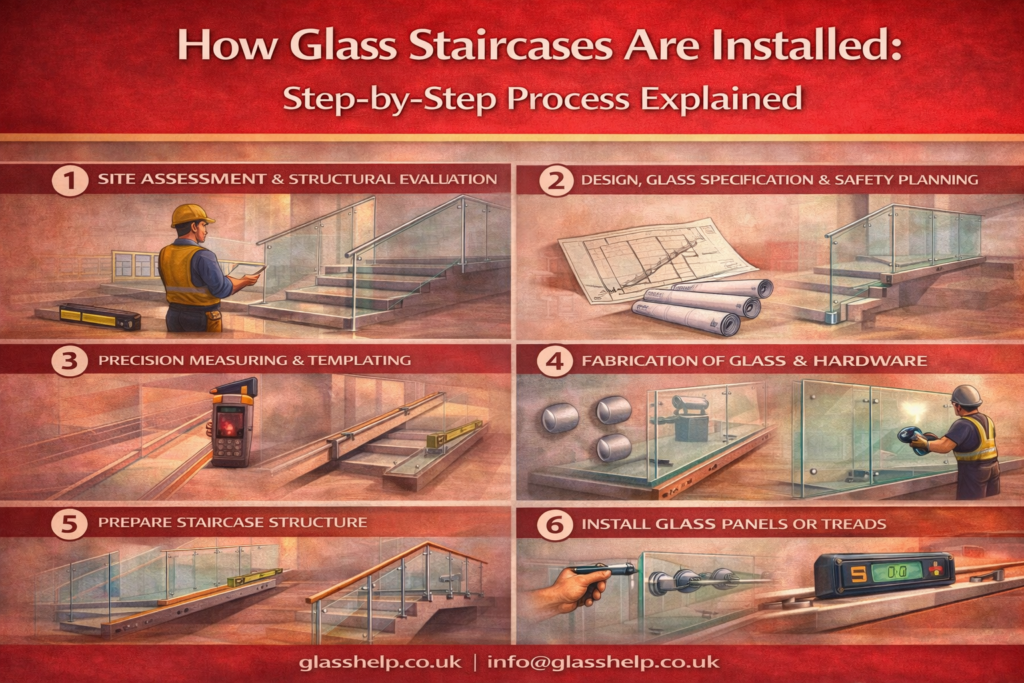
How Glass Staircases Are Installed: Step-by-Step Process Explained

Dec 19, 2025

Glass staircases look effortless once installed — clean lines, floating steps, and uninterrupted light. But behind that sleek finish is a highly technical installation process that demands precision, planning, and strict safety compliance.

Whether you’re a homeowner planning a modern renovation or a designer specifying glass stairs for a project, understanding how glass staircases are installed helps you make better decisions, avoid costly mistakes, and know what to expect at each stage.

This guide walks you through the entire installation process step by step, from initial measurements to final safety checks — explained in simple, practical terms.
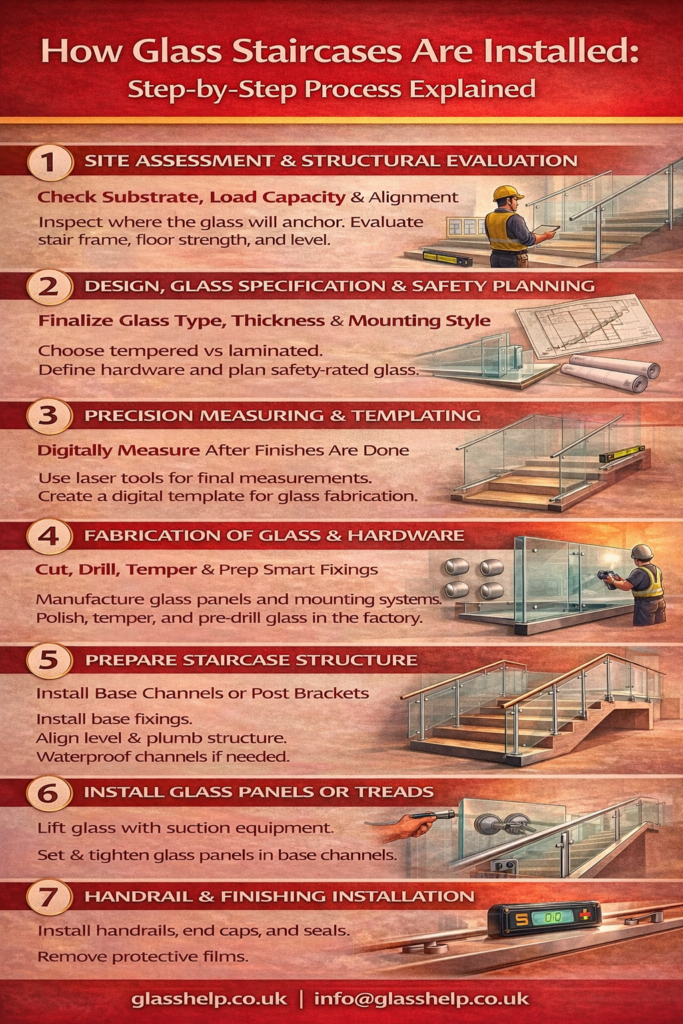

Step 1: Site Assessment & Structural Evaluation

Every successful glass staircase installation starts before any glass is ordered.

What professionals check at this stage:

  • Substrate type (concrete, steel, timber)
  • Load-bearing capacity of floors and stair strings
  • Wall and floor alignment (glass reveals imperfections)
  • Stair geometry (rise, run, angles, landings)

Glass staircases — especially frameless designs — rely heavily on what they are fixed into. If the structure isn’t sound, even the strongest glass won’t perform correctly.

This is why most installers insist on a structural review or engineer sign-off before proceeding.


Step 2: Final Design, Glass Specification & Safety Planning

Once the structure is confirmed, the exact staircase design is finalized.

Key decisions made here:

  • Frameless vs framed system
  • Glass type (tempered, laminated, or both)
  • Glass thickness (depends on load and span)
  • Finish (clear, frosted, tinted)
  • Handrail type (top-mounted, side-mounted, or none)

Safety glass selection is critical at this stage. Staircases always require safety-rated glass, and laminated glass is often used where fall protection is essential.

If you’re comparing different glass options for stairs and balustrades, this guide explains how glass behaves in load-bearing applications:
👉 https://www.glasshelper.co.uk/what-type-of-glass-is-used-in-staircases/


Step 3: Precision Measuring & Digital Templating

Glass staircases allow almost zero margin for error.

After finishes like flooring and plastering are complete, installers perform final site measurements, often using:

  • Digital laser measurement tools
  • Physical templates for complex angles
  • CAD drawings for glass fabrication

This step ensures:

  • Glass panels fit exactly between floors and rails
  • Fixings align perfectly with pre-drilled glass holes
  • No on-site cutting is required (glass cannot be altered later)

⚠️ Skipping this step or measuring too early is one of the most common causes of delays and costly remakes.


Step 4: Fabrication of Glass & Hardware

Once measurements are approved, fabrication begins.

What happens in the factory:

  • Glass is cut to size
  • Edges are polished or beveled
  • Glass is tempered and/or laminated
  • Holes and notches are pre-drilled
  • Surface finishes (frosted, tinted) are applied

At the same time, mounting systems are prepared:

  • Base channels
  • Clamps or spigots
  • Handrails
  • Gaskets and setting blocks

This stage typically takes 2–4 weeks, depending on complexity.


Step 5: Preparing the Staircase for Installation

Before glass arrives on site, installers prepare the staircase structure.

This includes:

  • Installing base channels or post brackets
  • Verifying level and plumb alignment
  • Setting expansion gaps where required
  • Waterproofing channels (especially near bathrooms or exterior stairs)

For frameless systems, base channels must be perfectly level — even a few millimeters off can cause visible glass lean.


Step 6: Installing Glass Panels or Treads

This is the most delicate and visually critical stage.

How glass is installed:

  • Panels are lifted using glass suction equipment
  • Glass is seated on setting blocks (never directly on metal)
  • Panels are temporarily braced and aligned
  • Gaskets and pressure plates are fitted
  • Fixings are tightened in a controlled sequence

For staircases with glass balustrades, installation usually proceeds:

  1. Lower flight
  2. Landings
  3. Upper flight

For glass treads (less common but premium):

  • Laminated glass steps are installed individually
  • Anti-slip treatments are verified
  • Load distribution is carefully checked

Step 7: Handrail & Finishing Installation

Once glass is secure, finishing elements are added.

Common finishing steps:

  • Installing top handrails (wood, stainless steel, aluminum)
  • Adding end caps and trims
  • Cleaning protective films
  • Sealing joints if required

Handrails are not just decorative — in many regions they are legally required for stair safety, even when glass is used.


Step 8: Safety Checks, Load Testing & Compliance

Before sign-off, installers perform final safety checks.

Typical checks include:

  • Verifying glass alignment and fixings
  • Checking handrail height and continuity
  • Confirming no glass-to-glass contact
  • Ensuring there are no chips or edge damage
  • Confirming compliance with local building codes

In high-end or commercial projects, load testing may be conducted to verify performance.

If you want to understand how compliant glass stair systems are designed and installed, this overview is helpful:
👉 https://www.glasshelp.co.uk/glass-staircase/


Step 9: Final Cleaning & Handover

After installation:

  • Glass is professionally cleaned
  • Installation documentation is provided
  • Care and maintenance guidance is shared

Good installers will also explain:

  • How to clean glass safely
  • What products to avoid
  • How often fixings should be inspected

How Long Does Glass Staircase Installation Take?

StageTypical Time
Design & approval1–2 weeks
Fabrication2–4 weeks
On-site installation1–3 days
Final checksSame day

Complex staircases or multi-level installations may take longer.


Common Installation Mistakes to Avoid

  • Measuring before finishes are complete
  • Ignoring substrate strength
  • Using non-laminated glass where fall protection is needed
  • Poor drainage in base channels
  • Choosing installers without glass-specific experience

Glass staircases are not a DIY project — even small errors can compromise safety or appearance.


How Glass Staircases Compare to Traditional Installations

Compared to timber or steel stairs, glass installations require:

  • Higher precision
  • Cleaner site conditions
  • Better coordination between trades
  • Longer planning but less ongoing maintenance


Final Thoughts

A glass staircase may look simple, but its installation is anything but.

From structural checks and precision measuring to careful glass handling and safety verification, every step matters. When installed correctly, glass staircases offer exceptional durability, safety, and visual impact — often outperforming traditional materials in modern homes.
DIY Guide

Frameless vs Framed Glass Staircases: Pros, Cons, and Costs

Dec 19, 2025

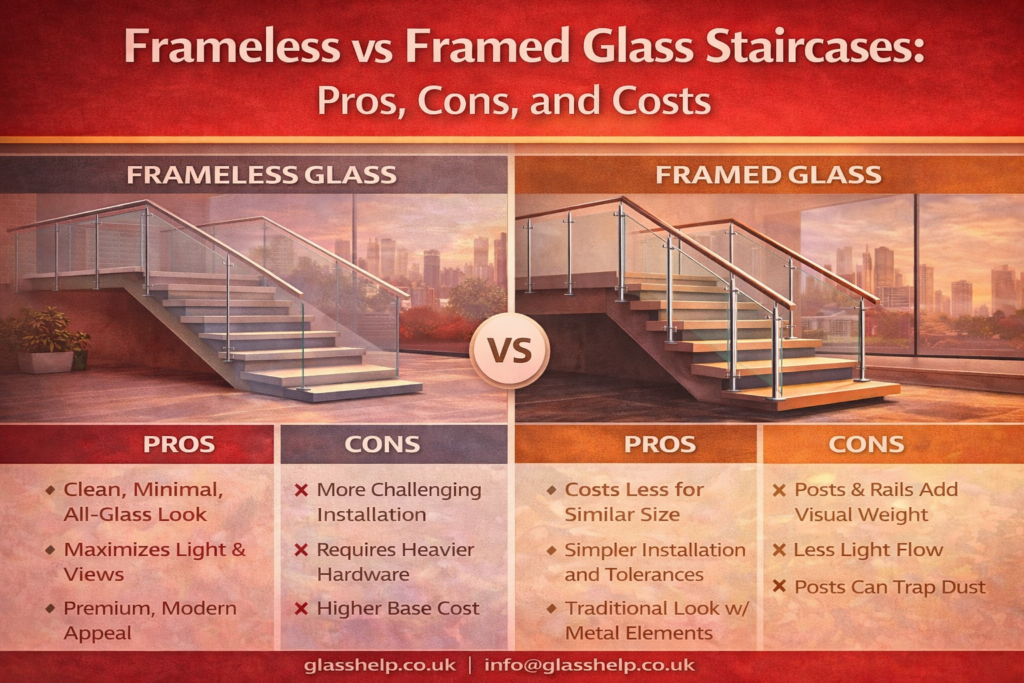
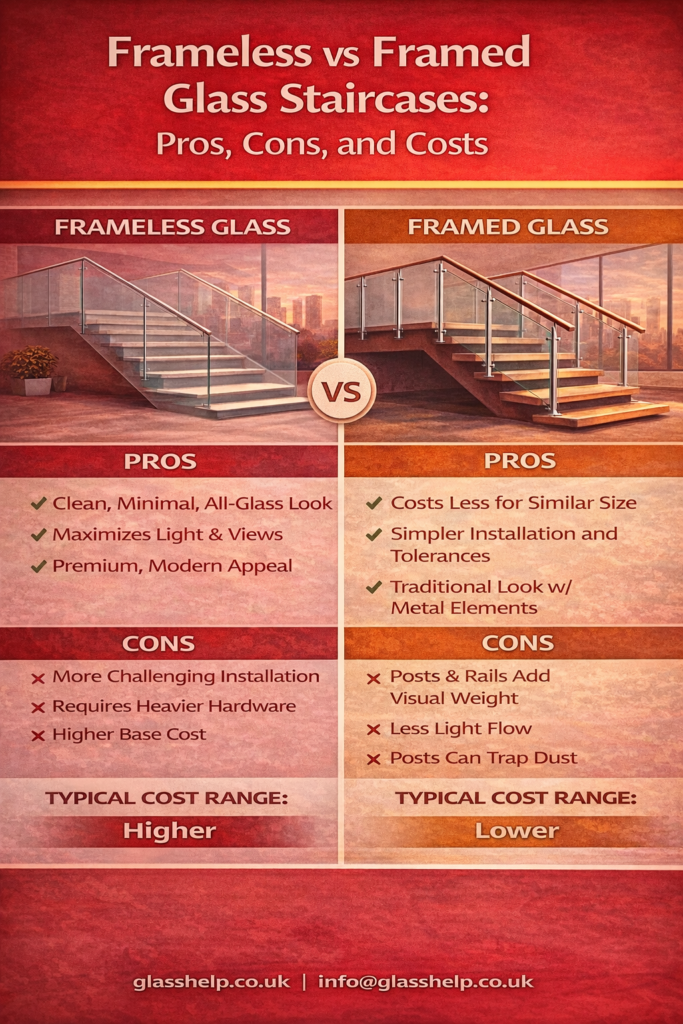
Glass staircases instantly modernize a space. They brighten interiors, open up sightlines, and create a “floating” feel that traditional spindles and bulky rails can’t match. But when you start planning a real project, the biggest decision usually isn’t “glass or not”—it’s frameless vs framed.

Both options can be safe, strong, and building-code compliant when specified correctly. The difference is how the glass is supported, how it looks day-to-day, how much it costs, and what you’ll maintain over the years.

This buyer-friendly guide explains the differences in plain English, including practical pros/cons, realistic cost drivers, and what to ask before you order.


What “frameless” and “framed” mean in real staircase builds

Frameless glass staircase (rail/balustrade)

A frameless glass staircase usually means the glass panels have minimal visible support—no chunky posts every few inches. The glass is typically held in place by:

  • Base channels (base shoe) fixed into the stair/landing structure
  • Spigots / clamps / concealed fixings, depending on the design

This delivers the cleanest “all-glass” look, but it relies on precision installation and often heavier-duty hardware. whitemetal.co.uk+1

Framed glass staircase (rail/balustrade)

A framed glass staircase has a visible supporting structure—usually:

  • Metal posts (uprights)
  • A top rail and/or side framing
  • Glass used as infill panels inside the frame

It’s still modern and premium, but the frame adds visible lines and support.


Visual impact: which looks better?

Choose frameless if you want:

  • The most open, uninterrupted view
  • Maximum light flow (especially in tight hallways)
  • A true “luxury minimal” style

Frameless is the look most people imagine when they say “glass staircase.”

Choose framed if you want:

  • A modern look with more visible structure
  • A staircase that visually “matches” other metal elements (handrails, industrial features)
  • Slightly more traditional proportions (posts can make a space feel grounded)

Safety and strength: which is safer?

When built correctly, both can be safe. The bigger difference is how they behave and what they rely on:

Frameless safety realities

  • Relies heavily on the base/channel/fixings and what they’re anchored into
  • Demands accurate alignment; small errors can show and can reduce performance
  • Often needs higher-grade hardware choices (especially outdoors)

A key point from installation guidance is that a balustrade is only as strong as what it’s fixed into—structure matters as much as glass. whitemetal.co.uk

Framed safety realities

  • The frame provides additional mechanical support and may feel sturdier to some users
  • Generally more forgiving if the building substrate isn’t perfectly flat
  • Posts/rails can simplify load transfer and installation

Bottom line: neither is “automatically safer.” Safety comes from:

  • correct glass specification (toughened/laminated where needed),
  • correct fixing system,
  • correct installation to the right loads for your location.

Maintenance: cleaning and long-term upkeep

Frameless maintenance

Pros

  • No posts to trap dust every few inches
  • The “glass wall” is easy to wipe in long runs

Cons

  • Any misalignment or unevenness is more noticeable
  • Base channels and exposed fixings need occasional inspection
  • Outdoors: you must be careful about corrosion-resistant hardware selection

Framed maintenance

Pros

  • Rails and posts can hide minor imperfections and alignment tolerances
  • Some framed systems allow easier panel replacement in modular sections

Cons

  • More surfaces to clean (posts, rails, corners)
  • If painted/powder-coated, you may eventually touch up chips/scratches

Costs: what you can realistically expect (and what drives price)

Pricing varies by layout, glass height, hardware choice, and site conditions—but it’s still useful to understand typical patterns.

A UK price guide comparing glass balustrade systems notes that framed options are typically cheaper per linear metre than frameless, while frameless systems cost more due to premium hardware and installation demands. Class Glass Limited

Typical cost pattern (UK-style guidance)

  • Framed glass balustrades: usually lower cost range
  • Frameless glass balustrades: typically higher cost range Class Glass Limited

Why frameless costs more:

  1. More expensive mounting systems (base channels, precision clamps, concealed fixings)
  2. More demanding labour/installation
  3. Higher “fit and finish” expectations (because everything is visible)

Why framed can cost less:

  1. Posts/rails can reduce reliance on heavy base channels
  2. Install tolerances are often more forgiving
  3. Simpler site conditions can reduce labour time

Practical tip: If your staircase run is complex (turns, winders, landings, angled transitions), the labour portion can rise quickly for frameless systems because alignment is everything.


Which one is best for your staircase?

Pick frameless if:

  • Your priority is the cleanest possible look
  • You have a solid substrate (concrete or properly reinforced structure)
  • You want a premium “architectural” finish and you’re okay paying more
  • You’re working with an experienced installer who does frameless systems regularly whitemetal.co.uk+1

Pick framed if:

  • You want glass + modern style but with better cost control
  • You want extra visible structure (especially for family homes or high-traffic stairs)
  • You expect simpler installation and easier future modifications
  • Your design suits posts/rails (industrial, mixed materials, classic-modern)

What to ask before you buy (avoid expensive surprises)

Use these questions when comparing quotes:

  1. What fixing system is included? (base channel, spigots, clamps, posts)
  2. What is the substrate and how will it be reinforced? (critical for frameless) whitemetal.co.uk
  3. Is the quote supply-only or supply + install?
  4. What’s included in finishing? (end caps, trims, cover plates, rail finish)
  5. What’s the plan for corners, turns, and stair angles?
  6. What warranty covers hardware corrosion and installation movement?
  7. How will the installer handle tolerances and leveling? (especially frameless)

A helpful starting point for your design choices

If you’re still comparing layouts, glass styles, and staircase configurations, start here and shortlist the look you want first. It’ll also make supplier conversations much easier:

👉 Explore glass staircase options here (use it for style + configuration planning):
https://www.glasshelp.co.uk/glass-staircase/ Glass Help


Conclusion

Frameless glass staircases deliver the cleanest, most high-end look—but they usually cost more and demand more precision in structure and installation. Framed glass staircases are often more budget-friendly, can be simpler to install, and still look modern and premium—just with visible posts/rails.

DIY Guide

How to Maintain Wall Mirrors: Cleaning, Polishing, and Scratch Prevention

Dec 15, 2025

Wall mirrors are not only functional but also enhance the aesthetic appeal of your home. Whether it’s in the living room, bathroom, or hallway, mirrors add depth, light, and style. However, dust, smudges, scratches, and moisture can diminish their clarity and beauty over time. Proper maintenance ensures that your mirrors remain sparkling and pristine for years.

This guide covers cleaning techniques, polishing tips, scratch prevention strategies, and general maintenance practices to help your mirrors stay in top condition.


1. Cleaning Wall Mirrors Properly

Regular cleaning is the cornerstone of mirror maintenance. Using the wrong tools or products can damage the reflective surface.

Recommended Cleaning Supplies

  • Microfiber cloths: Soft and lint-free, ideal for preventing scratches
  • Glass cleaner: Alcohol-based or ammonia-free cleaners work best
  • Distilled water: Minimizes streaks caused by mineral deposits
  • Soft cotton pads or paper towels: Optional for buffing, but microfiber is preferred

Cleaning Steps

  1. Dust First: Use a soft cloth to remove dust before applying liquid cleaner.
  2. Spray Cleaner on Cloth: Avoid spraying directly onto the mirror to prevent liquid from seeping behind the glass and damaging the backing.
  3. Wipe in Circular Motions: Gently clean the surface, paying attention to edges.
  4. Buff for Shine: Use a dry microfiber cloth to remove streaks.

Tip: For mirrors in humid areas like bathrooms, use a moisture-resistant or tempered mirror to minimize water damage. (GlassMirrorPro Wall Mirrors)


2. Polishing Wall Mirrors

Polishing enhances the reflective quality of your mirror and removes minor smudges or streaks.

Steps for Polishing

  1. Use a soft microfiber cloth
  2. Apply a small amount of vinegar and water solution (50/50) or a specialized glass polish
  3. Rub gently in circular motions
  4. Buff with a dry cloth until the surface gleams

Pro Tip: Avoid abrasive polishes or scrubbing pads, as these can scratch the glass or damage coatings.


3. Preventing Scratches on Wall Mirrors

Scratches are one of the most common problems with mirrors, but they can be minimized with careful handling.

Scratch Prevention Tips

  • Use soft cleaning cloths: Avoid paper towels with rough fibers
  • Avoid harsh chemicals: Ammonia-heavy or acidic cleaners can etch the glass over time
  • Be mindful of jewelry and accessories: Bracelets, rings, or watches can scratch edges when cleaning
  • Keep mirrors away from high-traffic zones: Accidental bumps can cause nicks or scratches

For Minor Scratches

  • Use cerium oxide or glass polish with a microfiber cloth to reduce the appearance of fine scratches
  • Always test on a small area first


4. Protecting the Edges and Backing

The edges and backing of a mirror are often the most vulnerable areas. Moisture can seep in, causing black spots or corrosion.

  • Seal edges if exposed to humidity
  • Avoid direct water contact on the mirror backing
  • For bathrooms or high-moisture areas, consider tempered or moisture-resistant mirrors to prevent damage (GlassMirrorPro Wall Mirrors)

5. General Maintenance Tips

  1. Regular Dusting: Prevents buildup that can scratch the surface when wiped
  2. Avoid Excessive Heat: Do not place mirrors near heating vents
  3. Check Mountings: Ensure wall anchors and brackets are secure
  4. Use Protective Coatings: Anti-fog or moisture-resistant coatings extend mirror life in bathrooms
  5. Avoid Pressure on Edges: Never press hard on corners or edges, as this can weaken the glass

6. When to Call a Professional

Even with careful maintenance, mirrors may develop larger scratches, cracks, or frame damage over time. Consult a professional for:

  • Polishing deep scratches
  • Replacing mirror backing
  • Re-mounting heavy or large wall mirrors

Professional services ensure that your mirror remains safe and functional without causing further damage.


Conclusion

Maintaining wall mirrors is essential for keeping them clear, shiny, and damage-free. By following proper cleaning, polishing, and scratch prevention techniques, you can enjoy crisp reflections and long-lasting beauty in your home.

For high-quality wall mirrors that are durable, stylish, and suitable for any space, check out GlassMirrorPro’s wall mirror collection. Their mirrors are designed for both aesthetic appeal and longevity, making maintenance easier and your home brighter.

DIY Guide

Tempered Glass Thickness Guide: 6mm, 8mm, 10mm & More

Dec 15, 2025

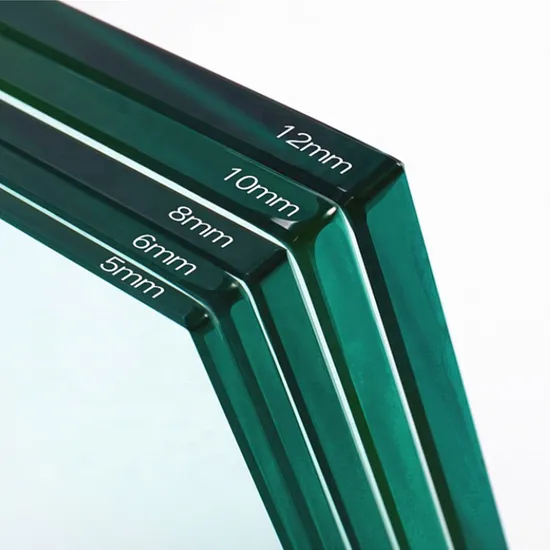
Choosing the correct tempered glass thickness is one of the most important decisions in any glass project. Whether you’re installing a shower enclosure, glass table top, balcony railing, or commercial partition, thickness directly affects strength, safety, performance, and longevity.

This comprehensive guide explains 6mm, 8mm, 10mm, 12mm, and thicker tempered glass options, where each thickness is best used, how load and safety factors work, and how to choose the right one for your application.


What Is Tempered Glass and Why Thickness Matters

Tempered glass—also known as toughened glass—is heat-treated safety glass that is 4 to 5 times stronger than ordinary annealed glass. The tempering process creates compressive stress on the surface, making it more resistant to impact and thermal shock.

However, thickness still plays a critical role:

  • Thicker glass = higher load capacity
  • Thicker glass = better rigidity and less flex
  • Thicker glass = improved safety in structural applications

For many residential and commercial projects, builders choose tempered glass cut to size so thickness, dimensions, and edge finishes match exact requirements.

For a deeper understanding of safety glass behavior, the Glass Association of North America explains how thickness impacts strength and compliance:
👉 https://www.glass.org/glass-education/what-is-safety-glass


6mm Tempered Glass (¼ Inch): Lightweight & Practical

Best Uses

  • Cabinet doors
  • Interior partitions
  • Small shelves
  • Decorative panels
  • Low-impact windows

Strength & Performance

6mm tempered glass is roughly 4x stronger than 6mm annealed glass, making it suitable for light-duty applications. However, it is not recommended for load-bearing or structural use.

Pros

✔ Lightweight
✔ Affordable
✔ Easy to install
✔ Clean, minimal appearance

Limitations

✘ Not ideal for large spans
✘ Can flex under pressure
✘ Limited impact resistance compared to thicker options

Typical applications: interior glazing where aesthetics matter more than structural strength.


8mm Tempered Glass (5/16 Inch): Balanced Strength

Best Uses

  • Shower doors
  • Medium glass shelves
  • Table tops
  • Office partitions
  • Balustrade infill (non-structural)

Strength & Performance

8mm tempered glass offers noticeably improved rigidity over 6mm and is one of the most popular thicknesses for residential use.

It provides a good balance between strength, weight, and cost—especially in bathrooms and living spaces where safety matters.

Pros

✔ Good impact resistance
✔ Reduced flexing
✔ Suitable for frequent use areas

Limitations

✘ Not ideal for long unsupported spans
✘ May require framing for safety in tall installations


10mm Tempered Glass (⅜ Inch): Heavy-Duty Residential Favorite

Best Uses

  • Frameless shower enclosures
  • Glass railings (with support)
  • Glass table tops
  • Large shelves
  • Glass doors

Strength & Performance

10mm tempered glass is significantly stiffer and more resistant to bending, making it ideal for frameless designs. It is often specified for safety-critical applications in homes.

In many projects, tempered glass panels of 10mm thickness are chosen because they meet common building safety requirements while maintaining a sleek appearance.

According to architectural glass guidelines from Pilkington, thicker safety glass improves both structural stability and user safety:
👉 https://www.pilkington.com/en/global/products/product-categories/architectural-glass

Pros

✔ Excellent rigidity
✔ Suitable for frameless installations
✔ Premium look and feel

Limitations

✘ Heavier
✘ Higher cost than thinner glass


12mm Tempered Glass (½ Inch): Structural & Commercial Grade

Best Uses

  • Glass balustrades
  • Stair railings
  • Large glass doors
  • Commercial partitions
  • Outdoor glass barriers

Strength & Performance

12mm tempered glass is commonly used in structural and semi-structural applications. It provides high resistance to impact, wind loads, and human force.

In many cases, it is specified by building codes for areas where people may lean, push, or fall against glass.

The International Building Code (IBC) references safety glass requirements for guardrails and barriers:
👉 https://codes.iccsafe.org/content/IBC2021P2/chapter-24-glass-and-glazing

Pros

✔ High load capacity
✔ Minimal flex
✔ Suitable for safety barriers

Limitations

✘ Very heavy
✘ Requires professional installation


15mm–19mm Tempered Glass: Extra-Thick Specialty Applications

Best Uses

  • Structural glass floors
  • High-end commercial façades
  • Public space railings
  • Luxury furniture
  • Heavy-duty tabletops

These thicknesses are less common in residential homes but are used where maximum strength and stiffness are required.

In many cases, designers combine thickness with lamination for additional redundancy and safety.


How to Choose the Right Thickness: Key Factors

1. Load & Usage

  • Will people lean on it?
  • Will it support weight?
  • Is it subject to frequent impact?

2. Span Size

Larger glass panels require greater thickness to prevent flexing.

3. Safety Requirements

Areas like bathrooms, railings, and doors often require tempered glass sheets by building code.

4. Installation Type

  • Frameless systems require thicker glass
  • Framed systems can use thinner panels

5. Local Building Codes

Always confirm local regulations before selecting thickness.

For many home and commercial projects, using tempered glass ensures compliance with safety standards while offering durability and peace of mind.


Thickness Comparison Table

ThicknessCommon UseStrength Level
6mmCabinets, partitionsLight
8mmShowers, shelvesMedium
10mmFrameless doors, tablesHigh
12mmRailings, barriersVery High
15mm+Structural & commercialMaximum

Common Myths About Tempered Glass Thickness

❌ “Thicker glass is unbreakable”

Even thick tempered glass can break if edge damage occurs.

❌ “6mm tempered glass is unsafe”

6mm is safe when used correctly—just not for structural loads.

❌ “All applications need the thickest glass”

Over-specifying increases cost and weight without added benefit.


Final Thoughts: Choosing the Right Tempered Glass Thickness

There is no single “best” thickness—only the right thickness for the right application.

  • Use 6mm–8mm for light interior applications
  • Choose 10mm for frameless residential designs
  • Select 12mm or thicker for railings and safety barriers

Understanding tempered glass thickness helps ensure safety, durability, compliance, and long-term performance—whether you’re designing a modern home or a commercial space.

DIY Guide

How to Measure for a Custom Mirror Without Making Mistakes

Dec 14, 2025

Step-by-Step Guide to Perfectly Fitting Custom Mirrors

Custom mirrors can transform a space, enhancing light, creating a sense of openness, and adding style. However, even the most beautiful custom mirror will fail to impress if it doesn’t fit your wall perfectly. Accurate measurement is essential for both functionality and aesthetics.

This guide walks you through step-by-step measurement techniques, common mistakes to avoid, and tips for ensuring your custom mirror fits flawlessly.

For high-quality custom mirrors crafted to your exact specifications, visit:
👉 Custom Mirrors for Home Interiorshttps://www.glassmirrorpro.com/custom-mirrors/


🔹 Why Accurate Measurements Matter

Incorrect measurements can lead to:

  • Ill-fitting mirrors that require re-cutting or replacement
  • Unsightly gaps around the frame or wall edges
  • Misaligned mirrors above vanities, cabinets, or furniture
  • Wasted money and time

Custom mirrors are made exactly to your specifications, so precise measurement is essential for a perfect installation (hgtv.com).


📏 Tools You’ll Need

To measure accurately, gather the following:

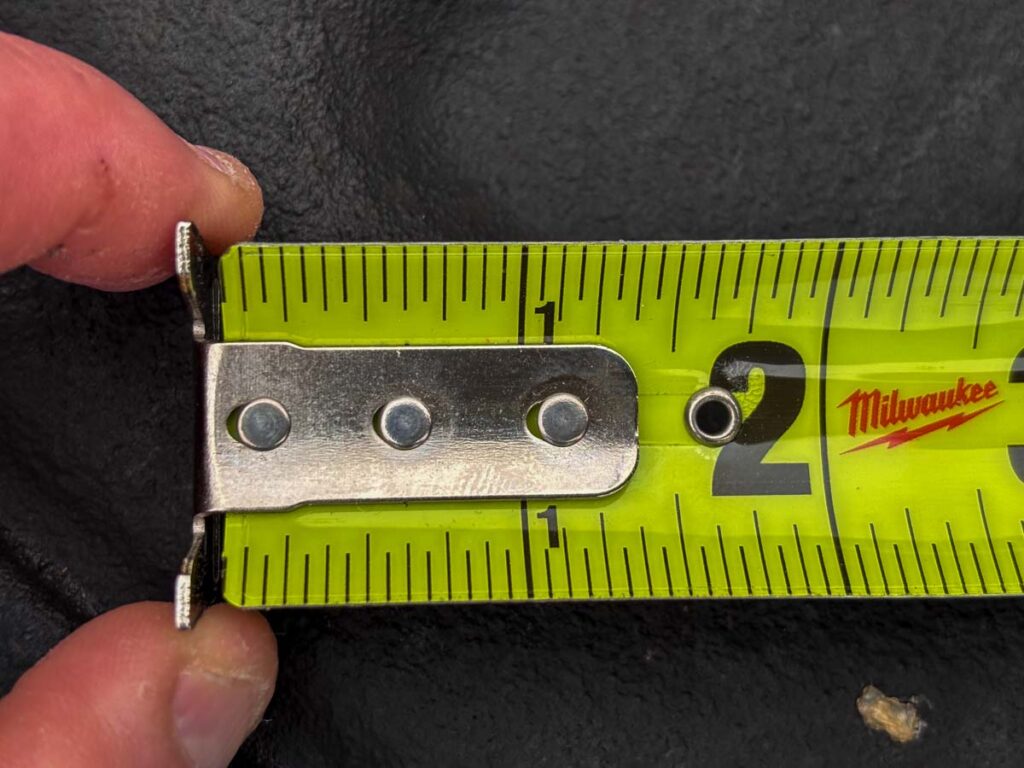
  • Tape measure (metal, retractable, minimum 16–25 feet)
  • Level (to ensure horizontal alignment)
  • Pencil or painter’s tape (for marking wall reference points)
  • Paper and pen (to record measurements)
  • Step ladder (for high placement measurements)

🪞 Step 1: Determine Mirror Placement

Before measuring, decide:

  • The exact wall where the mirror will go
  • The height from the floor for center alignment
  • Any fixtures, switches, or outlets nearby that might affect placement

Tip: For bathroom vanities, the mirror center is usually 57–65 inches from the floor (elledecor.com).


🪜 Step 2: Measure Width and Height

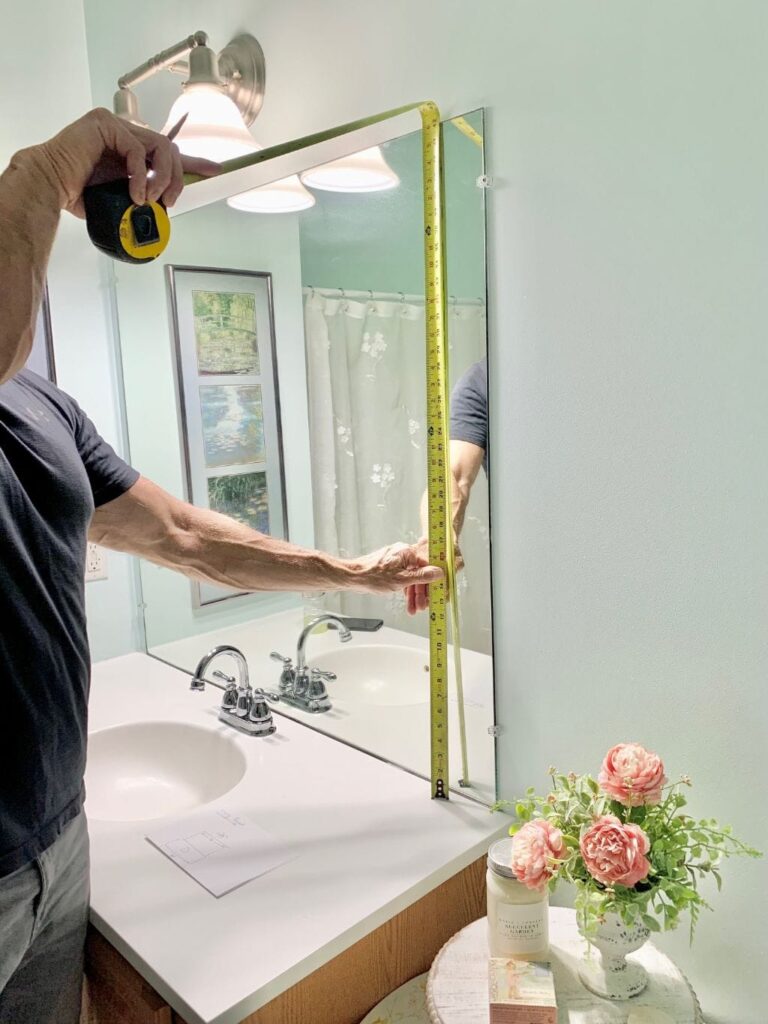
  1. Width: Measure the available wall space horizontally.
    • For vanity mirrors, aim for two-thirds the width of the vanity for balance (hgtv.com).
  2. Height: Measure from the floor to the top edge of the desired mirror position.
    • Ensure it doesn’t interfere with light fixtures or shelves.
  3. Double-Check: Always measure twice, from both left-to-right and top-to-bottom, to avoid errors.

🪞 Step 3: Account for Obstacles

Consider nearby elements:

  • Light switches or outlets — mark positions and avoid placing mirrors over them
  • Cabinet edges or moldings — ensure there’s enough clearance
  • Windows — reflect light effectively without blocking natural views

📐 Step 4: Mark the Reference Points

Use painter’s tape or light pencil marks to outline the mirror on the wall.

  • This visual guide helps you see how it fits in the space
  • Allows adjustments before ordering the custom mirror

Tip: Take photos of the markings for reference when placing your order.


🧰 Step 5: Choose a Frame or Edge Style

For framed mirrors, include frame thickness in your measurements to avoid surprises.

  • Frameless mirrors: measure exactly the visible glass area
  • Framed mirrors: add frame width to the overall dimension

✅ Step 6: Verify Diagonal Measurements

To ensure the wall isn’t slightly skewed, measure corner-to-corner diagonally.

  • If diagonals differ, the wall isn’t perfectly square
  • Communicate the discrepancy to your mirror fabricator (hgtv.com)

This ensures a precisely cut mirror that sits flush against the wall.


❌ Common Mistakes to Avoid

  1. Measuring only once — always double-check
  2. Ignoring wall irregularities — walls may not be perfectly flat or square
  3. Not accounting for frame thickness
  4. Assuming symmetry — some spaces have uneven walls or ceiling slopes
  5. Relying on estimates — use tape measure and level, not guesswork

🌟 Step 7: Communicate Measurements Clearly

Provide your exact measurements to the manufacturer, along with:

  • Placement references (height from floor, wall edges)
  • Desired orientation (portrait or landscape)
  • Edge details (beveled, polished, or framed)
  • Any cutouts for lighting, outlets, or fixtures

Tip: Send photos of the wall space to ensure accurate understanding (elledecor.com).


🧼 Step 8: Installation Considerations

  • Use level and stud-finding tools for mounting
  • Heavy custom mirrors may require additional brackets or anchors
  • In bathrooms, moisture-resistant adhesives or mounts are recommended (hgtv.com)

💡 Final Tips

  • Always measure multiple times to prevent ordering errors
  • Consider room lighting and reflections when determining height and width
  • Take into account furniture, cabinetry, and wall features
  • For complex spaces, consult a professional installer or the mirror manufacturer

A perfectly measured mirror ensures both style and functionality, making your bathroom, bedroom, or living space look polished and professionally designed.


🔗 Explore Custom Mirror Options

For custom mirrors crafted to your exact measurements and style, visit:
👉 Custom Mirrors for Home Interiorshttps://www.glassmirrorpro.com/custom-mirrors/

DIY Guide

Glass Frosting Techniques: DIY vs Professional Installation

Dec 14, 2025

Complete Guide to Methods, Benefits & Best Practices

Glass frosting transforms ordinary transparent glass into a translucent, privacy‑enhancing surface that still allows light to pass through. It’s widely used in bathrooms, doors, partitions, windows, and decorative installations for both functional and aesthetic purposes.Wikipedia

But if you’re considering a glass frosting project, you may be wondering:

  • What frosting techniques are available?
  • Which methods are DIY‑friendly?
  • When should you hire a professional?
  • What are the long‑term outcomes of each approach?

This guide breaks down DIY vs professional glass frosting techniques, highlighting how they differ in durability, look, safety, cost, and skill needed.


🔎 What Is Glass Frosting?

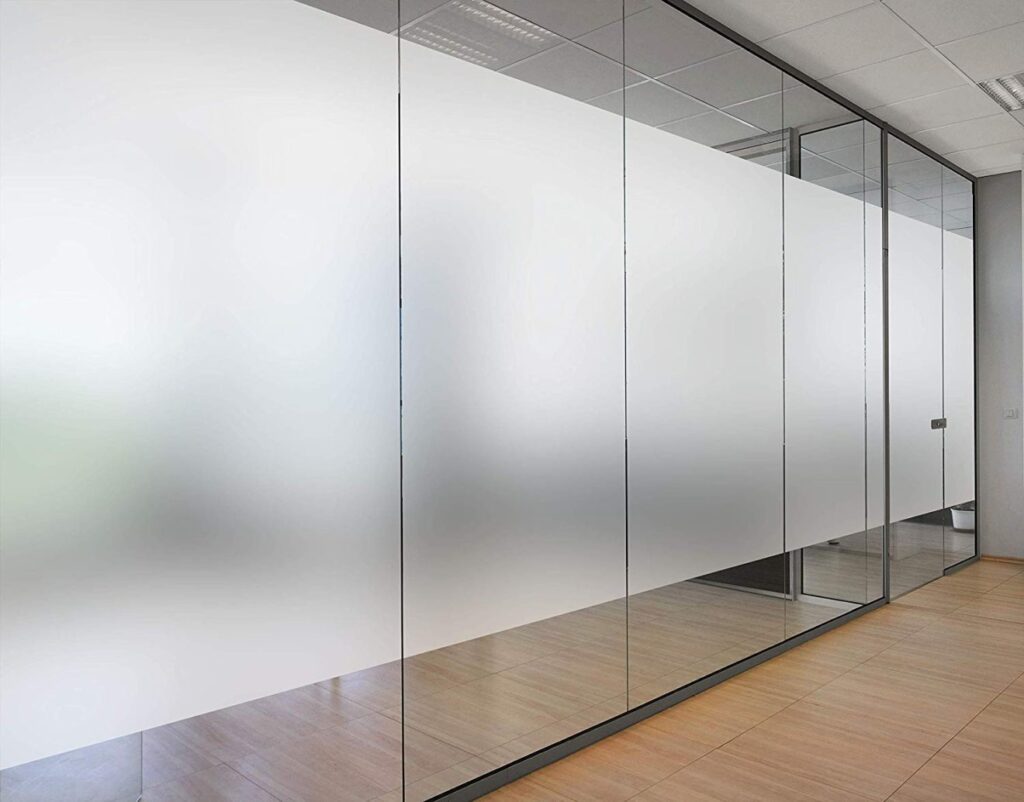
Glass frosting refers to any technique that alters the surface of clear glass to make it light‑diffusing and translucent, obscuring direct visibility while still letting light through. Traditional professional methods include acid etching and sandblasting, while DIY methods include films, sprays, and etching cream.Wikipedia


🛠️ DIY Glass Frosting Techniques

DIY techniques are great options if you want a quick, budget‑friendly solution or are trying glass frosting for the first time.

🧰 1. Frosted Window Film

A self‑adhesive film that mimics the frosted look is one of the simplest DIY options. It’s removable and reusable, making it ideal for rentals or temporary privacy improvements. Installation involves cutting to size, wetting the glass, and smoothing the film into place to avoid bubbles.Angi

Pros:

  • Inexpensive and quick
  • Removable and less permanent
  • Great for rental properties or seasonal changes

Cons:

  • Can peel over time
  • Bubbles or edges may appear if not installed perfectly

🎨 2. Frosted Glass Spray Paint

Frosted glass spray provides a uniform, semi‑permanent frosted finish that looks more integrated than film. It’s easy to apply and dries quickly, making it a popular choice for interior glass panels, doors, or small windows.Angi

Pros:

  • Affordable
  • Easy for beginners
  • Works on curved or small surfaces

Cons:

  • Not as durable as etched or sandblasted glass
  • Finish may peel or scratch over time

🧪 3. Etching Cream (Milder DIY Option)

Glass etching cream chemically reacts with the surface of glass to create a permanent frosted finish. DIY etching creams are available at craft and hardware stores, and they can make attractive frosted panels when used with stencils.Glassy India

Pros:

  • Permanent frosting
  • Works well with simple designs or patterns

Cons:

  • Chemicals require careful handling
  • Not as precise or textured as professional methods

🍽️ 4. Homemade or Novel Techniques

Some DIYers experiment with techniques like cornstarch pastes or salt solutions to create temporary frost effects for small decorative projects. While creative, these aren’t ideal for long‑lasting or performance‑critical installations.Checkatrade


🏆 Professional Glass Frosting Techniques

Professional methods produce durable, consistent, high‑quality finishes that are ideal for architectural elements or spaces where longevity matters.

🔧 1. Acid Etching

Acid etching uses chemical solutions (often including hydrofluoric acid mixtures) to permanently alter the glass surface, creating a smooth, uniform frosted appearance. This method works well for both full coverage and detailed designs.Rocketroseat

Benefits:

  • Smooth, uniform frost
  • Permanent and durable
  • Excellent for decor and privacy

Considerations:

  • Requires specialized materials and safety gear
  • Best done by experienced professionals

🔨 2. Sandblasting (Abrasive Blasting)

Sandblasting propels fine abrasive particles at the glass under high pressure to erode the surface and create a frosted appearance. It can also produce intricate designs and variable texture depths, making it a top choice for custom architectural projects.Glassy India

Benefits:

  • Highly customizable
  • Can create deep textures and layered effects
  • Durable and long‑lasting

Considerations:

  • Requires industrial equipment and expertise
  • Not suitable for home tools without training

🖨️ 3. Ceramic Frit and Silk Screen Printing

A more specialized professional technique involves screen printing ceramic frit onto glass and firing it in a kiln, resulting in precise, permanent patterns. This technique is common in architectural glass used in commercial buildings and high‑end homes.Sans Soucie Art Glass

Benefits:

  • Extremely precise and decorative
  • Durable under heavy use

Considerations:

  • Usually more expensive
  • Not typical for basic interior glass frosting

📊 Comparing DIY vs Professional Frosting

Here’s a quick look at how DIY techniques stack up against professional methods:

FeatureDIY TechniquesProfessional Frosting
Cost⭐⭐⭐⭐ (Low)⭐⭐ (Higher)
Durability⭐⭐⭐⭐⭐⭐
Precision & Finish Quality⭐⭐⭐⭐⭐⭐
Safety Requirements⭐⭐⭐ (Lower)⭐⭐ (Higher)
Design Flexibility⭐⭐⭐⭐⭐⭐⭐
Best ForTemporary, decorative projectsPermanent, architectural uses

🧠 Which Technique Should You Choose?

🔹 Consider DIY When:

✔ You’re on a budget
✔ You want a non‑permanent solution
✔ You’re frosting small, interior areas
✔ You enjoy creative hands‑on projects

Options like frosted film and spray give excellent results for casual or decorative upgrades.Angi


🔹 Consider Professional Methods When:

✔ You need long‑lasting, durable frosting
✔ Frosting large or structural panels
✔ Frosting in areas subject to wear or weather
✔ You want custom designs or intricate patterns

Professional techniques like acid etching and sandblasting deliver results that withstand time and traffic far better than most DIY approaches.Glassy India


🔧 Safety Considerations

Any frosting technique involving chemicals or abrasive blasting requires proper safety precautions:

  • Wear eye protection, gloves, and ventilation gear
  • Follow manufacturer instructions closely
  • Work in a well‑ventilated area

DIY etching creams and professional etchants can be hazardous if improperly handled, so even DIYers should take safety seriously.


🔗 Enhance Your Space with Custom Frosted Glass

For high‑quality, long‑lasting architectural frost finishes — whether for privacy, design, or lighting diffusion — custom glass solutions offer superior performance and visual appeal.

👉 Custom Frosted Glass Solutionshttps://www.glassmirrorpro.com/frosted-glass/

Custom options ensure precise sizing, professional finishes, and design flexibility that DIY techniques simply can’t match.


🧩 Final Takeaways

Glass frosting isn’t a one‑size‑fits‑all proposition. Your choice depends on budget, skill level, desired durability, and how permanent you want the result to be:

DIY methods — affordable and accessible, ideal for decorative or temporary projects.Angi
Professional techniques — more expensive upfront but deliver unmatched quality, customization, and permanence.Glassy India

With the right technique, frost your glass with confidence — whether you’re adding privacy to interior doors or creating architectural statement pieces.

DIY Guide

How to Measure for Custom Glass Shelves the Right Way

Dec 13, 2025

A step‑by‑step, user‑oriented guide to measuring accurately so your custom glass shelves fit perfectly — no surprises, no ill‑fitting pieces.

Getting the measurements right is the most important step before ordering custom glass shelves. Even a small error can lead to shelves that are too tight, won’t fit bracket systems, or wobble once installed. Glass isn’t easily modified once cut, so careful measuring saves time, money, and stress.

👉 When you’re ready to order shelves that match your exact dimensions, check out professionally cut options here:
https://www.glassmirrorpro.com/glass-shelves/


Why Accurate Measurement Matters

Glass used for shelves — especially tempered safety glass — is cut precisely to size, and once cut it can’t be trimmed or resized without losing its strength or safety certification. Submitting precise measurements ensures:

✔ The shelf fits your space
✔ Brackets or supports align correctly
✔ You avoid costly returns or re‑orders
✔ The final installation looks professional and functions safely

Even walls that look straight might be irregular, so measuring carefully today avoids hassles later. SHELFIX


What Tools You’ll Need Before You Start

Before measuring:

  • Tape measure (metal preferred, at least 2–3 m/6–10 ft)
  • Pencil and notepad or smartphone notes
  • Level (optional but helpful if installing shelving hardware)
  • Helper (useful for larger or deeper shelf areas) SHELFIX

1. Measure Wall Width (Left to Right)

When measuring where the shelf will sit:

  1. Measure the distance from the left wall to the right wall at the height where the shelf will be installed.
  2. Do this in three places: near the bottom, middle, and top — because walls are rarely perfectly straight.
  3. Use the smallest measurement as your maximum width — this prevents ordering a shelf that’s too big to fit in a narrower section. SHELFIX

Pro Tip: If you measure, for example, 36 in at the bottom, 36 ⅛ in in the middle, and 36 ¼ in at the top, choose 36 in as your base. Then subtract a small clearance (see Step 3). SHELFIX


2. Measure Depth (Front to Back)

Next, measure how deep you want the shelf:

  1. Place one end of the tape at the back wall.
  2. Measure out toward where the front edge of the shelf will be.
  3. Take this measurement in a few spots (left, centre, right) to ensure it’s consistent.

Think about the function of the shelf — deeper shelves work for display or storage, but may reduce usable floor space or interfere with doors/drawers. SHELFIX


3. Allow for Clearance and Fit Tolerance

If you make your custom shelf exactly the same size as the measurement, it might be too tight to install or get wedged in a space.

  • Subtract a small clearance (e.g., around 3 mm / ⅛ in) from your width and depth to allow easy installation.
  • This accounts for wall irregularities, paint thickness, or mounting hardware tolerances. Resident Magazine

For example:
If measured width = 901 mm, the ordered shelf might be 898–899 mm for smooth fit and ease of placement.


4. Mark and Note Obstructions

Before finalising measurements:

✔ Check for baseboards, tiles, picture frames, plugs, pipework, or vents that might interfere with shelf fit.
✔ If there’s a window sill, door frame, or trim in the way, measure its relevant distance and note it separately.
✔ In niches or alcoves, walls may slope or bow — that means you may need individual measurements at top, middle, and bottom to choose how the shelf sits. SHELFIX

Taking photos of the area with measurement notes can also be very useful when communicating with a glass supplier.


5. Measure for Brackets and Supports

If your custom glass shelf will be mounted with brackets or shelf pins, you also need:

  • Bracket spacing — the horizontal distance between centres of each support.
  • Pin diameter or slot width — some brackets are made specifically for certain glass thicknesses and need matching hole or slot measurements.

Tell your supplier the exact bracket type and measurements so they can adjust hole positions or edge clearances accordingly.

Tip: Many custom glass suppliers can add pre‑drilled holes or cut notches based on these measurements, making installation easier and safer. Prad Glass


6. Check Vertical (Height) Commitment

If custom shelves stack vertically or go from floor to ceiling:

  • Measure from floor to lowest obstruction (e.g., windowsill) first.
  • Then measure upward from that point to where the next shelf will sit.
  • Leave enough spacing between shelves for what you plan to store (e.g., towels, books, display items). SHELFIX

This ensures that shelves don’t sit too close together or awkwardly cut into usable space.


7. Draw a Simple Diagram

Before finalising your numbers, sketch:

✔ Wall outline
✔ Shelf width and depth
✔ Locations of brackets
✔ Obstacles (plugs, trims)

Visualising helps confirm you didn’t miss anything and makes it much easier when placing your custom order.


8. Write Down and Double‑Check Dimensions

Once measured:

✔ Write each measurement clearly — e.g.,
”Shelf size: 900 mm (W) × 250 mm (D)”
✔ Double‑check each one.
✔ Verify clearances and allowance for tolerance.
✔ Confirm bracket dimensions if relevant.

Measure twice, order once — especially important for glass because it cannot be resized after cutting. Resident Magazine


9. Special Notes for Irregular Spaces

For areas like alcoves or spaces that aren’t perfectly rectangular:

  • Consider making a cardboard or paper template first to test fit.
  • Use this template to check the real fit before ordering glass.
  • Where walls slope, take top and bottom measurements and decide which side to use, or consult your supplier for tapered shelves. SHELFIX

10. Communicate Clearly With Your Supplier

When submitting measurements to a custom glass supplier:

✔ Include width, depth, thickness, and any holes/notches
✔ Specify clearance tolerance you want
✔ Mention bracket or support type if relevant
✔ Note room type (bathroom, kitchen) if humidity is involved

Clear communication reduces errors and ensures the final product fits perfectly.


Final Tips for Custom Glass Shelving

  • Always round down to account for minor irregularities. SHELFIX
  • Measure flat against the wall for depth. SHELFIX
  • Use a level to ensure bracket placement is even. SHELFIX
  • Avoid guessing — walls and cabinets aren’t always square.

Ready to Order Your Custom Glass Shelves?

Once your measurements are accurate and clear, you can confidently order custom glass shelving tailored to your space:
👉 High‑quality, made‑to‑size glass shelves
https://www.glassmirrorpro.com/glass-shelves/


Summary: Key Measurement Steps

  1. Measure width at multiple points — use the smallest. SHELFIX
  2. Measure depth from the back wall outward. SHELFIX
  3. Allow clearance for tolerance and wall irregularities. Resident Magazine
  4. Check for obstructions and mark bracket positions. SHELFIX
  5. Double‑check everything before ordering. Resident Magazine

Accurate measurement leads to glass shelves that fit beautifully — and last for years.

DIY Guide

Common Glass Shelf Installation Mistakes (And How to Avoid Them)

Dec 13, 2025

Glass shelves look beautiful and can add practical storage to bathrooms, kitchens, living rooms, and offices — but installing them incorrectly can lead to aesthetic problems, reduced load capacity, damaged walls, or even glass breakage. Knowing the typical mistakes and how to avoid them ensures your glass shelving is safe, secure, and long‑lasting.

If you’re ready to pick your shelves or upgrade your space, start here:
👉 Glass shelves for your design and space:
https://www.glassmirrorpro.com/glass-shelves/


1. Ignoring Wall Type and Fixings

One of the most common mistakes is mounting glass shelves without considering the type of wall — plasterboard, brick, tile, or concrete all behave differently under load.

  • Drywall without proper anchors can pull out, causing shelves to sag or fall.
  • Plasterboard needs heavy‑duty anchors or toggles rated for load.
  • Masonry walls require concrete anchors.

Always match fixings to the wall material so the shelf remains secure over time. glasshelper.co.uk+1

Pro Tip: Use a stud finder if possible — mounting directly into studs is the most secure solution for load‑bearing shelves. glasshelper.co.uk


2. Misaligned Brackets and Uneven Shelves

A shelf that looks crooked is not only unattractive — it can also be structurally unsafe.

  • Not using a spirit level when marking drill points leads to uneven shelf placement.
  • Installing brackets at different heights or angles causes stress on the glass.

Before drilling, use a precision level and mark all bracket locations clearly. Minor misalignment can concentrate stress and lead to cracks later. glasshelper.co.uk


3. Choosing Incorrect Glass Thickness

Too thin a shelf will flex or bow, especially with heavier items or longer spans.

  • Shelves under 8 mm thickness are often unsuitable for general use and can sag under moderate loads.
  • For most household shelving, 8–10 mm tempered glass is a safe starting point.
  • Wider yet heavier shelves may need thicker glass or extra support to prevent bending. glasshelper.co.uk

Always consult your glass supplier for recommended thickness based on span and load.


4. Improper Bracket Spacing

Glass shelves rely heavily on support distribution:

  • Placing brackets too far apart increases the risk of flexing or stress fractures.
  • A good rule of thumb is keeping bracket spacing within 40–60 cm for typical domestic shelves.
  • For heavier loads or larger spans, consider additional supports or closer spacing. Quality Glass Fittings LTD

Better distribution reduces stress on the glass and increases stability.


5. Overloading the Shelf

Every glass shelf has a load limit — and placing too many heavy items can lead to failure.

  • Glass is strong under uniform loads but weak if weight is concentrated on one side.
  • Avoid stacking heavy objects like books or large ceramics at the edge.

Distribute weight evenly and heed manufacturer load limits for safety. glasshelper.co.uk


6. Not Using the Right Brackets for Glass

Not all shelf brackets are created equal — especially for glass shelves:

  • Brackets should match glass thickness. A bracket made for 6 mm glass won’t securely hold 10 mm glass, and vice versa.
  • Glass‑specific clamps are designed to grip and support glass safely, often with rubber buffers to protect edges.
  • Waterproof or rust‑resistant brackets are essential in humid areas like bathrooms. Tidy Home Guide

Using generic brackets may look okay initially but can fail over time.


7. Using Inappropriate Adhesives or Mounting Tape

Glass shelves should never rely on tape or basic adhesives as the primary support. These DIY methods lack:

  • Strength for heavier loads
  • Reliability under humidity or temperature changes
  • Long‑term durability

Always use mechanical fixings like screws, anchors, or bracket systems designed for glass. glasshelper.co.uk


8. Forgetting to Prepare the Surface

Dust, paint splatter, or uneven wall surfaces affect how securely brackets can be fixed.

  • Clean the surface thoroughly before drilling.
  • Sand or level uneven areas before installation.
  • If installing over tiles, use the correct masonry drill bits to avoid cracking tiles. Journeyman HQ

A prepared surface reduces the risk of damage and improves bracket adhesion.


9. Failing to Account for Thermal and Moisture Conditions

Glass itself doesn’t absorb water, but moisture can affect metal fixings and wall anchors, especially in bathrooms and kitchens.

  • Use stainless‑steel or corrosion‑resistant hardware in humid areas.
  • Avoid mounting shelves directly above heat sources (radiators or heat lamps), which can introduce thermal stress. glasshelper.co.uk

This prolongs the life of both the shelf and the mounting system.


10. Not Double‑Checking Measurements

As with all proper installations, measure twice, drill once applies here too.

  • Failing to check height, width, or levelness leads to shelves that look wrong or don’t fit properly.
  • Instead of guessing, use painters tape to mark positions, then verify before committing. Homes and Gardens

Accurate measurements also help when drilling into studs or avoiding fixtures behind the wall.


11. Neglecting Regular Inspection and Maintenance

Installation isn’t the end of the story:

  • Glass shelves should be inspected periodically for loose screws, bracket wear, or slight sagging.
  • Tighten any loose hardware if needed and clean both glass and bracket surfaces regularly to prevent corrosion or buildup. glasshelper.co.uk

Routine checks help you spot small problems before they become major ones.


12. Placing Shelves in High Traffic or Unsafe Locations

Poor placement can increase the chance of accidents:

  • Avoid low shelves where people might bump into them.
  • Don’t place shelves too close to doors or walkways where they can be hit.
  • Keep shelves high enough to avoid head bumps but low enough to reach comfortably. Homes and Gardens

Thoughtful placement enhances both safety and usability.


Final Tips to Ensure a Successful Installation

Plan ahead: Consider load, wall type, and use before ordering shelves.
Match hardware to glass thickness: Correct clamps and brackets make the installation more secure.
Build with safety in mind: Wear gloves and goggles; handle glass carefully.
Test load gently: After installation, place lighter items first to check stability.

With the right preparation and attention to detail, your glass shelves can be a beautiful, functional, and long‑lasting feature of your space.


Explore Quality Glass Shelves & Accessories

For professionally cut glass shelves, suitable hardware recommendations, and wall‑ready solutions, visit:
👉 https://www.glassmirrorpro.com/glass-shelves/

DIY Guide

How to Measure a Table Base Correctly Before Ordering a Custom Glass Top

Dec 13, 2025

Ordering a custom glass table top requires precision. One wrong measurement can lead to a table top that doesn’t fit, wobbles, or looks awkward. Whether you’re replacing an old top, upgrading a dining table, or designing a unique workspace, accurate measurement of the table base is crucial.

This guide explains how to measure a table base correctly, step by step, so your custom glass top fits perfectly.


1. Understand Your Table Type

Before taking measurements, identify the table base type, as this affects how you measure:

  • Four-legged bases: Standard rectangular or square tables.
  • Pedestal bases: Central single column supporting the table.
  • X-shaped or trestle bases: Modern designs with open frames.
  • Custom or freeform bases: Unique shapes that require precise templates.

Knowing the base type helps you understand where your glass top will rest and where clearance is needed.


2. Gather the Right Tools

To measure accurately, you’ll need:

  • Tape measure (metal or flexible)
  • Pencil and paper for notes
  • Level (optional, to ensure base is even)
  • Calculator for conversions if needed

Using accurate tools minimizes errors and ensures a perfect fit.


3. Measure Width and Length (or Diameter)

For rectangular or square tables:

  1. Measure the distance between the outer edges of the base — this is usually slightly smaller than the desired glass top to provide overhang.
  2. Add 2–5 cm (1–2 inches) on each side for overhang depending on style preference.

For round tables:

  1. Measure the diameter of the base.
  2. Decide how much overhang you want (typically 5–10 cm / 2–4 inches) and add to your measurement.

For oval tables, measure both length and width, and add the overhang allowance similarly.

Pro Tip: Overhang adds elegance and allows chairs to slide in without bumping the base.


4. Measure Base Height and Clearance

Height is just as important as width and length:

  • Measure from floor to the top of the base.
  • Ensure sufficient clearance for legs, chairs, and movement underneath.
  • Standard clearance for dining chairs is about 75 cm (30 inches) between seat and tabletop.

For pedestal or trestle tables, check side clearance and width between supporting legs to avoid interference with glass edges.


5. Account for Special Features

Some bases have unique designs or protrusions:

  • Central columns
  • Decorative beams
  • Crossbars or supports

Measure the distance between any obstacles to ensure your glass top will rest flat and stable. Note areas where glass might not touch supports directly, as this may require adhesive pads or rubber bumpers for stability.


6. Consider Glass Thickness

The thickness of your glass table top impacts both safety and aesthetics:

  • 6–8 mm: Suitable for smaller tables or low-use surfaces.
  • 10–12 mm: Recommended for larger or heavy-use tables, especially with children or pets.
  • Custom thickness may be required for very large or uniquely shaped tops.

Tip: Confirm with your glass supplier that the chosen thickness is compatible with the base.


7. Create a Template for Complex Bases

For irregular or freeform bases, creating a paper or cardboard template is highly recommended:

  1. Lay the template on the floor or table frame.
  2. Mark where the glass will rest and any overhang.
  3. Use the template to communicate exact dimensions to your glass supplier.

This method ensures that custom shapes fit perfectly.


8. Double-Check Your Measurements

Before ordering:

  • Measure each dimension at least twice.
  • Check diagonal measurements for rectangular or square bases to ensure they are square.
  • Confirm overhang allowances are consistent on all sides.

A small error can become a costly mistake, so taking the time to double-check is critical.


9. Selecting the Right Supplier

Once measurements are ready, choose a trusted glass supplier that offers:

  • Precision cutting based on exact measurements
  • Edge finishing (beveled, polished, or rounded edges)
  • Custom shapes and thickness options
  • Delivery and professional handling

Authority Reference: Table Glass Online – Glass Table Tops Guide


10. Installation Considerations

When the glass top arrives:

  • Have two people lift large or heavy panels.
  • Use adhesive pads or bumpers to prevent slipping.
  • Ensure the base is level before setting the glass.
  • Avoid dragging the glass across the base to prevent scratches.

Following these steps ensures a stable, safe, and beautiful tabletop.

Authority Reference: Fab Glass & Mirror – Glass Table Top Types


11. Explore Custom Glass Options

For high-quality custom-cut glass table tops tailored to your base:
👉 Browse custom glass table tops – GlassMirrorPro

They offer a range of finishes, shapes, and thicknesses to match any style or use.


12. Final Tips for Perfect Fit

  • Always account for overhang for both aesthetics and functionality.
  • Consider edge finishes for safety and style.
  • Communicate clearly with your supplier using exact measurements or a template.
  • Check for compatibility with chairs or stools to prevent interference.

With careful measurement, planning, and attention to detail, your custom glass top will fit perfectly, enhance your décor, and provide long-lasting durability.


Summary Checklist Before Ordering:

  1. Identify your table base type
  2. Gather proper measuring tools
  3. Measure width/length/diameter accurately
  4. Measure height and leg clearance
  5. Account for special features or obstacles
  6. Decide on glass thickness
  7. Make a template for complex shapes
  8. Double-check all measurements
  9. Choose a reliable supplier
  10. Prepare for safe installation
DIY Guide

Replacing a Broken Glass Table Top: Step-by-Step Buyer’s Guide

Dec 13, 2025

A broken glass table top can be frustrating, but replacing it doesn’t have to be complicated. With careful planning, correct measurements, and the right materials, you can restore your table to both safety and style. This guide walks you through the step-by-step process, from choosing the right replacement to installation, and provides tips to avoid common pitfalls.


Step 1: Assess the Damage

Before you start shopping for a replacement, carefully examine your broken table top:

  • Determine if the damage is partial or complete.
  • Identify the type of glass used (tempered, laminated, or standard).
  • Check for any damage to the table base or support that might affect stability.

Pro Tip: If your table used tempered glass, it’s important to replace it with tempered glass again, as it is stronger and safer than standard glass.


Step 2: Measure Your Table Correctly

Accurate measurements are critical to ensure the replacement fits perfectly:

  • Measure the length and width (or diameter for round tables).
  • Measure the thickness of the existing glass. Most table tops are between 6mm and 12mm thick.
  • If your table has curved or beveled edges, note the exact shape for the replacement.

Pro Tip: Take your measurements to a professional glass supplier to avoid errors.


Step 3: Choose the Right Type of Glass

Selecting the correct glass type ensures durability and safety:

  • Tempered Glass: Breaks into small, less dangerous pieces. Highly recommended for tables.
  • Laminated Glass: Stronger, with an interlayer that holds pieces together if broken.
  • Clear or Frosted Finish: Choose based on your décor preference.

Authority Reference: Table Glass Online – Glass Table Tops Guide


Step 4: Select a Reliable Supplier

Purchase your replacement from a reputable supplier. Consider:

  • Quality and certification of the glass.
  • Ability to cut to exact dimensions.
  • Options for custom shapes if needed.

Pro Tip: Many suppliers also offer edge finishing (polished, beveled, or rounded) which increases safety and aesthetics.

Authority Reference: Fab Glass & Mirror – Glass Table Top Types


Step 5: Prepare for Installation

Before installing your new glass top:

  • Clear the table base and surrounding area.
  • Wear protective gloves to handle the glass safely.
  • Lay the new glass on a soft, non-abrasive surface if adjusting before placement.

Step 6: Install the Replacement Glass

Carefully follow these steps:

  1. Lift the glass carefully using suction cups or with two people.
  2. Align the glass with the table base.
  3. Check stability before letting go.
  4. Secure with adhesive pads or bumpers if the table design requires it.

Pro Tip: Never drag the glass across the table surface; it may scratch or chip.


Step 7: Maintain Your New Table Top

To prolong the life of your new glass table top:

  • Clean with non-abrasive cleaners and a soft cloth.
  • Avoid placing extremely heavy objects directly on the glass.
  • Use coasters and placemats to prevent scratches and stains.

Step 8: When to Call Professionals

Some situations require professional help:

  • Custom-shaped glass tops or unusual sizes.
  • Damage to the table base or supports.
  • Tempered glass replacements (for safety compliance).

Pro Tip: Professional installers can also polish edges or add protective finishes.


Explore Replacement Options

For professional guidance and a wide range of glass table tops, including custom and standard sizes, visit Glass Table Top Options by Glass Mirror Pro.


Final Thoughts

Replacing a broken glass table top can be simple if you follow these steps carefully: assess damage, measure accurately, select the correct glass type, and handle installation with care. By choosing the right supplier and maintaining the new glass properly, your table will look great and remain safe for years.

Design Tip: Always use tempered glass for dining tables and work surfaces — it maximizes both strength and safety.