Shelves

Shelves

Tempered vs Regular Glass Shelves: What’s the Difference and Which Is Safer?

Dec 26, 2025

Glass shelves are popular in modern homes because they look clean, minimal, and let light pass through spaces. But when people order glass shelves, one of the most important (and often misunderstood) decisions is tempered glass vs regular (annealed) glass.

At first glance, both can look identical. The real difference is how they behave under stress, impact, and breakage—and that difference directly affects safety, durability, and where each type should be used.

This guide explains the differences clearly, without jargon, so you can choose the right and safest option for your home.

What Is Regular (Annealed) Glass?

Regular glass, also known as annealed glass, is standard float glass that has cooled slowly during manufacturing. This slow cooling leaves the glass in a natural, unstressed state.

Key characteristics of regular glass:

  • Smooth, clear appearance
  • Easier to cut and drill after manufacturing
  • Lower cost than tempered glass
  • Breaks into large, sharp shards when it fails

Because of how it breaks, regular glass is not considered safety glass.

Common uses of regular glass:

  • Picture frames
  • Small decorative panels
  • Low-risk, non-structural applications
  • Shelves that carry very light loads and are not in high-traffic areas

While it may be acceptable in limited situations, regular glass carries a higher injury risk if it breaks.


What Is Tempered (Toughened) Glass?

Tempered glass (also called toughened glass) is regular glass that has undergone a heat treatment process. The glass is heated to high temperatures and then rapidly cooled, creating internal stresses that dramatically increase strength.

Key characteristics of tempered glass:

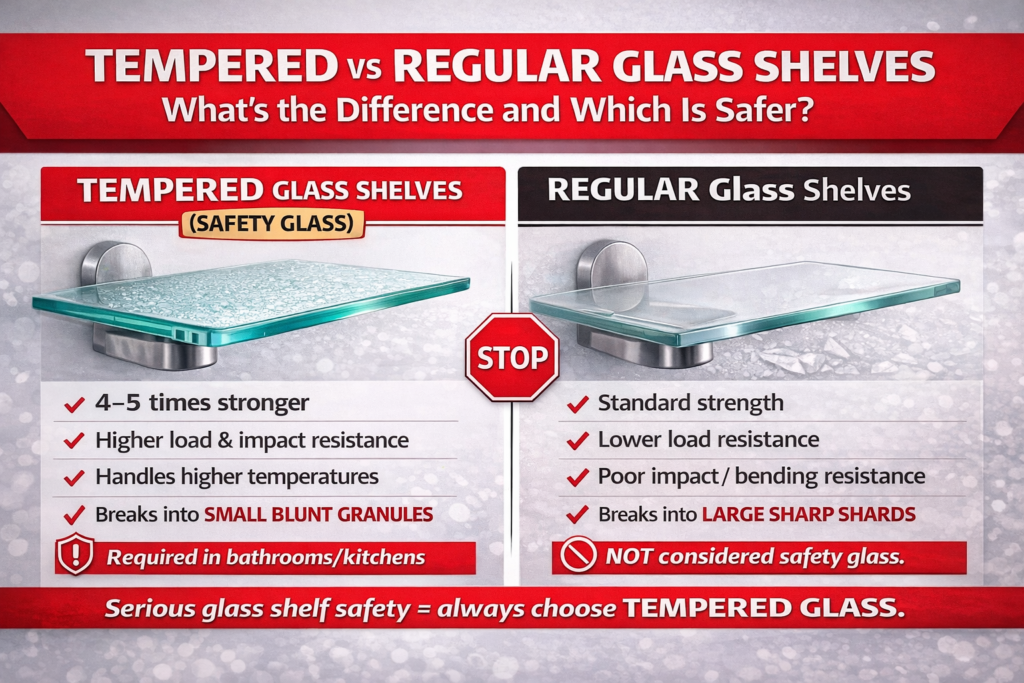
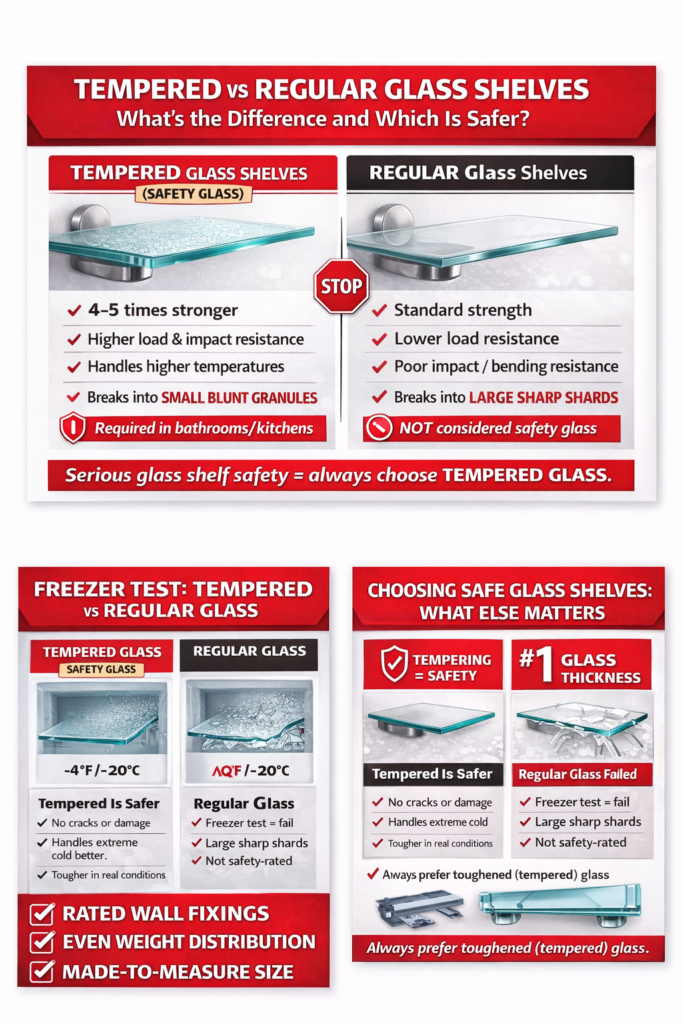
  • 4–5 times stronger than regular glass
  • Highly resistant to impact and bending
  • Handles temperature changes better
  • Breaks into small, blunt granules instead of sharp shards
  • Classified as safety glass

This break pattern is the main reason tempered glass is required or strongly recommended in many household applications.


Strength Comparison: Tempered vs Regular Glass Shelves

FeatureRegular GlassTempered Glass
StrengthStandard4–5× stronger
Load resistanceLimitedMuch higher
Impact resistanceLowHigh
Heat resistanceLowHigh
Break patternLarge sharp shardsSmall blunt pieces
Safety rating❌ Not safety glass✅ Safety glass

For shelving, strength and break behavior are not optional considerations—they directly affect user safety.


Which One Is Safer for Glass Shelves?

Tempered glass is significantly safer.
There is no real comparison when safety is the priority.

Here’s why:

1. Safer breakage

If a tempered glass shelf breaks, it crumbles into small, rounded pieces that are far less likely to cause serious cuts. Regular glass breaks into long, razor-sharp shards that can cause deep injuries.

2. Better load tolerance

Shelves are exposed to:

  • Uneven loads
  • Accidental knocks
  • Items placed and removed daily

Tempered glass handles these stresses far better than regular glass.

3. Required in many household settings

In bathrooms, kitchens, hallways, and areas near people, safety glass is strongly recommended. Some building and safety standards effectively rule out regular glass in these locations.


Can Regular Glass Be Used for Shelves at All?

Technically, yes—but only in very limited scenarios.

Regular glass shelves may be acceptable when:

  • The shelf is small and short-span
  • Load is extremely light (decor only)
  • Shelf is not above head height
  • Area has minimal foot traffic
  • Safety risk is clearly understood

Even then, many professionals advise upgrading to tempered glass because the price difference is small compared to the safety benefit.


Weight Capacity Differences (Real-World Use)

While exact load limits depend on thickness, span, and support type, the same thickness of tempered glass will always outperform regular glass.

For example:

  • An 8mm tempered glass shelf can safely support loads that would put an 8mm regular glass shelf at risk.
  • Tempered glass flexes less and tolerates accidental point loads better.

If you’re unsure how thickness and glass type affect strength together, this guide explains real limits clearly:
👉 https://www.glasshelper.co.uk/how-much-weight-can-a-glass-shelf-hold-real-limits-explained/


Tempered Glass Thickness Options for Shelves

Tempered glass shelves are commonly available in:

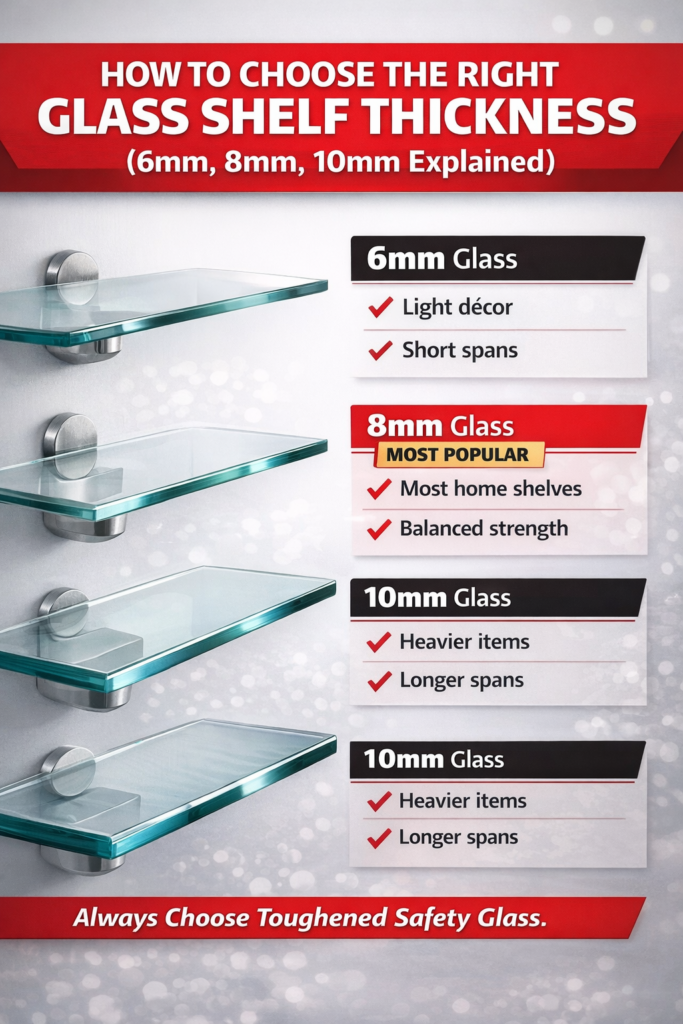
  • 6mm – light use, short spans
  • 8mm – most common household choice
  • 10mm – heavier loads, longer spans, premium feel

Thickness selection matters, but tempering is what makes the shelf safe in daily use.

If you’re ordering custom shelves, most suppliers allow you to choose both thickness and glass type at the same time.


Bathrooms, Kitchens & Living Areas: What Should You Use?

Bathrooms

  • High humidity
  • Frequent handling
  • Bottles and toiletries
    Tempered glass only (8mm preferred)

Kitchens

  • Heavier items
  • Temperature changes
  • Higher impact risk
    Tempered glass only (8–10mm recommended)

Living rooms & display areas

  • Decorative shelves: tempered preferred
  • Books or collectibles: tempered essential

In real homes, tempered glass is not a luxury—it’s a practical safety upgrade.


Cost Difference: Is Tempered Glass Worth It?

Many people assume tempered glass is much more expensive. In reality:

  • The price difference is usually modest
  • Especially for custom-cut shelves, tempering adds relatively little
  • The safety and durability benefits far outweigh the extra cost

Considering that a glass shelf sits above people, pets, or valuable items, tempered glass offers better long-term value.


Important Limitation to Know About Tempered Glass

Once tempered:

  • ❌ It cannot be cut, drilled, or reshaped
  • All sizing, holes, and edge finishes must be finalized before tempering

This is why accurate measurements are critical when ordering.


Which Should You Choose? (Simple Answer)

Choose regular glass only if:

  • The shelf is decorative
  • Load is minimal
  • Safety risk is very low
  • Budget is extremely tight

Choose tempered glass if:

  • The shelf will carry real weight
  • The shelf is above waist height
  • The shelf is in a bathroom, kitchen, or living space
  • Safety matters (it usually does)

For most homes, tempered glass is the correct and safest choice.


Ordering the Right Glass Shelves

If you’re planning to buy custom shelves, look for options that allow:

  • Tempered (toughened) safety glass
  • Multiple thickness choices (6mm, 8mm, 10mm)
  • Polished edges
  • Made-to-measure sizing

You can explore custom-cut tempered glass shelves here:
👉 https://www.glasshelp.co.uk/glass-shelves/


Final Verdict

Tempered glass shelves are safer, stronger, and better suited to real-life use.
Regular glass may look the same, but it does not perform the same—and when it fails, the consequences are much more serious.

If you’re investing in glass shelves for your home, tempered glass is the smarter and safer decision almost every time.
DIY Guide

How to Choose the Right Glass Shelf Thickness (6mm, 8mm, 10mm Explained)

Dec 26, 2025

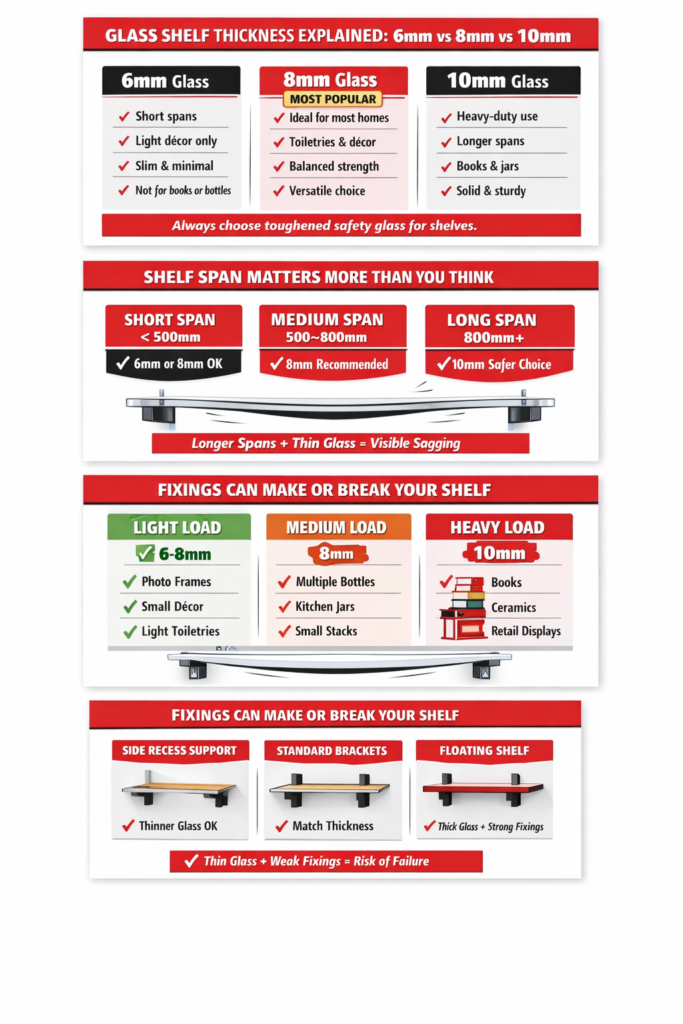
Glass shelves look lightweight and minimal — but they still need to behave like a structural component. Pick a thickness that’s too thin and you’ll get noticeable flex (sag) and higher break risk. Pick one that’s thicker than necessary and you may simply spend more than you need to.

This guide breaks down 6mm vs 8mm vs 10mm in a practical way, using the factors that matter most: span (distance between supports), expected load, shelf depth, fixing type, and safety glass choice. Glass Helper+1


Start here: the 3 things that decide thickness

Before choosing 6/8/10mm, answer these:

  1. Span (support-to-support distance)
    This is the big one. The longer the span, the more the centre wants to bow under load. Glass Helper
  2. Load (what you’ll actually put on it)
    Light décor is very different from stacks of toiletries, jars, or books. Glass can often hold more than people expect — but only when properly supported and evenly loaded. Glass Helper
  3. Support / fixing style
    A shelf supported at both ends behaves differently than one on two small brackets or “floating” supports. Poor fixing choices are a common cause of shelf failures. Glass Helper

Safety first: choose toughened (tempered) glass where possible

For most home shelving, toughened (tempered) safety glass is the sensible option because it’s made for impact and safer break behaviour. Many UK suppliers provide shelves in BS EN 12150 toughened safety glass options. Glass Help Ltd+1

If you’re ordering custom shelves, you’ll typically be able to select:

  • Glass type (clear, low-iron, tinted, frosted)
  • Thicknesses (including 6mm, 8mm, 10mm)
  • Edge finishing (polished edges look better and reduce chip risk during handling) Glass Help Ltd

What 6mm, 8mm, and 10mm are best for

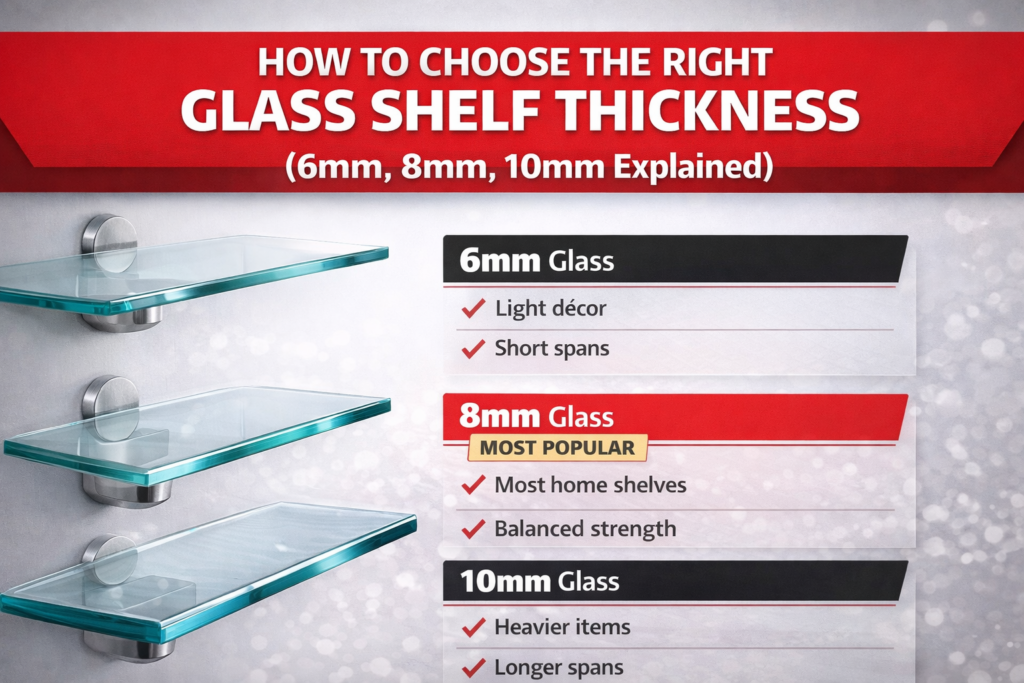
6mm glass shelves: best for light loads + short spans

Choose 6mm when:

  • The shelf span is short (think small alcoves, narrow gaps, compact bathroom shelving)
  • You’re placing lightweight items only (decor, small toiletries, lightweight display items)
  • You want the slimmest look and the shelf is well-supported

Avoid 6mm if:

  • The shelf is long (visible flex becomes likely)
  • You’re storing anything “dense” (books, stacked products, bottles, kitchen jars)
  • You’re using minimal brackets or a floating look with limited support Glass Helper+1

Real-world expectation:
6mm can be fine — but it’s the most unforgiving if span/support isn’t right. Many installation guides warn that thin glass can flex or bow under moderate weight. Glass Helper


8mm glass shelves: the best all-rounder for most homes

If you’re unsure, 8mm is usually the safest “default” for everyday residential shelves.

Choose 8mm when:

  • You want a shelf that feels solid under normal household use
  • It will hold toiletries, small appliances, framed photos, small stacks of items
  • The span is moderate and supported correctly

Many practical thickness guides describe 8mm as the “general household” choice — strong enough for daily use without looking bulky. Glass Helper+1


10mm glass shelves: for heavier loads, longer spans, or premium feel

Go for 10mm when you want noticeably less flex and a more “premium, sturdy” feel.

Choose 10mm when:

  • You’re storing heavier items (books, larger bottles, kitchen storage, display stock)
  • The shelf span is on the longer side
  • You want higher confidence with fewer supports (still needs correct hardware)

Weight-capacity guidance commonly shows a clear jump from 8mm to 10mm in practical loading situations (assuming proper support and even loading). Glass Helper


Quick thickness selector (simple, practical)

Use this as a rule-of-thumb starting point:

  • 6mm: short spans + light décor
  • 8mm: most bathroom / kitchen / living room shelves
  • 10mm: heavier items, longer spans, or “no flex” preference Glass Helper+1

If you’re between two options, it’s usually smarter to go one thickness up to reduce flex and improve long-term reliability. Glass Helper


Span matters: why thickness changes everything

Even good glass will flex if it’s too thin for the span. Thickness impacts stiffness strongly — so small increases in thickness can make a shelf feel dramatically more rigid in the middle. Glass Helper+1

Practical examples (general guidance):

  • Short shelf between strong side supports → 6–8mm can work well
  • Medium span with standard brackets → 8–10mm is typical
  • Longer span (especially with only 2 brackets) → 10mm+ is often the safer call Glass Helper+1

Load matters: what are you putting on the shelf?

Here’s a simple way to think about “load”:

Light load (often OK with 6–8mm)

  • Small décor, lightweight ornaments
  • Small toiletries (few items)
  • Light display products

Medium load (usually 8–10mm)

  • Multiple toiletries bottles lined up
  • Kitchen spices/jars (not overly dense)
  • A few books (not full rows)
  • Medium display stock

Heavy load (usually 10mm, sometimes thicker)

  • Books across the full width
  • Stacked jars/containers
  • Larger bottles, ceramics, dense items
  • Retail displays with frequent use

Also remember: uneven loading (heavy items clustered in the middle) increases stress and flex. Many shelf failures are caused by overloading or poor weight distribution. Glass Helper+1


Support type: the hidden factor people forget

Thickness alone can’t “fix” bad mounting.

Common support styles:

  • Side supports / recess supports (best support for thinner glass)
  • Standard brackets (good when properly spaced and anchored)
  • Floating supports (can be safe, but demands correct rated hardware and careful installation)

Installation guides repeatedly highlight mistakes like:

  • wrong wall fixings
  • poor bracket alignment
  • choosing incorrect thickness for the span
  • overloading the shelf Glass Helper

If you want a “floating” look:
You often need either thicker glass or more robust rated fixings — sometimes both.


Shelf depth: deeper shelves need more stiffness

A deeper shelf (front-to-back) can behave like a longer “lever” under load, especially when weight sits toward the front edge. If you’re doing deeper shelves for storage or display, consider moving from 6mm → 8mm, or 8mm → 10mm for the same span.


Bathrooms, kitchens, and kids: choosing thickness by room

Bathroom shelves

  • Usually short spans, but humidity and frequent use matter
  • 8mm is a safe everyday choice for bottles and toiletries
  • 6mm can work for small shelves with light items and strong supports Glass Helper+1

Kitchen shelves

  • Loads can get heavy quickly (jars, appliances, plates)
  • 10mm is often the safer pick for real storage shelves

Living rooms / display

  • For décor: 6–8mm depending on span
  • For books/collectibles: 8–10mm depending on span and bracket spacing Glass Helper+1

Ordering checklist (use this before you buy)

Before you order, make sure you’ve covered:

  • Span: measure exact distance between supports
  • Depth: how deep is the shelf?
  • Load: what will you place, realistically, in 3–6 months?
  • Glass type: prefer toughened safety glass for most household shelving Glass Helper+1
  • Edge finish: polished edges look better and help reduce chip risk during handling Glass Help Ltd
  • Fixings: choose hardware rated for the thickness and load, and anchor properly Glass Helper

Where to order (and 2 helpful guides)

If you’re ordering made-to-measure shelves, here’s the product page to start your custom order with a natural reference:

And if you want deeper guidance for “real life” decisions:


Final recommendation (simple)

  • Choose 6mm for small, light-use shelves with strong support.
  • Choose 8mm for most homes (bathrooms, general shelving, typical use).
  • Choose 10mm when the shelf is longer, deeper, or will carry heavier items — or you just want minimal flex and a premium feel.