Tips

Tips

Top 10 Design Trends for Custom Glass in Modern Interiors

Oct 16, 2025

Top 10 Design Trends for Custom Glass in Modern Interiors (2025)

Updated · Trends & Design by Glass Helper

Glass is no longer just a window to the outside — in 2025 it’s a bold design element.
Here are the top 10 trends shaping custom glass use in modern interiors, from soft curves to smart innovations.

1) Curved & Organic Glass Forms

Curved partitions and glass furniture pieces are softening the hard edges of modern spaces.
According to Saint-Gobain,
rounded edges and organic shapes will dominate in 2025 for a more fluid architectural aesthetic.

2) Floor-to-Ceiling & Oversized Panels

Large glass panels create open, airy spaces and enhance light flow.
Guardian Glass reports that
new coatings and structural systems allow wider panes without heat loss or distortion.

3) Textured, Reeded & Ribbed Surfaces

Designers are rediscovering the beauty of tactile finishes.
KP Glass
calls reeded glass a retro comeback, while
Architectural Glass
highlights how patterns enhance privacy and style simultaneously.

4) Digitally Printed & Decorative Glass

High-definition printing and etching allow custom artwork, patterns, and branding directly on glass.
ToughGlaze
lists digital printing as one of the top ways to make glass both functional and expressive.

5) Smart / Switchable Glass

Switchable (PDLC or electrochromic) glass lets you control privacy with a button — a growing trend in luxury interiors.
Hallmark Glass
highlights its use in bathrooms, offices, and smart homes.

6) Colored & Tinted Glass Layers

From subtle greys to bold bronzes, colored interlayers are adding mood and warmth.
Both ToughGlaze
and Saint-Gobain Glass UK
predict colored glass will feature in balustrades, partitions, and furniture in 2025.

7) Minimal Frameless & Floating Systems

Thin profiles and invisible fixings keep designs sleek.
KP Glass
and Architectural Glass
both identify frameless glazing as a staple of minimal interiors.

8) Internal Glazing & Partition Walls

Internal glass walls define zones while preserving natural light.
Cantifix
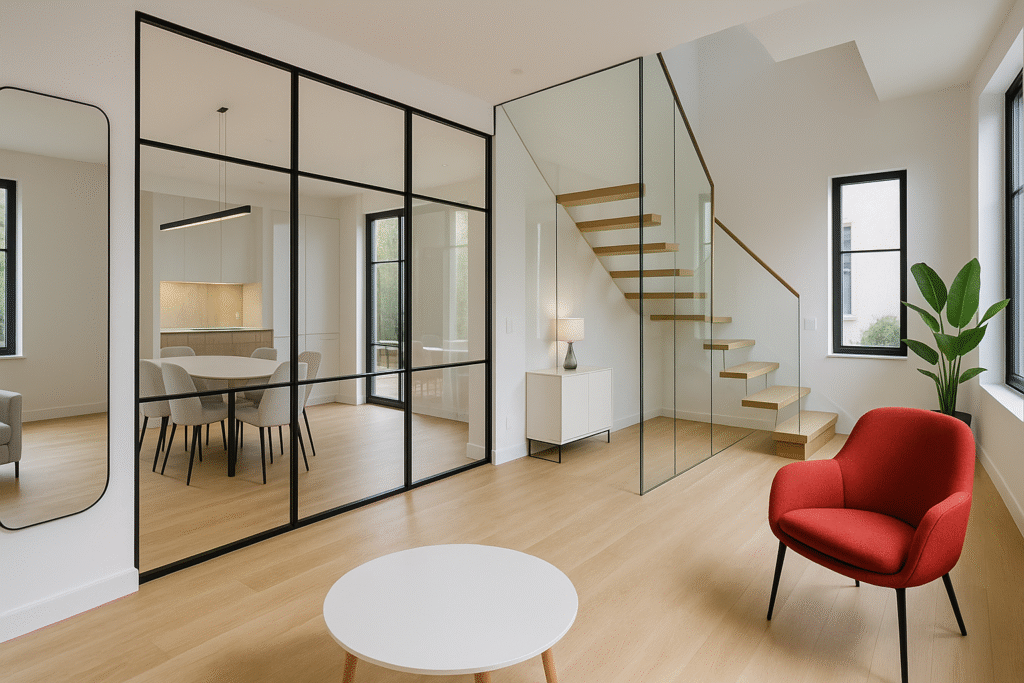
explores how glass partitions reshape homes and offices, combining openness with acoustic control.

9) Sustainable & High-Performance Glass

Energy-efficient glazing and low-iron clarity are essential in eco-friendly interiors.
Guardian Glass
notes that 2025 designs must merge sustainability with aesthetics to meet environmental targets.

10) Revival of Stained & Artistic Glass

Stained and engraved glass art is making a stylish comeback.
House & Garden
showcases how modern homes now feature artistic panels that balance tradition with contemporary design.

Pro Tip: Combine trends wisely — for example, reeded glass with bronze tint and minimal framing gives a warm, timeless aesthetic. Always verify safety glass standards for any structural application.

Explore Custom Glass Options

Tailor-made glass for partitions, balustrades, splashbacks & more — delivered UK-wide.
Sources & Further Reading
Tips

Best Glass Types for Bathroom Renovations in 2025

Oct 16, 2025

Best Glass Types for Bathroom Renovations in 2025

Updated · Bathroom Design Insights by Glass Helper

Choosing the right glass type for your bathroom isn’t just about looks — it’s about safety, privacy, durability, and maintenance.
In 2025, innovations in safety coatings and finishes make bathrooms brighter, safer, and more energy-efficient. Here’s a guide to help you choose the best.

1) Toughened (Tempered) Safety Glass

This is the industry standard for shower enclosures, screens, and glass doors.
Toughened glass is heat-treated to be 4–5 times stronger than standard glass.
If it ever breaks, it shatters into small blunt fragments, reducing injury risk.

Required by Building Regulations – Part K, it must be used for any glazing within 800 mm of the floor or 1,500 mm in doors.

More info: Everest – Safety Glass

2) Laminated Safety Glass

Laminated glass has two or more glass layers bonded with a PVB interlayer.
When broken, shards stick to the interlayer instead of scattering — ideal for bathroom windows or roof glazing.

It blocks 99% of UV rays and provides sound insulation, making it perfect for peaceful spa-style bathrooms.
Laminated glass also meets BS EN 14449 and EN 12600 impact standards.

Read more: Pilkington – UK Glass Standards

3) Obscure / Frosted Glass for Privacy

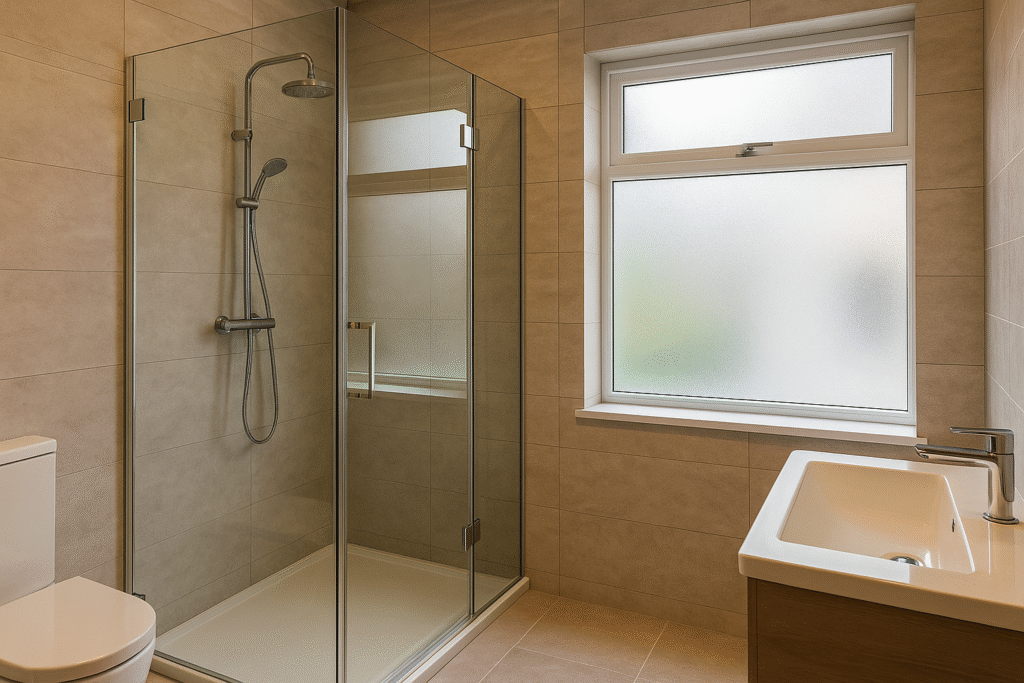
For bathroom windows and shower panels, obscure glass diffuses light while hiding details behind it.
Options include:

  • Acid-etched (Frosted): Smooth matte finish with modern elegance.
  • Patterned: Traditional designs that scatter light effectively.
  • Reeded or fluted: Vertical texture popular in contemporary designs.

A frosted or reeded finish can make small bathrooms appear brighter while maintaining full privacy.

Reference: Glass Genius – Types of Obscure Glass for Bathrooms

4) Low-E or Energy-Efficient Glass

For bathrooms with exterior windows, Low-E (low emissivity) glass helps retain heat while allowing natural light to enter.
This keeps the space warmer and prevents condensation during cold months.

Learn more: Energy Saving Trust – Windows & Doors Guide

5) Smart / Switchable Glass

Switchable glass uses electrochromic or PDLC technology to turn opaque or clear with the flick of a switch.
It’s increasingly common in high-end renovations where aesthetics meet privacy control.

Though more expensive, it removes the need for blinds or curtains — keeping your bathroom sleek and minimalistic.

Learn more: Smart Glass International – Bathroom Applications

6) Easy-Clean & Water-Repellent Coatings

Anti-limescale coatings such as hydrophobic nano-layers are now standard in many shower glass systems.
These reduce soap-scum build-up, water stains, and cleaning frequency.

Leading products like Pilkington Optishield™ or EnduroShield for Glass make maintenance effortless.

Pro Tip: Always specify glass that complies with BS EN 12150 (Toughened) or BS EN 14449 (Laminated).
These ensure your bathroom glazing meets safety requirements and insurance conditions.

Explore Tempered Glass for Bathrooms

Cut-to-size · Privacy · Easy-Clean · UK Delivery
Sources & References
Tips

Energy-Efficient Glazing: How Modern Glass Saves You Money in 2025

Oct 16, 2025

Energy-Efficient Glazing: How Modern Glass Saves You Money in 2025

Updated · Sustainability & Glass Help Insights

Glass technology has advanced. Modern energy-efficient glazing reduces heat loss in winter, controls solar gain in summer, and delivers real savings on energy bills. Here’s how to choose and benefit from it in 2025 UK homes.

1) What is energy-efficient glazing?

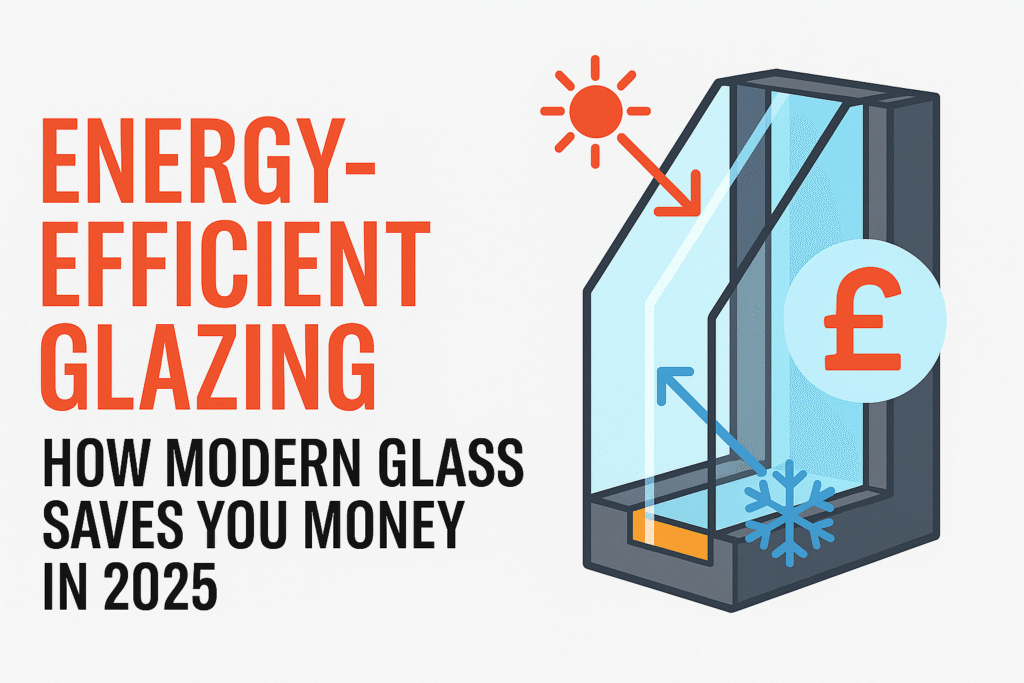
Energy-efficient glazing typically involves **Low-E (low emissivity)** coatings on glass surfaces, which reflect radiant heat back indoors while allowing visible light through.
Paired with **double or triple glazing** and inert gas fills (e.g. argon), these systems improve thermal insulation significantly.

Learn more: Energy Saving Trust – Windows & Doors Guide :contentReference[oaicite:0]{index=0}

2) How it saves money

Upgrading from single glazing to modern double glazing can cut heat loss by a large fraction. According to Energy Saving Trust data, a full upgrade may save around £140 per year for many homes. :contentReference[oaicite:1]{index=1}
Over time, that adds up — especially with rising energy costs.

3) Key features that boost performance

  • Low-E coatings: Reflect internal heat back into the room.
  • Inert gas fills (argon, krypton): Reduce conductive heat transfer between panes.
  • Warm edge spacers: Lower edge heat loss and reduce condensation.
  • Triple glazing: Adds a third pane for higher performance in colder climates.

For reference, see general energy-efficiency work by Carbon Trust. :contentReference[oaicite:2]{index=2}

4) Environmental benefits & carbon savings

Less energy usage means lower CO₂ emissions. Even modest upgrades contribute to the UK’s net-zero goals.
Reduced heating load, cooler interiors in summer, and improved insulation all help create a more sustainable home.

5) When to consider upgrading

Consider replacement if your windows show signs of failing seals, condensation between panes, or feel cold to touch.
Old windows built before modern standards often lack Low-E coatings or gas fills, making upgrades highly worthwhile.

You can order custom-cut replacement glazing via Replacement Window Glass on GlassHelp.

Pro tip: Combine tempered safety glass with Low-E coatings when replacing windows in critical locations. That way you get both **safety** and **efficiency** in one unit.
Also review your window frames (uPVC, composite, timber) since frame insulation matters too.

6) Financial incentives & support schemes

There are grants, loans or VAT reliefs available in some parts of the UK for energy-saving home improvements. Check with your local authority or via Energy Saving Trust programs. :contentReference[oaicite:3]{index=3}


View Tempered & Energy-Rated Glass

Custom sizes • UK delivery • Low-E, safety, acoustic options
Sources & References
Tips

How to Maintain and Clean Glass Surfaces Without Streaks

Oct 16, 2025

How to Maintain and Clean Glass Surfaces Without Streaks

Updated · Care & Maintenance by Glass Helper

Crystal-clear glass depends on two things: the right tools and the right technique.
Below is a simple, proven routine you can use on windows, mirrors, table tops and shower screens—plus
do’s and don’ts for coated/self-cleaning glass.

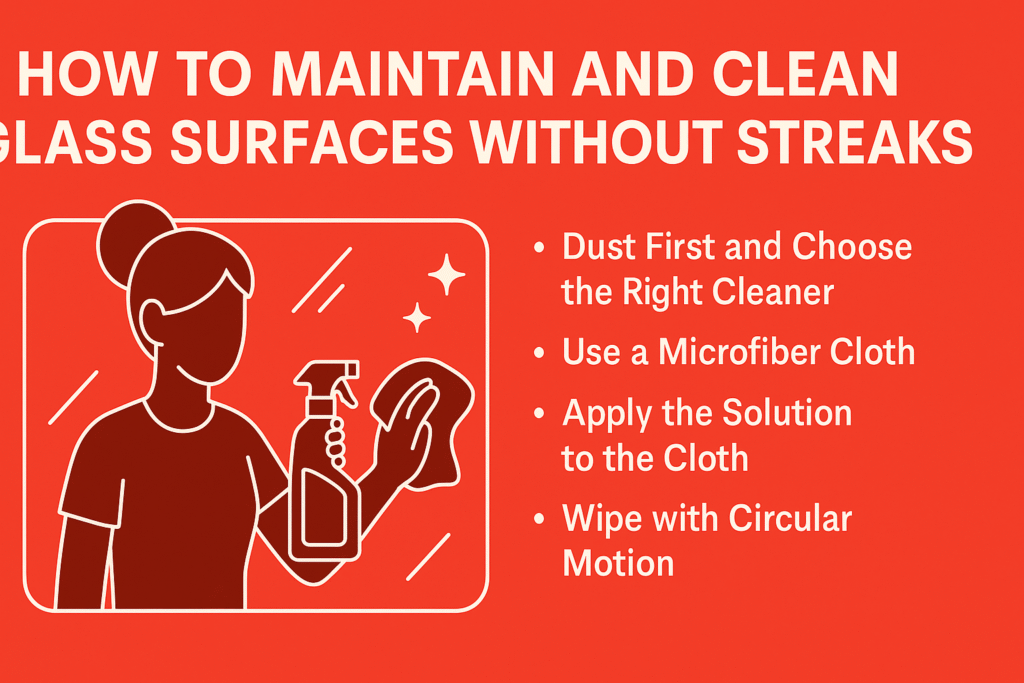
1) Start with dust removal

Dry-wipe edges, frames and the glass surface to remove grit that could scratch during wet cleaning.
A soft brush or clean microfiber works best.

2) Use microfiber (two-cloth method)

Use one lightly damp microfiber cloth to clean and a second dry cloth to polish. Microfiber lifts soil
effectively, often with just water, and reduces streaks versus paper towels.

Why microfiber works: UCSF Fact Sheet.

3) Choose the right cleaner (or DIY safely)

For standard glass, use clean warm water with a mild detergent or a purpose glass cleaner.
A simple DIY option is distilled water with a small splash of white vinegar. Avoid abrasive powders.

Manufacturer guidance: Pilkington – Cleaning & Maintenance,
Vetrotech – Care & Cleaning (PDF).

4) Work top-to-bottom; don’t over-wet

Mist the cloth (not the glass), clean in vertical strokes, then buff dry with your second microfiber.
Excess liquid leaves residues and can drip into frames. A rubber squeegee is great for large panes.

5) Avoid direct sun and temperature shock

Clean on overcast days or when the glass is cool—solutions evaporate slower and won’t flash-dry into streaks.
Never throw very hot water on cold glass (or vice versa); sudden temperature change can cause thermal stress.

Guidance: Saint-Gobain Glassolutions – Maintenance & Care (PDF).

6) For construction grime: flush first

If there’s cement dust, paint specks or mortar, first hose or rinse generously with clean water and a soft applicator.
Avoid scraping with blades unless a specialist method is specified—grit can scratch toughened and annealed glass alike.

See: Pilkington – Glass Cleaning Guidelines (PDF).

7) Special care for coated or self-cleaning glass

Follow the maker’s instructions for low-E, reflective or self-cleaning products—some agents and tools are restricted.
After installation, some coatings need a short activation period and gentle first clean only.

Examples: Pilkington Activ™ FAQs,
SGG BIOCLEAN Maintenance Guide (PDF).

Quick troubleshooting

  • Streaks: Switch to distilled water, use less solution, and polish with a dry microfiber.
  • Lint: Avoid paper towels; wash microfibers separately (no fabric softener).
  • Hard-water spots: Dampen cloth with a little vinegar, then rinse and dry thoroughly.

Need new glass instead of another clean?
Explore our custom options:
Wall Mirrors ·
Glass Table Tops ·
Tempered Glass

Sources & Further Reading
DIY Guide

Top 7 Safety Tips for Handling and Installing Glass at Home

Oct 16, 2025

Top 7 Safety Tips for Handling and Installing Glass at Home

Updated · Guide by Glass Helper

Glass looks simple, but it’s a specialist material. Whether you’re fitting a shower screen, replacing a table top, or hanging a mirrored panel,
follow these essentials to reduce cuts, breakages, and costly re-do’s. Where possible, choose tempered (toughened) safety glass in impact-risk areas.

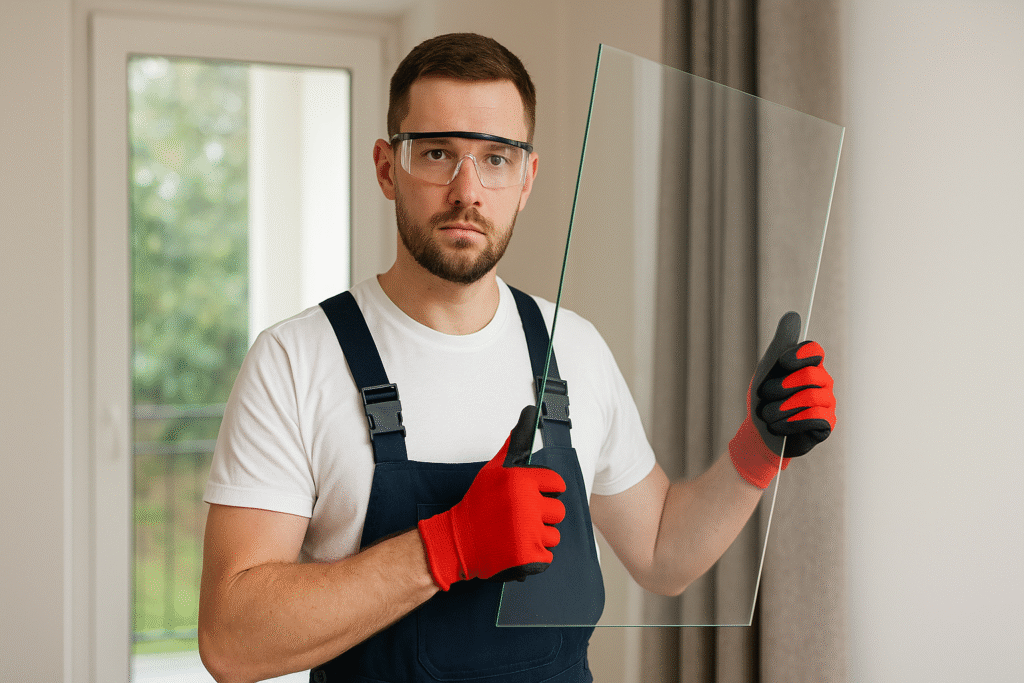
1) Wear the right PPE & control the workspace

  • Cut-resistant gloves (EN 388), safety goggles, long sleeves, and sturdy footwear.
  • Clear pathways; keep floors dry; protect edges with cardboard/rubber; store panels vertical at ~6–7° lean on padded bearers.
  • Keep children and pets out; use a competent helper for sheets over ~0.8 m².

Further reading: HSE: Safety in the handling of flat glass.

2) Choose safety glass for impact-risk areas

Use toughened (EN 12150) or laminated safety glass where impacts are possible (doors, side panels, low-level glazing, bathrooms).
Safety glass is engineered either to break into small cubes (toughened) or stay bonded by an interlayer (laminated).

Standards & guidance: BS EN 12150 overview (BSI),
RoSPA: Preventing accidents in the home.

3) Carry and lift glass the safe way

  • Lift from the vertical with two hands; don’t carry flat/horizontal unless on a rigid board.
  • Use glass-suction lifters rated for the panel weight; check seals; test on clean, dry glass.
  • Never grip by corners; support the long edge; avoid twisting the sheet through doorways.

4) Prepare edges, holes & fixings correctly

  • Only drill/cut before toughening. Never drill toughened glass.
  • Use proper pads, gaskets and setting blocks; avoid point-loads and metal-to-glass contact.
  • Respect manufacturer edge clearances for clamps/hinges; keep frames square and plumb.

5) Fit safety glazing in “critical locations”

UK guidance identifies zones (around doors, low-level panes, bathrooms, stairs) where safety glazing or protection is required.
When replacing panes in these areas, specify glass tested to EN 12150 (toughened), EN 14449 (laminated) or EN 12600 (impact).

See: GGF: Right Glazing in the Right Place (PDF),
and IBC Chapter 24 reference for hazardous locations.

6) Clean-up & dispose of broken glass safely

  • Wear gloves and goggles; ventilate the area; keep others away.
  • Pick large pieces with cardboard; sweep shards with stiff card; finish with duct tape or a damp paper towel.
  • Bag double (thick bin liners or a box), label “Broken Glass”, and follow your council rules for disposal.

RoSPA suggests using shatter-resistant film on existing panes and clearing broken glass quickly and safely:
RoSPA: Accidents to children.

7) First-aid basics for glass cuts

  1. Rinse the wound with clean water; do not scrub.
  2. Apply direct pressure for up to 10 minutes with a clean cloth.
  3. Elevate the limb if possible and cover with a sterile dressing.
  4. Seek urgent care for deep cuts, embedded glass, heavy bleeding, or numbness.

NHS guidance: Cuts and grazes.

Pro tip: For shower screens, balustrades, doors and low-level windows, tempered or laminated safety glass dramatically reduces injury risk and is often required by regulations. Start with our guide:
Tempered Glass (Toughened) — Benefits & Uses.


Get Safety-Rated Tempered Glass

Advice from UK sources (HSE · RoSPA · NHS). Always follow manufacturer instructions.

Sources & Further Reading
Tips

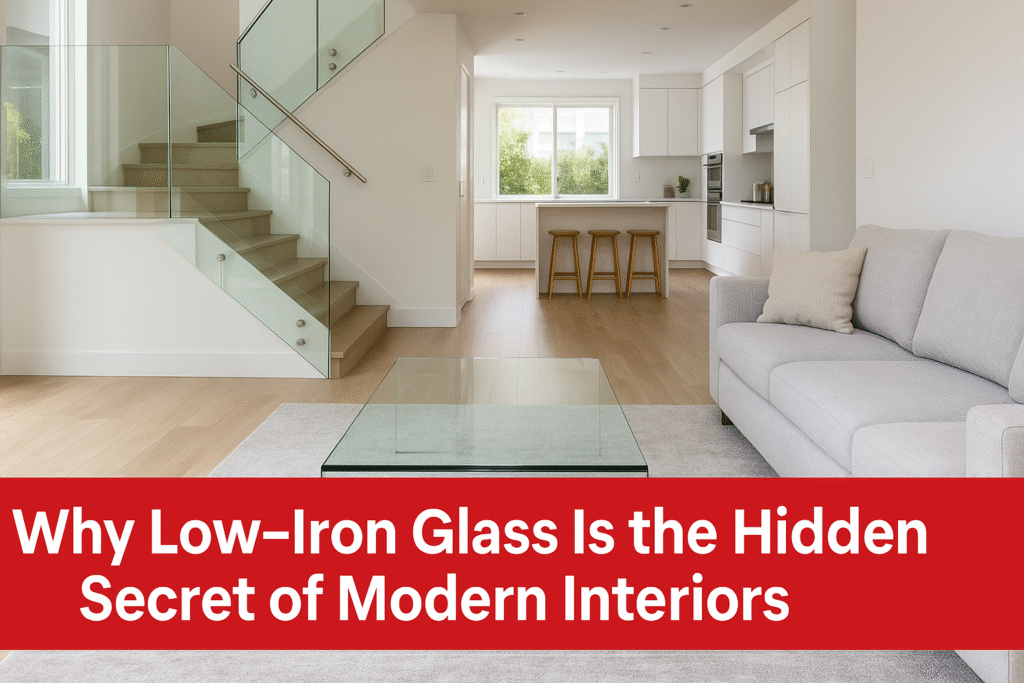
Why Low-Iron Glass Is the Hidden Secret of Modern Interiors

Oct 15, 2025

Design & Innovation · 2025

Read time: ~6 mins · Updated: 16 Oct 2025

When you walk into a bright, airy space with crystal-clear glass features, there’s a good chance you’re looking at low-iron glass.
Known for its remarkable clarity and brilliance, this ultra-transparent glass has become the secret ingredient in high-end homes, luxury furniture, and architectural interiors across the UK.
In this article, we’ll explore what makes low-iron glass so special, where to use it, and how it compares to standard glass in modern design.

What is low-iron glass?

Low-iron glass is a type of high-clarity glass made with reduced iron content during production.
The lower iron level removes the green tint typically seen on the edges of standard glass, producing a crystal-clear, true-colour appearance.
Leading manufacturers such as Pilkington UK and
Guardian Glass offer specialist low-iron ranges that deliver exceptional light transmission and neutrality.

Benefits over standard glass

The biggest advantage of low-iron glass is its optical purity.
It allows more visible light to pass through, revealing the true colour of furnishings, artwork, and architectural details.
This makes it ideal for premium interior applications.

  • ✅ 10–15% higher light transmission than ordinary float glass
  • ✅ Virtually colourless and distortion-free edges
  • ✅ Ideal for displaying natural stone, metals, or light tones
  • ✅ Available in toughened, laminated, and double-glazed versions

For performance data and transmittance charts, see the
Saint-Gobain DIAMANT® low-iron glass page.

Best uses in modern interiors

Low-iron glass is highly versatile and is now used widely in:

  • 🏠 Frameless windows and partitions for ultra-clear views
  • 🪟 Glass balustrades and staircases
  • 🪞 Mirrors and wall panels with accurate colour reflection
  • 🪴 Furniture, shelving, and table tops — especially for light materials
  • 💡 Architectural glazing where minimal colour distortion is required

According to the Energy Saving Trust, pairing low-iron outer panes with low-emissivity coatings can further enhance both aesthetics and thermal performance in double glazing.

Low-iron vs clear float glass

While both are visually similar, standard float glass contains more iron oxide, giving it a subtle green tint — most noticeable in thicker panels.
Low-iron glass removes this colour cast, making it the superior choice for minimalist and bright interior designs.

Feature Standard Clear Glass Low-Iron Glass
Light transmission ~83–87% ~90–92%
Colour neutrality Slight green tint Crystal clear, colour-true
Recommended uses Standard windows, basic glazing Luxury interiors, table tops, display cases

Care and maintenance

Low-iron glass requires the same care as regular glass but benefits from a softer, colour-neutral reflection.
Clean with pH-neutral glass cleaner and a microfibre cloth to avoid streaks.
For coated or laminated versions, follow the manufacturer’s guidance — see
Pilkington UK’s maintenance advice.

Want premium clarity in your home?

Discover custom low-iron tempered glass options for table tops, balustrades, and mirrors — precision-cut and delivered UK-wide.

Frequently Asked Questions

Does low-iron glass improve visibility?
Yes — it eliminates the green tint found in regular glass, producing clearer views and more accurate colours.
See Guardian Glass Low-Iron guide for examples.


Can low-iron glass be toughened or laminated?
Absolutely. It can be processed just like standard glass, including toughening and lamination for safety and structural uses (see BSI glazing standards).


Is it energy efficient?
By itself, low-iron glass does not add insulation, but it enhances the performance of coated or double-glazed systems. Pairing it with PLANITHERM® Low-E glass gives both clarity and efficiency.

References:
Pilkington UK – Optifloat & Low-Iron Glass ·
Pilkington UK – Maintenance ·
Guardian Glass – Low-Iron Glass ·
Saint-Gobain DIAMANT® Glass ·
Saint-Gobain PLANITHERM® Low-E ·
BSI – Glass & Glazing ·
Energy Saving Trust – Windows & Doors

Ready to experience crystal-clear glass?


Get a Free Low-Iron Glass Quote

Made to measure · Ultra-clear finish · Delivered across the UK
Tips

How Glass Coatings Improve Energy Efficiency and Sun Protection

Oct 15, 2025

Energy Efficiency · 2025

Read time: ~7 mins · Updated: 16 Oct 2025

Modern glass is more than just a transparent barrier — it’s a high-performance material that can cut energy use, reduce glare, and protect interiors from damaging UV rays.
Thanks to advanced glass coatings, today’s windows can reflect heat, improve comfort, and even lower energy bills.
This guide explains how glass coatings work, the different types available, and how they can enhance both energy efficiency and sun protection in UK homes.

How glass coatings work

Glass coatings are microscopic layers of metal oxides or ceramic compounds applied during or after manufacture.
They modify the way glass interacts with light and heat — either reflecting infrared energy (to retain warmth) or blocking solar radiation (to stay cool).
According to the Energy Saving Trust, well-designed coatings can drastically improve window performance compared with uncoated glass.

Main types of glass coatings

  • Low-E (Low-Emissivity) Coatings: Reflect heat back into the room while letting visible light through.
    Learn more at Guardian Glass – Low-E Overview.
  • Solar-Control Coatings: Limit heat and glare from sunlight — ideal for south-facing façades or conservatories.
    See Saint-Gobain COOL-LITE® Solar Control Glass.
  • Self-Cleaning Coatings: Use UV light to break down dirt, allowing rain to wash it away naturally.
    Pilkington explains this in its Activ™ Self-Cleaning Glass Guide.
  • Reflective or Mirror Coatings: Reflect more light than they transmit, offering privacy while reducing glare.
    Common in offices or commercial façades, but increasingly popular in modern homes.

Benefits for energy and comfort

In the UK, windows account for up to 20% of heat loss in poorly insulated homes.
Coated glass dramatically reduces this, lowering heating bills and improving comfort year-round.
Verified testing by the Energy Saving Trust shows that high-performance coated glazing can save up to £300 annually for an average household.

  • ✅ Keeps heat inside during winter
  • ✅ Reflects excess solar gain in summer
  • ✅ Reduces condensation on inner panes
  • ✅ Improves EPC ratings and sustainability

For deeper UK efficiency standards, see the official Future Homes & Buildings Standards Consultation.

Sun protection and UV control

Prolonged UV exposure can fade fabrics, flooring, and artwork.
Modern solar coatings filter out up to 99% of harmful ultraviolet rays while allowing natural daylight.
Saint-Gobain’s PLANITHERM® range demonstrates how a single coating can combine solar protection and insulation.

  • ☀️ Protects furniture and finishes from UV damage
  • 🌡 Helps maintain balanced indoor temperatures
  • 🌤 Improves visual comfort by reducing glare

Choosing the right coated glass

The best choice depends on orientation, window size, and use:

  • North-facing: Choose Low-E coatings to retain warmth.
  • South-facing: Pick solar-control glass like COOL-LITE® to block excess heat.
  • Bathrooms and façades: Combine coatings with tempered safety glass for durability and compliance.

For installers, UK technical standards are covered under BSI Glass & Glazing, which outlines approved testing and performance requirements.

Ready to upgrade your windows?

Discover energy-efficient tempered and coated glass options designed for modern UK homes — combining performance, protection, and style.

Frequently Asked Questions

What are Low-E coatings made of?
They typically consist of thin metal oxide layers that reflect infrared heat while allowing visible light to pass. See Guardian Glass – Low-E explainer.


Do coated windows block UV rays?
Yes — solar control coatings like PLANITHERM® or COOL-LITE® can block up to 99% of UV radiation.


Are coated glass units recyclable?
Yes. Coated glass can be remelted and reused; see WRAP UK’s recycling guidelines for glass best practices.

References:
Energy Saving Trust – Windows & Doors ·
Guardian Glass – Low-E Coatings ·
Saint-Gobain – COOL-LITE® Solar Control ·
Saint-Gobain – PLANITHERM® ·
Pilkington – Activ™ Self-Cleaning Glass ·
BSI – Glass & Glazing ·
Gov.uk – Future Homes & Buildings Standards ·
WRAP UK – Glass Recycling

Looking for expert advice on glass coatings?


Get a Free Glass Efficiency Quote

Made to measure · UV-protected · Energy-smart glass across the UK
Tips

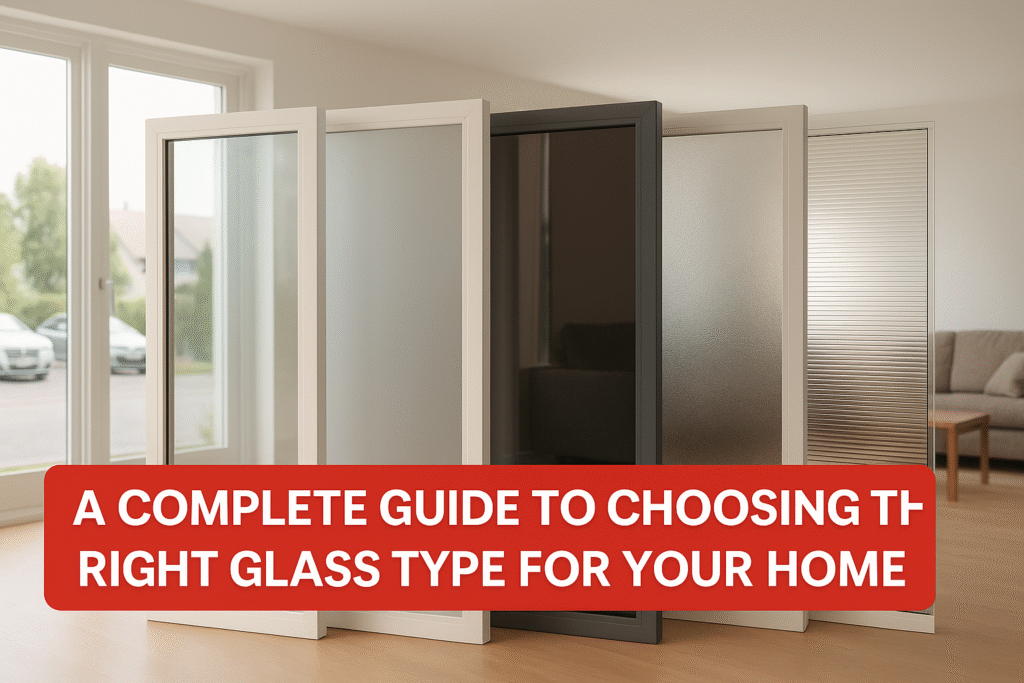
Complete Guide to Choosing the Right Glass Type for Your Home

Oct 15, 2025

Home Improvement · 2025

Read time: ~8 mins · Updated: 16 Oct 2025

Glass shapes your home’s safety, comfort, energy efficiency, and style. This guide explains the main glass types used in UK homes — where each works best, key pros and cons, and when to choose
tempered safety glass for extra protection.

1. Clear Float Glass

The most common, cost-effective option for interiors (furniture, shelving, small panes). For safety-critical areas, specify toughened or laminated versions.

2. Tempered (Toughened) Glass

Around five times stronger than ordinary glass and designed to crumble into small, blunt fragments on breakage — ideal for doors, showers, and low-level glazing. See UK regulatory guidance on glass safety via the
Health & Safety Executive (HSE), and explore our
tempered glass panels.

  • ✅ High impact strength & heat resistance
  • ✅ Safe breakage pattern
  • ⚠️ Must be cut/drilled before toughening

3. Laminated Safety Glass

Two or more sheets bonded with a PVB/EVA interlayer that holds fragments together on impact — excellent for security, overhead glazing, and balustrades.
Technical standards and selection guidance are outlined in the BSI Glass & Glazing hub.

  • ✅ Higher security, stays in place when cracked
  • ✅ Good acoustic and UV performance
  • ⚠️ Heavier and typically higher cost than basic float

4. Frosted / Satin Glass

Diffuses light while maintaining privacy — great for bathrooms, doors and partitions. See examples in Pilkington’s UK decorative range:
Pilkington Decorative Glass.

  • ✅ Natural light + privacy
  • ✅ Multiple finishes and patterns

5. Tinted Solar-Control Glass

Helps reduce glare and solar heat gain while adding a sleek aesthetic. See Saint-Gobain’s solar-control family:
COOL-LITE®.

  • ✅ Cuts glare and UV exposure
  • ✅ Improves comfort in sunny rooms
  • ⚠️ Slight reduction in visible light transmission

6. Acoustic (Sound-Control) Glass

Laminated with sound-dampening interlayers to reduce noise from roads, rail, or neighbours — ideal for bedrooms and home offices.
Practical noise and building-fabric advice is also covered by the Energy Saving Trust.

  • ✅ Noticeable reduction in external noise
  • ✅ Can be combined with Low-E/solar control

7. Low-E (Energy-Efficient) Glass

Low-emissivity coatings reflect heat back indoors while letting light in — essential for energy-efficient double or triple glazing. Manufacturer explainers:
Guardian Glass Low-E.
For broader home guidance, see the EST’s windows & doors page:
Energy Saving Trust – Windows & Doors.

  • ✅ Lower heat loss and bills
  • ✅ Reduced condensation on inner panes

How to Choose the Right Type

Match glass to your goals — safety, energy, privacy, or noise:

  • 🏠 Windows & doors: Low-E double/triple glazing; add laminated layers for security.
  • 🚿 Bathrooms: Use tempered glass for showers; frosted for privacy.
  • 🎧 Near roads/rails: Laminated acoustic glass for noise control.
  • 🌞 South-facing rooms: Add solar control (e.g., COOL-LITE®) to limit overheating.

Ready to upgrade your glass?

Explore custom tempered and laminated options for doors, windows, and interiors — made to measure across the UK.

FAQs

Which glass is safest for homes?
Tempered and laminated glass meet safety expectations for impact-prone or low-level areas (see HSE guidance).


Will energy-efficient glazing reduce bills?
Yes — Low-E double/triple glazing reduces heat loss and improves comfort (see the Energy Saving Trust).


What about sustainability?
Solar-control and Low-E coatings help meet UK efficiency ambitions under the Future Homes & Buildings Standards. Glass is also widely recyclable (see WRAP recycling guidelines).

References:
Energy Saving Trust – Windows & Doors ·
Energy Saving Trust – Energy at Home ·
BSI – Glass & Glazing ·
HSE – Glass & Glazing ·
Pilkington – Decorative Glass (UK) ·
Saint-Gobain – COOL-LITE Solar Control ·
Guardian Glass – Low-E explainer ·
Gov.uk – Future Homes/Buildings Standards ·
WRAP – Recycling Guidelines

Need help choosing?


Get a Free Glass Recommendation

Expert advice · Made to measure · UK-wide service
Tips

How Modern Glazing Enhances Both Safety and Sustainability

Oct 15, 2025

Innovation · 2025

Read time: ~7 mins · Updated: 16 Oct 2025

Today’s glazing does far more than keep out the weather. With the right glass and coatings, you can boost home safety, cut energy use, and support a lower-carbon lifestyle. Below we show how modern glazing achieves both — with trusted references throughout — and when to choose tempered safety glass for added protection.

The evolution of glazing technology

UK standards and guidance now expect high performance from glass in both homes and workplaces. The
BSI Glass & Glazing knowledge hub outlines the families of standards used to demonstrate compliance with building regulations.
Manufacturers have responded with advanced product lines such as Saint-Gobain Glass (thermal, acoustic, safety and low-carbon ranges) and
Guardian Glass Low-E (explaining how low-emissivity coatings reflect heat back indoors).

How modern glazing improves safety

  • Tempered (toughened) glass: Up to ~5× stronger than standard glass and designed to crumble into small blunt pieces. See the UK regulator’s guidance on glass safety at the Health & Safety Executive (HSE).
  • Laminated glass: Uses a PVB/EVA interlayer to hold fragments together on impact — ideal for doors, balustrades and shopfronts.
  • Fire-resistant glazing: Helps contain fire and smoke for a rated period; see official guidance in Future Homes & Buildings Standards consultation documents and Approved Documents.

For doors, low-level windows and bathrooms, upgrading to tempered safety glass is often the correct route to meet safety expectations while keeping a sleek modern look.

Sustainability advantages

Energy-efficient glazing reduces heat loss, cuts bills and lowers emissions. The
Energy Saving Trust explains how double/triple glazing and low-E coatings improve performance and comfort.
Glass is also endlessly recyclable; policy and how-to guidance are covered by WRAP’s Recycling Guidelines and its sector report on closed-loop glass roadmap.

  • Thermal insulation: Low-E double/triple glazing keeps inner panes warmer, reducing condensation and draughts (see EST guidance).
  • Lower carbon: Better windows reduce heating demand and help meet the UK’s efficiency targets under the evolving Future Buildings Standard.
  • Recyclability: Modern flat glass can be remelted and reused without losing quality (see WRAP roadmap).

Smart materials and innovations

Coatings and constructions are getting smarter. Examples include the Pilkington Suncool™ range (high-performance solar control/low-E) and Saint-Gobain’s dedicated page on increased energy efficiency.
Pairing these with laminated or tempered safety layers yields windows that are tough, secure and energy-smart.

Ready to upgrade?

Explore custom tempered and energy-efficient glass to make your home safer, quieter and more sustainable.

Frequently Asked Questions

How much can energy-efficient glazing save?
Savings vary by home and window area, but the Energy Saving Trust details typical reductions in heat loss and bills for double and triple glazing.


What standards apply to safety glass?
See the BSI Glass & Glazing section and HSE guidance on glass safety at hse.gov.uk/glass.


Which products should I ask about?
Low-E/solar-control lines such as Pilkington Suncool™,
plus Saint-Gobain’s thermal and acoustic products, or Guardian’s Low-E glass explainer.

References:
Energy Saving Trust – Windows & Doors ·
BSI – Glass & Glazing ·
Gov.uk – Future Buildings Standard ·
Saint-Gobain Glass – Products ·
Guardian Glass – Low-E Glass ·
Pilkington – Suncool™ ·
WRAP – Recycling Guidelines ·
WRAP – Closed-Loop Glass Recycling Roadmap

Looking for sustainable glass solutions?


Get a Free Sustainable Glass Quote

Made to measure · Energy-efficient · UK-wide delivery
Tips

How Acoustic Glass Reduces Noise in Homes and Offices

Oct 15, 2025

Glass Acoustics · 2025

Read time: ~6 mins · Updated: 12 Oct 2025

Living or working near busy roads, airports, or in dense urban zones brings a constant challenge: intrusive noise.
Your windows are one of the weakest links in a building’s barrier to sound.
Acoustic glass is engineered to reduce that noise, helping you reclaim peace, privacy, and comfort in your space.
In this article, we’ll explain how it works, how effective it can be, and how to choose the right system — while pointing out when you should use tempered safety glass for safety.

How acoustic glass works

Acoustic glass (also called noise-reduction glass or sound-control glass) enhances traditional glazing by interrupting, absorbing, and reflecting sound waves as they pass through the glass. Key mechanisms include:

  • Layered construction: It typically uses at least one laminated layer (e.g. a PVB interlayer) bonded between glass sheets. This interlayer damps vibrations and reduces sound transmission. :contentReference[oaicite:0]{index=0}
  • Different pane thicknesses: Using panes of unequal thickness (e.g. 4 mm + 6 mm) breaks up resonant frequencies and spreads sound energy across frequencies, which helps reduce noise across a broader spectrum. :contentReference[oaicite:1]{index=1}
  • Wide air or gas gaps: A larger gap (often filled with inert gas) between panes further slows and attenuates sound waves. :contentReference[oaicite:2]{index=2}
  • Seals and frame construction: Even the best acoustic glass will underperform if window frames, seals, or installation are not sound-proofed, allowing noise leakage around the edges. :contentReference[oaicite:3]{index=3}

Typical noise reduction performance

In real-world tests, acoustic glass can outperform standard double glazing by several decibels. For example:

  • A standard double-glazed unit might reduce noise by ~33 dB. :contentReference[oaicite:4]{index=4}
  • An acoustic glazed unit (with PVB interlayer and asymmetric panes) can reach up to ~40 dB of noise reduction. :contentReference[oaicite:5]{index=5}
  • In more advanced systems (in commercial settings), acoustic glass and triple glazing combinations may reach 50 dB or more reduction in certain conditions. :contentReference[oaicite:6]{index=6}

To put this into context: a 7–10 dB difference is significant — it can turn heavy street noise into a quiet whisper. :contentReference[oaicite:7]{index=7}

Where acoustic glass is most beneficial

While acoustic glass has many uses, some scenarios benefit more than others:

  • Homes near busy roads, highways, or railways: Acoustic glass in windows helps reduce traffic and train noise penetrating your living spaces. :contentReference[oaicite:8]{index=8}
  • Rooms facing noisy exteriors: Bedrooms, living rooms, or offices with direct exposure to street noise gain the biggest comfort improvement.
  • Office partition walls and meeting rooms: Acoustic glazing can control internal noise — ideal for open-plan offices, boardrooms, or shared workspaces. :contentReference[oaicite:9]{index=9}
  • Schools, hospitals and public buildings: Acoustic design is integral for wellbeing and privacy in these buildings, often guided by standards like acoustic codes or health facility requirements. :contentReference[oaicite:10]{index=10}
  • Combined glazing upgrades: Acoustic glass can be combined with Low-E coatings or laminated safety treatments to deliver multiple benefits (thermal, safety, acoustic) in one unit. :contentReference[oaicite:11]{index=11}

How to choose the right acoustic glazing system

You want a solution that balances cost, performance, and practicality. Here are key considerations:

  • Sound insulation index (Rw / R): Look for ratings from manufacturers — higher is better. For instance, some acoustic systems advertise R = 40–54 dB performance. :contentReference[oaicite:12]{index=12}
  • Pane thickness and asymmetry: Use glass of different thicknesses to broaden frequency attenuation. :contentReference[oaicite:13]{index=13}
  • Interlayer quality: Higher-grade PVB or acoustic interlayers perform better in damping. :contentReference[oaicite:14]{index=14}
  • Gap width: A wider air/gas cavity (within reason) helps — but excessively wide gaps yield diminishing returns.
  • Frame and seal quality: Use tightly sealed frames, acoustic gaskets, and professional installation to avoid leakage paths. :contentReference[oaicite:15]{index=15}
  • Safety & multi-functionality: Combine acoustic with tempered or laminated safety layers for better durability and protection.

Want to make your home quieter this year?

Explore custom tempered and acoustic glass options tailored to your window layout and noise levels.

Frequently Asked Questions

Can acoustic glass completely soundproof a window?
No — while it can greatly reduce noise, true “soundproofing” requires addressing all parts of a building’s envelope (walls, roof, floors). Acoustic glass is a major improvement but not a total solution. :contentReference[oaicite:16]{index=16}


Will simply replacing glass help if my frames are old?
Not fully. Frames and seals are critical. Upgrading glass in poor frames can produce only marginal gains. Always consider full window replacement where possible. :contentReference[oaicite:17]{index=17}


Is acoustic glazing expensive?
Yes, it costs more than standard double glazing, but the enhanced comfort, productivity, and peace often justify the investment — especially in noisy areas.


Does acoustic glass help with insulation too?
Yes. Many acoustic glazing units are combined with thermal coatings (Low-E) to reduce heat loss while also reducing noise. :contentReference[oaicite:18]{index=18}

References:
• Everest “Acoustic Glass Explained” guide :contentReference[oaicite:19]{index=19}
• GGF – Glazing & Noise Reduction in Homes :contentReference[oaicite:20]{index=20}
• British Glass & Glazing – Noise Reduction Glass :contentReference[oaicite:21]{index=21}
• Specialist Glass – commercial applications :contentReference[oaicite:22]{index=22}
• Manchester Window Factory – acoustic vs triple glazing perspectives :contentReference[oaicite:23]{index=23}

Ready for a quieter home or office?


Request a Free Acoustic Glass Consultation

Custom cuts · Professional installation · UK-wide delivery