Tips

Tips

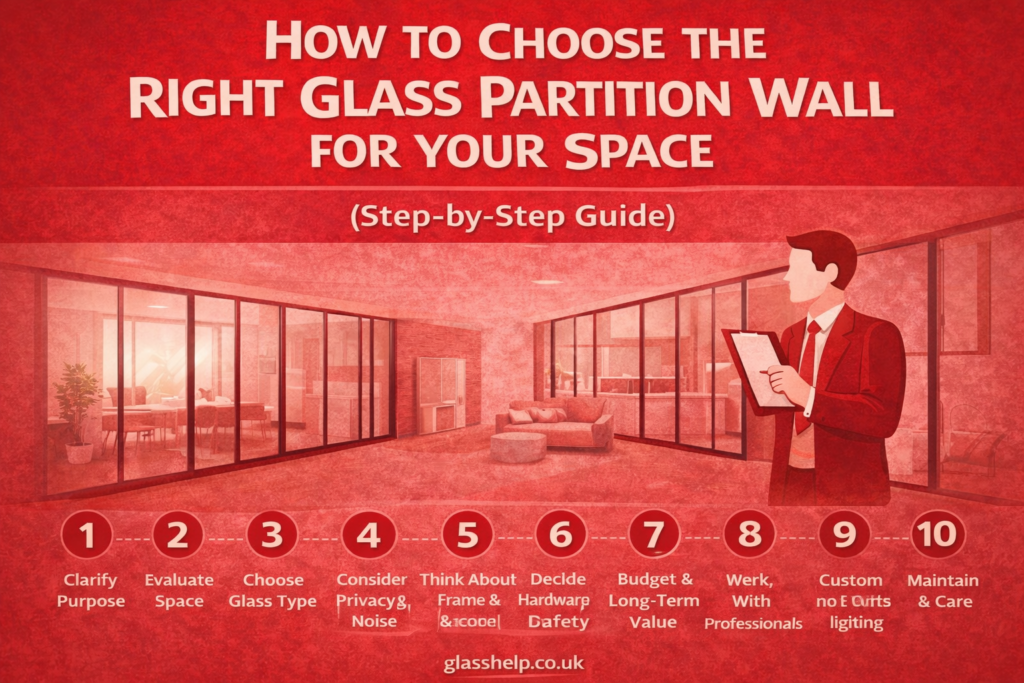
How to Choose the Glass Right Partition Wall for Your Space (Step-by-Step Guide)

Dec 18, 2025

Glass partition walls are one of the most stylish and effective ways to divide interior spaces while maintaining light, openness, and visual connection. But choosing the right glass partition wall for your specific room — whether it’s a home office, living space, commercial area, or studio — requires careful planning and informed decisions.

This step-by-step guide will walk you through every important factor to consider, helping you select a glass partition solution that delivers on functionality, aesthetics, acoustics, safety, and budget.

Why Glass Partitions Are Popular

Glass partition walls have become increasingly popular due to their ability to:

  • Maximise natural light — transparent or translucent panels let sunshine penetrate deep into interiors, reducing reliance on artificial lighting. Heritage Window Company
  • Improve sense of space — glass creates the illusion of openness even while defining zones. Vision Glass Doors
  • Blend style and function — they work in minimal, industrial, contemporary, and traditional settings. Kova

If you’re considering installing one, explore detailed design and installation options at this guide to glass partition walls, which showcases different systems and applications.


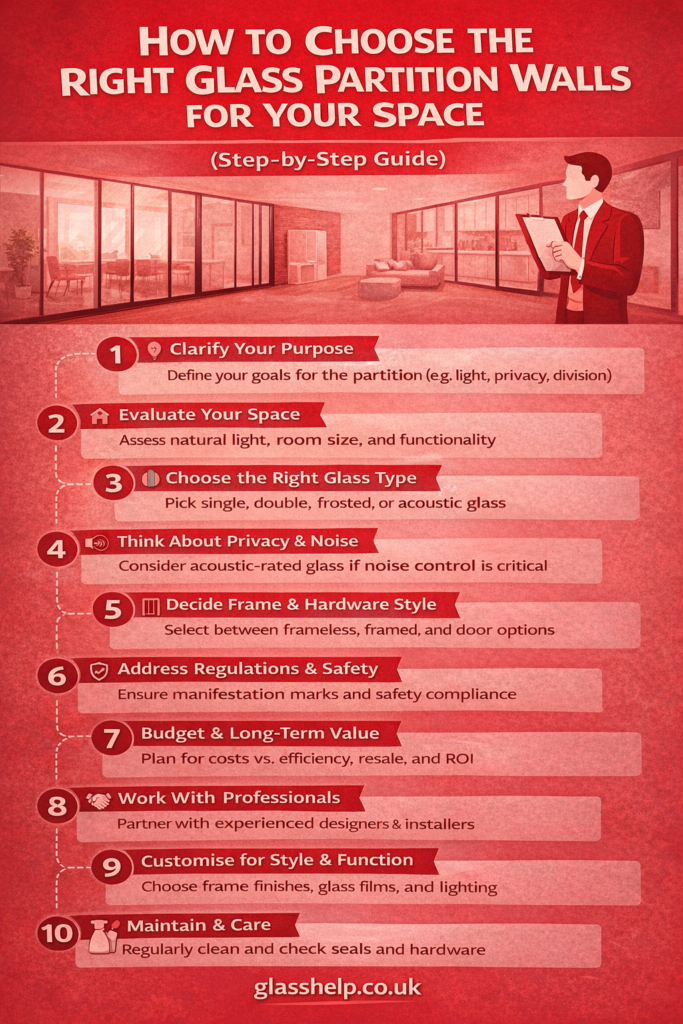
1. Clarify Your Purpose

Before diving into styles and specifications, identify why you want a glass partition:

A. Light & Visual Openness

Glass partitions let you visually connect rooms while still delineating spaces. This is ideal for dividing living areas, hallways, or studios without blocking light. Vision Glass Doors

B. Noise Control & Privacy

If you need acoustic separation — such as for a home office, bedroom divide, or meeting space — prioritising thicker or acoustic-rated glass is key. KCC Group

C. Functional Division

Glass works well where you want defined zones for activities (e.g., study areas, kitchen zones, entrance vestibules) without sacrificing openness or style. Kova


2. Evaluate Your Space

Assess your room’s layout, lighting, and structural features:

A. Natural Light Availability

If your space suffers from low light, fully transparent glass or even low-iron glass can help maximise brightness. Glass partitions outperform solid walls because they allow light to pass through and illuminate adjacent areas. Heritage Window Company

B. Room Usage

Consider how the space will be used:

  • High-traffic / multi-purpose areas: require tough, easy-to-maintain partitions.
  • Quiet zones / work areas: need acoustic considerations.
  • Moisture-prone areas: kitchens or bathroom adjacency may need tempered or laminated glass.

This upfront evaluation ensures that your glass partition is functional as well as stylish.


3. Choose the Right Glass Type

Glass partitions vary in terms of thickness, finish, and performance features. Here’s what to consider:

A. Single vs Double Glazed

  • Single-glazed glass is thinner, lighter, and generally more affordable — suitable for light division and open feel. Glass Partitioning UK
  • Double-glazed glass offers better acoustic performance and insulation, making it ideal for workspaces or bedroom divisions.

Double glazing also helps regulate temperatures between zones, which can be beneficial in both homes and offices. SunSeeker Doors

B. Safety & Tempered Glass

All interior glass partitions should use toughened or safety glass to reduce risk of injury if broken. Safety glass complies with building standards and is especially important in homes with children or in commercial settings.

C. Frosted, Textured, or Patterned Glass

Not every glass wall needs to be completely transparent. Frosted or patterned glass enhances privacy while preserving light flow, and is ideal for bathrooms, study zones, or bedroom enclosures. Glass Partitioning UK


4. Think About Acoustics and Privacy

Glass on its own does not block sound as effectively as solid walls. If you’re installing partitions between noisy zones or spaces where privacy matters, this step is critical:

A. Acoustic Glass Options

Acoustic-rated glass — such as laminated panels with a noise-reducing core — can help significantly reduce sound transmission. Some systems achieve advanced decibel reduction levels while remaining sleek. KCC Group

B. Double-Layer Systems

A double-layer approach — combining double glazing with acoustic seals — often delivers the best privacy without heavy solid walls.


5. Decide Frame & Hardware Style

The visual impact of your glass partition depends as much on the framing and hardware as the glass itself.

A. Frameless Glass

Frameless partitions offer a minimalist, uninterrupted look. They give the sharpest sense of openness but generally cost more and require careful installation.

B. Framed Glass

Framed systems — whether slim black metal, aluminium, or coloured frames — add architectural character. These are especially popular in industrial, contemporary, and heritage-inspired interiors.

C. Door Styles & Mobility

Consider how you’ll move between divided areas:

  • Sliding glass doors save space and maintain continuity.
  • Pivot or hinged doors feel more traditional and solid.
  • Folding / bi-fold systems maximise opening width.

Door choice impacts both functionality and cost — so plan early in the design process. prismglass


6. Address Building Regulations & Safety

Even internal partitions can trigger certain requirements:

A. Manifestation & Safety Markings

UK building standards often require visual markers (dots, bands, or patterns) on large glass surfaces to prevent people walking into them. Don’t skip this — it’s both a safety feature and a compliance requirement. prismglass

B. Load & Structural Considerations

Glass walls that span floor-to-ceiling, or contribute to structural movement control, may require professional input to ensure safety and durability.

Working with experienced suppliers and installers ensures compliance with local codes and reduces risk during installation.


7. Budget & Long-Term Value

Glass partitions vary widely in cost, and better planning means better value:

A. Base Costs

Basic single glazed systems are more affordable, while double-glazed, acoustic, or bespoke systems increase cost. Glass Partitioning UK

B. Installation Complexity

Site conditions, ceiling and floor finishes, and size all influence installation costs — often as much as the materials themselves. Glass Partitioning UK

C. ROI & Functional Benefits

Glass partitions often add perceived space, light, and modern appeal — all factors that can improve resale or rental value. Optima United Kingdom

Budget realistically for the entire project: materials, installation, hardware, and finishing touches like manifestations or privacy films.


8. Work With Professionals

Glass partition walls may look simple, but they require precise planning, measuring, and installation. Partnering with qualified designers and installers helps you:

  • Avoid measurement errors
  • Comply with regulations
  • Select the right glass performance
  • Get expert installation and aftercare

Most reputable companies will conduct a site survey and provide guided recommendations based on your goals.


9. Customise for Style & Function

Once you’ve chosen the fundamentals (glass type, frame, acoustics), it’s time to refine the design:

A. Colour & Finish Choices

Frames can be powder-coated to match your interior palette. Doors and fittings come in finishes from matte black to brushed steel.

B. Glass Films & Decals

Adding subtle films or patterns can enhance privacy or branding while complementing decor.

C. Integration With Lighting

Glass works beautifully with lighting — edge lighting, pendant fixtures, or integrated LEDs can create dramatic visual interest.


10. Maintenance and Care

Glass walls are easy to clean but benefit from routine care:

  • Use non-abrasive cleaners to avoid scratches.
  • Regularly inspect seals and hardware.
  • Clean frames and tracks to ensure smooth operation.

Proper care extends durability and keeps partitions clear and beautiful.


Conclusion — Choose with Purpose

Selecting the right glass partition wall means balancing light, privacy, acoustics, budget, and style. By clearly defining your goals, evaluating space conditions, selecting the right glass type and framing, and working with professionals, you ensure a design that enhances both function and aesthetics.

Glass partitions can redefine interiors — whether you want a luminous home office, a stylish kitchen divide, or modern commercial zones. Thoughtful planning makes all the difference.
Tips

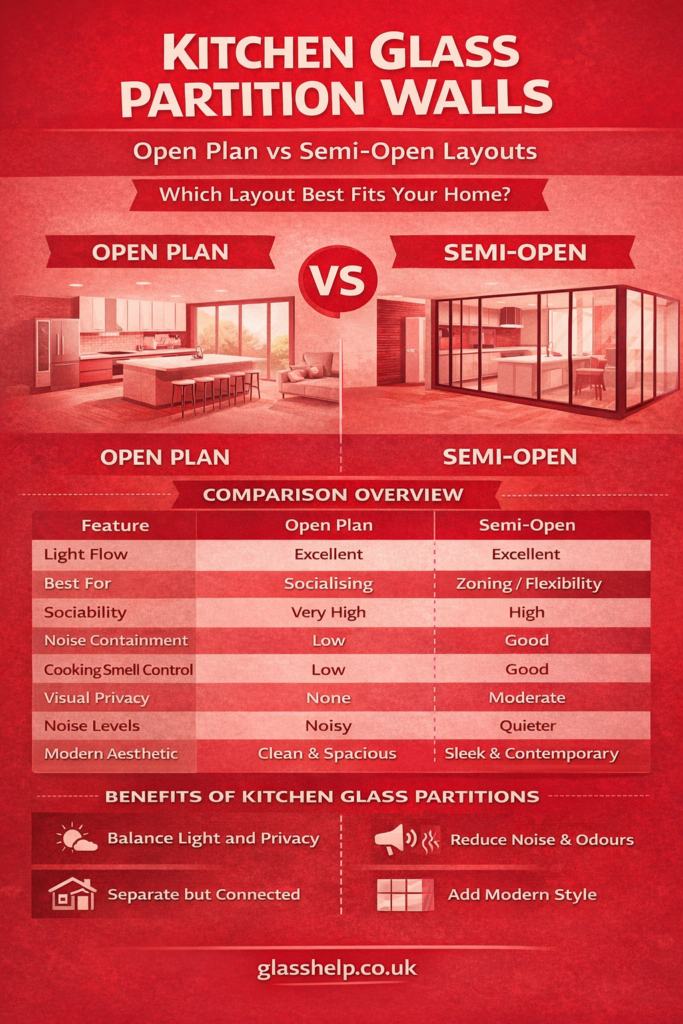
Kitchen Glass Partition Walls: Open Plan vs Semi-Open Layouts

Dec 18, 2025

When planning a kitchen remodel or redesign, one of the most transformative decisions is how your kitchen connects with the rest of your home. Kitchen layout isn’t just about cabinets and appliances — how you divide or unite your space affects light, sociability, smell control, privacy, and value.

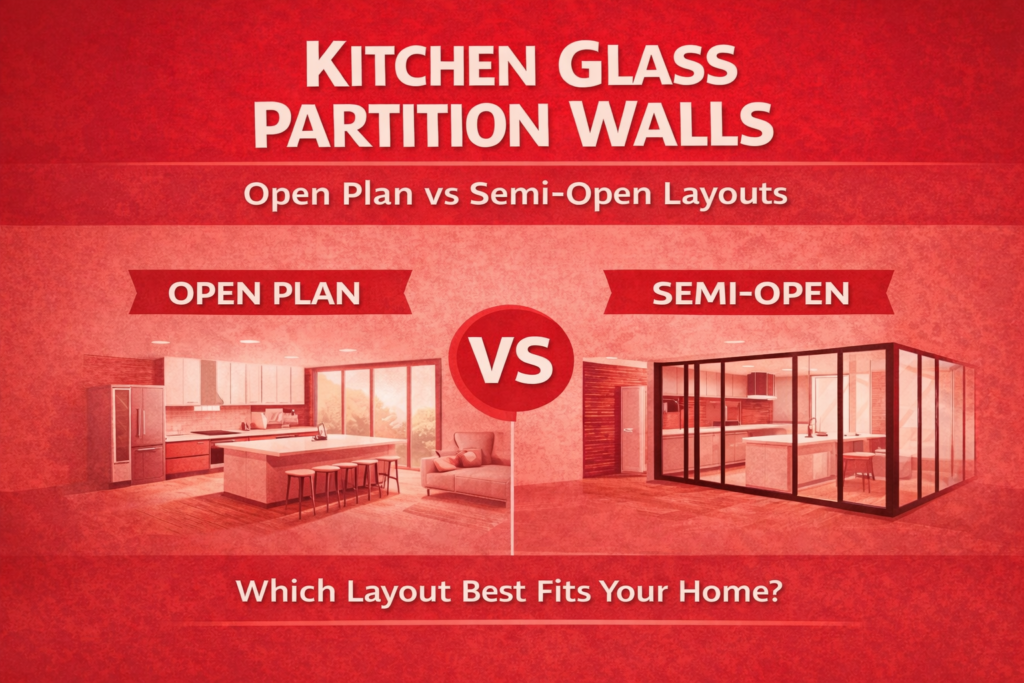
In recent years, designers and homeowners have begun to favor glass partition solutions to strike a balance between open connectivity and defined space. This article explores the key differences between open plan and semi-open (broken plan) kitchen layouts, why glass partitions are increasingly used, and how to choose the right approach for your lifestyle and property.


What Is an Open Plan Kitchen?

An open plan kitchen removes barriers between the kitchen, dining, and living areas, creating one unified, flexible space. Walls and doors are minimized or eliminated, allowing light and movement to flow freely throughout.

Open plan living first gained popularity in the late 20th century and has remained a dominant trend due to its sociable and spacious feel. Homes with open plan layouts feel larger and brighter because removing physical barriers maximizes natural light and sightlines. The Conversion Guy

Benefits of Open Plan Kitchens

1. Enhanced Social Interaction:
An open space encourages conversation between the cook and housemates or guests. Whether hosting dinner parties or keeping an eye on children while preparing meals, open plans foster togetherness. The Conversion Guy

2. Better Natural Light:
Without internal dividing walls, sunlight can brighten deeper sections of your home, creating a sense of airiness and wellbeing. All Well Property Services

3. Flexibility and Flow:
Open layouts are flexible — perfect for multifunctional use like cooking, dining, working, and lounging without feeling constrained. The Conversion Guy

4. Resale Appeal:
Many buyers and renters are drawn to open, uninterrupted spaces that feel modern and convenient.

Drawbacks of Open Plan Kitchens

Despite their benefits, open plan layouts have downsides:

  • Noise carries easily: Sound from appliances, conversations, or TV can travel across the space. The Conversion Guy
  • Smell and mess are visible: Cooking aromas and mess don’t stay contained. AIS
  • Less distinct home “rooms”: Some people miss the psychological comfort of compartmentalized living.

What Is a Semi-Open (Broken Plan) Kitchen?

The semi-open or broken plan concept sits between open and closed layouts. Instead of open expanses or full walls, this layout uses partial dividers, screens, or glass partitions to delineate space while still maintaining visual and light connectivity.

Traditionally, “broken plan” meant retaining some structural separation — half walls or changes in ceiling or floor levels — but modern interior design often substitutes glass partitions to achieve the same effect without blocking light. Homebuilding

Why use a broken plan?

Semi-open layouts attempt to give the best of both worlds:

  • Defined zones: Kitchen, dining, and living areas feel separate while still connected.
  • Light flow: Partial dividers, especially glass, do not restrict daylight the way solid walls do. House & Garden
  • Flexibility: Semi-open spaces often adapt better for work, dining, relaxing, or entertaining.

Glass Partitions: Bridging Open and Semi-Open Layouts

Glass partitions have emerged as a popular architectural feature to support semi-open kitchens. They allow homeowners to enjoy the sociability and brightness of an open plan, while also incorporating functional separation, smell containment, or acoustic zoning.

If you’re exploring options and inspiration, check out this guide to glass partition walls, which showcases how glazed solutions can redefine interior zones without closing them off.

Glass partitions come in many styles:

  • Frameless clear glass: For maximum light and view continuity
  • Crittall-style framed glass: Classic industrial look with architectural character
  • Frosted or patterned glass: For privacy and visual softness

According to interior design professionals, glazed partitions are increasingly used to create visual connection without sacrificing separation — a trend especially popular in urban homes and contemporary renovations. Glass Interiors


Open Plan vs Semi-Open: A Comparative Look

AspectOpen PlanSemi-Open with Glass Partitions
Light FlowExcellentExcellent
SociabilityHighHigh when partitions are open or transparent
Privacy/ContainmentLowModerate to High
Noise ControlLowBetter with glazed barriers
Odor ControlPoorBetter than open plan
Visual SpaceVery OpenSlightly defined but still airy
ZoningNonePartial to strong depending on design

Practical Considerations for Your Kitchen

1. How Do You Use Your Kitchen Day-to-Day?

  • If you love entertaining and conversation flows easily around cooking and dining, open plan may suit your lifestyle.
  • If noise and cooking smells are concerns, consider semi-open layouts with glazed partitions that offer separation while preserving connection.

2. Light and Orientation Matter

Open plan spaces excel in bright homes with large windows or extensions. Semi-open designs are ideal where light is limited or needs to be directed cleverly between zones.

3. Acoustics and Smell Control

Glass partitions provide an elegant way to reduce noise transmission and slow the spread of cooking odors without losing natural light — something fully open plans struggle to manage.

4. Privacy Without Isolation

A kitchen that’s fully open to living spaces can feel exposed. Strategically placed glass walls or sliding glazed doors let you “close” the kitchen visually while feeling connected. Houzz


Design Tips for Using Glass in Kitchen Layouts

Choose the Right Frame and Finish

Crittall-style black metal frames are classic and add character, while frameless glass creates a seamless, minimalist appeal. The frame finish should harmonies with your kitchen cabinetry and fixtures.

Consider Sliding or Folding Glass Panels

If flexibility is important, sliding or folding glass partitions let you open the kitchen fully when you want, then close it off when cooking odors or noise needs containment.

Use Frosted or Textured Glass for Partial Privacy

In busy households, you may want glass partitions that obscure detailed views while still admitting light. Frosted, patterned, or textured glass achieves this balance.


Costs & Practical Installation

Glass partition walls vary in price based on size, glass thickness, framing, and hardware. Compared to full wall rebuilds, glass systems can be a cost-effective compromise that delivers both form and function.

Professional installation is recommended to ensure structural stability, proper sealing (especially if condensation is a concern), and smooth operation of any moving parts like sliders.


Which Layout Is Right for You?

There’s no universally right answer — your choice depends on priorities:

Choose Open Plan If:

  • You prioritise sociability and light
  • You entertain frequently
  • You want a visually expansive layout

Choose Semi-Open with Glass Partitions If:

  • You want zoned spaces without blocking light
  • Noise and odors are considerations
  • You prefer a balance of privacy and connection
  • You want a contemporary design feature

Many designers now advocate hybrid approaches — open layouts softened with strategic zones and glazed boundaries that parcel space effectively without shutting it away completely. Harvey Jones


Conclusion — Balance Over Extremes

Open plan and semi-open kitchen layouts each have compelling benefits. The trend in modern interiors is less about rigid zoning or completely unobstructed spaces, and more about fluid, adaptable design that respects light, activity flow, privacy, and aesthetic coherence.

Glass partitions are one of the most effective ways to achieve this — offering separation where it matters while preserving light, view, and connection. Used thoughtfully, they make kitchens feel more functional, stylish, and enjoyable for everyday life.

Whether you choose full openness or a refined semi-open approach, start with how you live in your space, and let design and lifestyle guide the rest.

Rules & Regulations

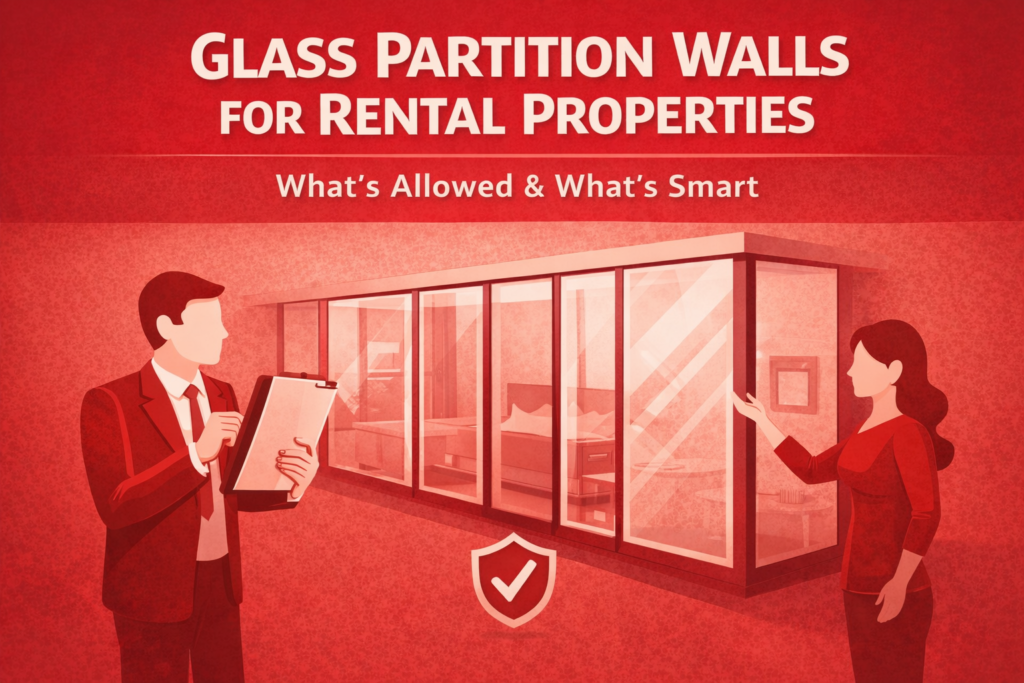
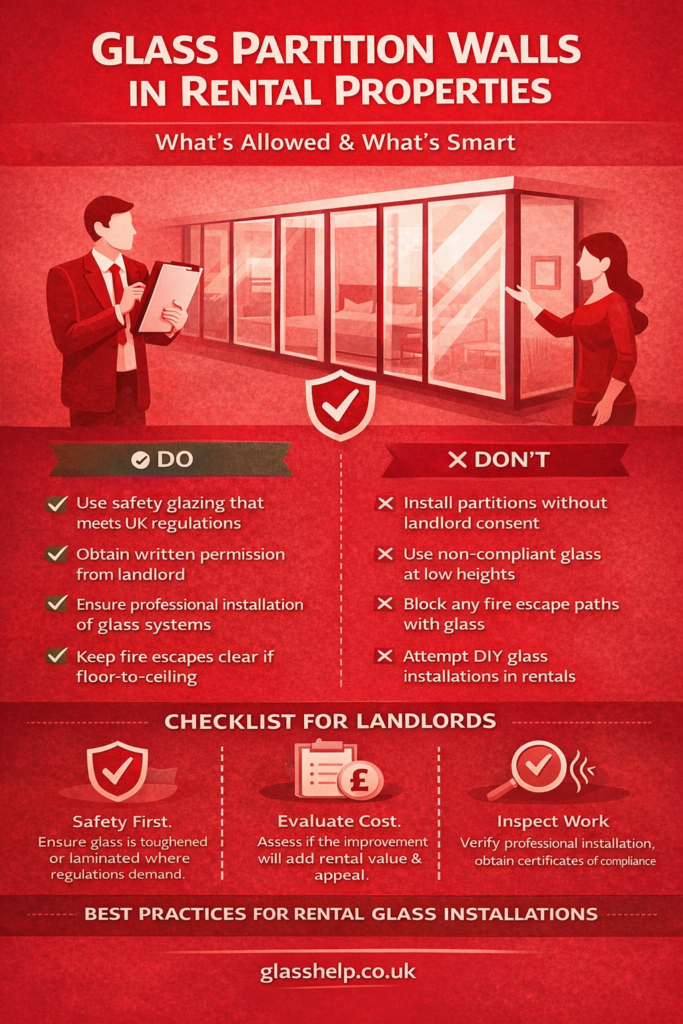
Glass Partition Walls for Rental Properties: What’s Allowed & What’s Smart

Dec 18, 2025

Glass partition walls are a stylish way to divide space, maximise natural light, and create modern, open-plan interiors — but when it comes to rental properties, landlords, tenants and property managers must understand what’s allowed, what’s required, and what’s best practice.

This guide combines legal context, safety requirements, practical installation advice, and value-enhancing strategies to help you decide when and how to implement glass partitions in residential rentals.


1. The Appeal of Glass Partition Walls in Rentals

Glass partition walls offer several advantages in rental properties:

  • Visual light and openness: They let daylight penetrate deep into interior spaces, making smaller rooms feel larger.
  • Modern aesthetics: Clean lines and transparency can elevate property appeal to premium renters.
  • Functional zoning: Separate areas (e.g., living vs. workspace) without solid walls.
  • Easy customisation: Options range from clear to frosted, coloured or patterned glass.

For design inspiration and technical options, explore this glass partition walls resource which showcases different styles and considerations for residential and commercial applications.


2. Legal Requirements Every Landlord Should Know

Before installing any feature — especially glass in interior walls — landlords must ensure compliance with safety and building standards.

a. Safety Glass Regulations

Under UK building regulations (particularly Approved Document K and related British Standards), safety glazing is required in critical locations where breakage poses a risk to people. Safety glass (toughened or laminated) must be used in areas where glass is:

  • Below 800 mm from the floor,
  • Within 1500 mm of doorway glazing,
  • Adjacent to doors within about 300 mm of the edge,
  • Anywhere people are likely to collide with it. Planning Portal+1

These rules apply to internal glazed partitions as well as doors and windows, so if a glass partition extends into critical safety heights, it must comply with these standards. Even in private rented homes, these safety requirements are essential to reduce the risk of injury and landlord liability.

b. Landlord Responsibilities for Repairs & Standards

Under UK tenancy law — such as the Homes (Fitness for Human Habitation) Act and guidance from Shelter — landlords must ensure rented homes are safe, fit for habitation, and free from hazards. This includes windows, doors, and glass installations. GOV.UK

While landlords don’t have to install features like partitions, they must ensure any glass present is safe and compliant. If existing glass becomes damaged, cracked, or unsafe, it must be repaired or replaced promptly.

c. Tenant Alterations vs Landlord Permission

Tenants generally cannot install permanent fixtures in a rented property without the landlord’s written consent. This includes glass walls, structural partitions, or modifications that impact the building fabric. Always check the tenancy agreement — and get permission in writing — before any such changes. If a tenant installs a feature without permission, they may be liable for costs to restore the property.

Often, landlords and tenants find creative compromises (like modular or temporary partitions) that provide functionality without permanent alteration.


3. When Are Glass Partition Walls “Allowed”?

There’s no blanket legal prohibition on glass partition walls in rental properties — but their use must:

✔ Comply with safety glazing regulations (especially at lower heights). Planning Portal
✔ Be consented in writing by the landlord if it’s a tenant-initiated improvement.
✔ Not interfere with fire escape routes or essential services.
✔ Be installed by qualified professionals if fixing into walls, floors, or ceilings.

In many cases, landlords choose to install partitions themselves as a value-adding feature, boosting rental appeal and differentiating the property from competitors.


4. Safety Glass: What It Is & Why It Matters

a. Toughened vs Laminated Glass

  • Toughened glass is stronger and shatters into small, less dangerous pieces.
  • Laminated glass holds together if broken, providing extra safety and security.

Both meet safety standards — and either can be appropriate for partitions depending on location and risk. In areas where tenants might lean, fall or brush into the glass (e.g., near living area walkways), using compliant safety glass is essential.

Applying safety glass is not just good practice — it’s part of meeting building regulations and reducing risk of injury or landlord liability. British Landlords Association


5. Practical & Smart Design Tips for Rental Glass Partitions

a. Choose the Right System

There are two broad approaches:

Fixed glass partitions – permanent, secure, often frameless or with minimal framing
Movable / modular glass systems – non-permanent, flexible panels that can be repositioned

In rentals, movable or modular systems can be especially smart because they avoid permanent alterations while offering light and zoning benefits.

b. Use Frosted or Manifested Glass for Privacy

Clear glass looks great but may not suit bedrooms or bathrooms. Using frosted glass or manifestation (visual markers to prevent accidental collision) satisfies safety and privacy needs — and often aligns with regulations requiring marking on large glazed areas. KCA Partitioning

c. Keep Fire & Escape Routes Clear

Partitions — especially when floor-to-ceiling — must not obstruct fire escape paths or compartmentation. Consult building regulations or a qualified installer when integrating partitions into circulation areas.

d. Consider Acoustic Performance

Glass may be less sound-insulating than solid walls. In flats or multi-tenant properties, consider acoustic glass systems or seals that reduce noise transmission between rooms.

e. Use Professional Installation

Glass systems (especially structural partitions) require precision. Professional installation ensures compliance with regulations, reduces the risk of damage, and maintains warranty obligations.


6. Does a Landlord Have To Install Glass Features?

No. According to general landlord responsibilities, property improvements (like installing glass partitions) are not mandatory unless required for safety or compliance with regulation. Landlords must keep properties free from serious hazards, but feature upgrades are usually optional unless stated in tenancy agreements. Shelter England

However, many landlords choose to invest in partitions (especially glass ones) because they:

  • Increase rental value and appeal
  • Attract higher-quality tenants
  • Provide modern living environments

It’s often part of a refurb strategy rather than a legal requirement.


7. Cost Considerations for Landlords

Glass partition walls vary widely in cost, depending on size, type, thickness, finishes, and installation complexity.

Key cost drivers include:

  • Safety glass specification (toughened or laminated)
  • Framed vs frameless design
  • Acoustic performance
  • Professional installation vs DIY

Typically, quality partition systems are more expensive than simple stud walls — but the aesthetic and rental return benefits often justify the investment, especially in premium markets.


8. Striking the Balance: Smart Strategies for Rentals

a. Communicate Early With Tenants

If tenants request partitions for lifestyle needs (e.g., creating a home office), landlords may agree if it enhances property value — but get written consent detailing responsibilities, removal terms, and repair obligations at tenancy end.

b. Choose Reversible or Modular Solutions

Movable glass systems or track-mounted partitions can offer style without permanent changes. If tenants leave, you can adapt the space for the next occupant without undoing construction work.

c. Document Everything

Keep records of installations, safety compliance certificates, and correspondence — especially when significant features like glass partitions are present. This protects landlords and supports regulatory compliance.


Conclusion: What’s Allowed & What’s Smart

Glass partition walls can be a valuable enhancement in rental properties — offering aesthetic appeal, better light, and flexible use of space. However, landlords and tenants must understand:

  • Safety glass and building regulations apply (especially in critical locations). Planning Portal
  • Installations should be consented and compliant.
  • Design choices (privacy, acoustics, fire safety) matter in rented settings.
  • Professional installation minimises risk and ensures quality.

When done right, glass partitions can boost rental value, tenant satisfaction, and long-term property appeal — making them a smart strategic investment for modern landlords.

Tips

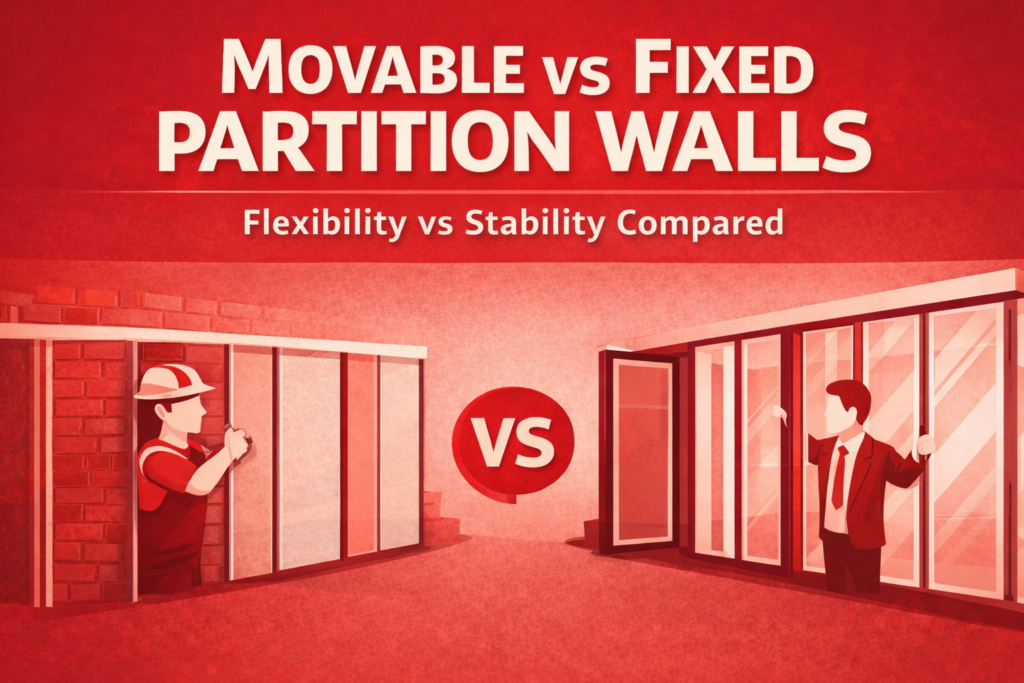
Movable vs Fixed Partition Walls: Flexibility vs Stability Compared

Dec 18, 2025

Introduction: What Are Partition Walls?

Partition walls are internal, non-load-bearing walls used to divide or organise space within homes, offices, schools, and commercial environments. Whether you’re redesigning an open-plan office or splitting a large room into functional zones, choosing the right partition system is essential for aesthetics, performance, and long-term satisfaction.

There are two primary approaches to space division:

  • Fixed partition walls — permanent, stable, hard-wired installations
  • Movable partition walls — flexible, reconfigurable systems

This guide explores movable vs fixed partition walls, comparing their advantages, drawbacks, costs, use cases, and how to decide which solution best suits your needs.


Understanding Fixed Partition Walls

What Are Fixed Partitions?

Fixed partition walls are permanent or semi-permanent structures that remain in place once constructed. They are typically built from traditional materials like timber studs and plasterboard, masonry block, or bespoke glazed systems.

These walls are ideal when you want long-lasting, uncompromising separation between spaces — for example, turning a studio apartment into two rooms or dividing offices permanently.

Key Characteristics of Fixed Partition Walls

Stable and durable – Once installed, fixed partitions remain solid and secure.
High sound insulation potential – Especially when combined with insulation and plaster finishes.
Custom finishes – Can integrate doors, shelving, or built-in lighting.
Longer installation time – Requires more extensive construction work.

Example uses: Bedroom creation, permanent office segmentation, bathrooms and utility rooms.

According to interior design cost guides, a simple stud partition wall typically costs £55–£65 per m² for materials and labour, though this varies with finishes and insulation levels. Checkatrade


Understanding Movable Partition Walls

What Are Movable Partitions?

Movable partition walls — also known as operable, reconfigurable, or operable walls — are systems of panels that can be moved, folded, or stacked to change the layout of a space quickly and efficiently. Unlike fixed walls, they are designed for flexibility and adaptability. Avant

Movable systems are particularly popular in conference centres, offices, classrooms, and open-plan homes where space use changes over time. They can be simple sliding panels, acoustic operable walls, or sophisticated track-mounted partitions.

Key Characteristics of Movable Partition Walls

Highly flexible and adaptive – Reconfigure rooms in minutes.
Quick installation – Minimal disruption and shorter setup.
Range of finishes and materials – Including wood veneer, acoustic panels, glass, and metal.
Scalable design – Easy to add or remove panels over time. midlandmovablewalls.co.uk

Example uses: Changing office layouts, multifunctional event spaces, home offices and play areas.


Movable vs Fixed: Side-by-Side Comparison

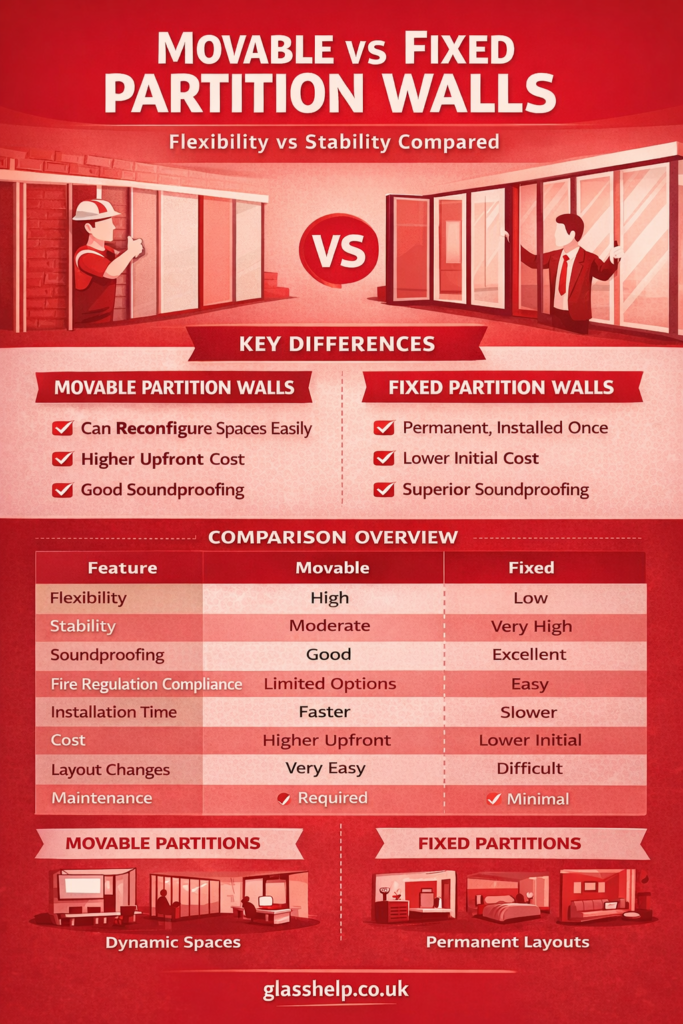
FeatureFixed Partition WallsMovable Partition Walls
Flexibility❌ Low✔ High
Space adaptability❌ Limited✔ Excellent
Acoustic insulation✔ Superior (with insulation)✔ Good to high (depends on system)
Installation timeLongerShorter
Initial costLower for simple systemsOften higher
Aesthetic optionsTraditional finishesWide variety (including modern glass panels)
Future layout changesHarder and costlyEasy and cost-effective

Advantages of Fixed Partition Walls

Stability and Durability

Fixed partitions are constructed to last. They resist wear and tear from impact, temperature fluctuations, and everyday use.

Superior Sound Performance

When properly insulated and sealed, fixed walls can significantly reduce sound transmission, making them ideal for private offices, bedrooms, meeting rooms, and media rooms.

Better Regulatory Compliance

For areas requiring fire ratings or building regulation certification, fixed walls are often simpler to engineer into compliance — particularly where doorways, wiring, and services are integrated.


Disadvantages of Fixed Partition Walls

Inflexible layouts — Permanent separation limits adaptability.
Longer disruption — Installation often involves dust, noise, and extended labour.
Future renovation costs — Removing or altering a fixed wall is costly and time-consuming.


Advantages of Movable Partition Walls

Space Flexibility and Efficiency

Movable walls allow you to reconfigure spaces whenever needed, adapting to daily, weekly, or seasonal changes in use — such as opening up meeting rooms for events or downsizing workspace zones.

Minimal Disruption

Most systems install faster than traditional walls and cause little disruption. They can often be installed without heavy construction tools or wet trades like plastering.

Design Variety & Aesthetics

Modern movable partitions come in a range of finishes, including glass, wood, metal, and acoustic textiles — enabling aesthetics that complement interiors while providing functional separation.

Scalability and Long-Term Value

Because panels can be added or removed, movable systems are future-proof. They allow your space to evolve without major renovation costs. midlandmovablewalls.co.uk


Disadvantages of Movable Partition Walls

Higher initial cost — Particularly for premium acoustic or automated systems.
Potentially lower sound insulation — Unless optimised for acoustic performance.
Maintenance needs — Tracks and moving parts may require upkeep if used frequently.


Where Does Glass Fit In?

For a modern, light-filled space that enhances aesthetics while maintaining separation, glass partition walls are an excellent choice — and they can be either fixed or movable. These systems allow natural light to penetrate deep into interior zones, promote visual connectivity, and give spaces a sophisticated feel.

Explore options and inspiration here: glass partition walls — a stylish and practical solution for both residential and commercial projects.

The sleek transparency of glass partitions has made them increasingly popular in contemporary homes and offices, balancing openness with functional zones. ccl-interiors.com


Which Should You Choose? Key Decision Factors

1. Purpose of the Space

  • Private, permanent rooms: Go with fixed partitions (e.g., bedrooms, consultation rooms).
  • Dynamic or collaborative areas: Movable partitions offer flexibility (e.g., offices, event spaces).

2. Budget and Long-Term Costs

Fixed walls are typically cheaper upfront, but ongoing renovation and demolition costs can add up. Movable systems may cost more initially but provide greater adaptability and future savings.

3. Acoustic Needs

For spaces where privacy and quiet are essential (like therapy rooms or recording studios), fixed walls with proper insulation often outperform movable systems — unless high-end acoustic operable walls are selected.

4. Aesthetics and Vision

If you want a modern, fluid interior where areas transition seamlessly, movable systems or office-grade glass panels bring design flexibility unmatched by traditional walls.


Practical Examples & Use Cases

Office Environments

  • Movable walls allow flexible meeting rooms, quiet zones, and partitioned work areas without permanent construction. midlandmovablewalls.co.uk
  • Fixed walls are more appropriate for private executive offices or secure spaces.

Home Renovations

  • Fixed partitions divide bedrooms, create en-suite bathrooms, or dens.
  • Movable partitions adapt living spaces for remote work, playrooms, and entertaining without compromising light.

Hospitality & Events

Large ballrooms or training facilities benefit from operable partitions to shift between open event space and breakout rooms.


Installation & Cost Considerations

A basic stud partition — including materials and labour — is often more economical (£55–£65 per m²) compared to high-end movable systems. Checkatrade However, costs depend on:

  • Materials (glass, timber, metal, acoustic panels)
  • Panel quality and thickness
  • Installation complexity
  • Acoustic and fire ratings
  • Automation and hardware systems

Conclusion: Flexibility vs Stability

There’s no one-size-fits-all answer. Your choice should reflect how you’ll use the space now — and in the future.

  • Choose fixed partitions for permanence, strong acoustic control, and structural simplicity.
  • Choose movable partitions when adaptability, aesthetics, and dynamic use are priorities.

In modern design, many spaces blend both approaches — using fixed walls for core zones and operable or modular systems where flexibility adds value.

If you’re considering a contemporary, light-filled space, glass partition solutions — including both fixed and movable styles — offer a compelling balance of form and function as you customise your interiors.

Tips

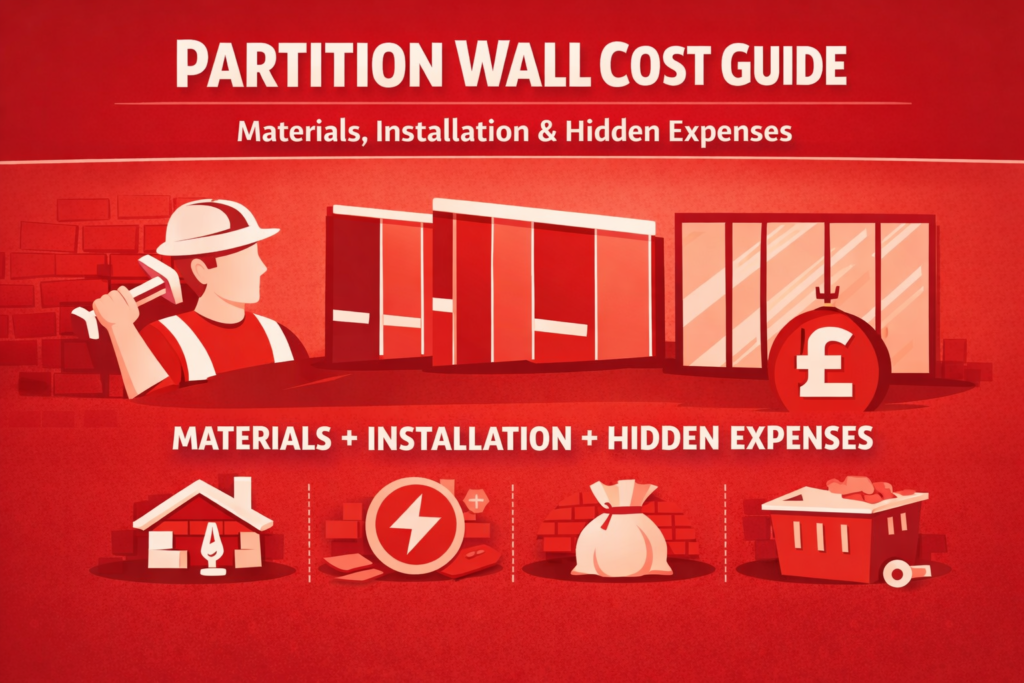
Partition Wall Cost Guide: Materials, Installation & Hidden Expenses

Dec 18, 2025

Are you planning to divide up space in your home or office with a partition wall? Whether it’s to create a new bedroom, an office nook, or reconfigure your workspace, understanding the true cost of a partition wall is crucial. This comprehensive guide walks you through everything you need to budget for — including materials, labour, installation, and those often‑overlooked hidden expenses.


🧱 What Is a Partition Wall?

A partition wall is a non‑load‑bearing wall used to divide space within a building. Unlike structural walls, partition walls don’t carry the weight of the roof or upper floors. Their purpose is mainly functional and aesthetic — to create enclosed areas, provide privacy, improve acoustics, or define zones within open‑plan spaces.

There are many types of partition walls, from basic stud walls to high‑end glazed systems.


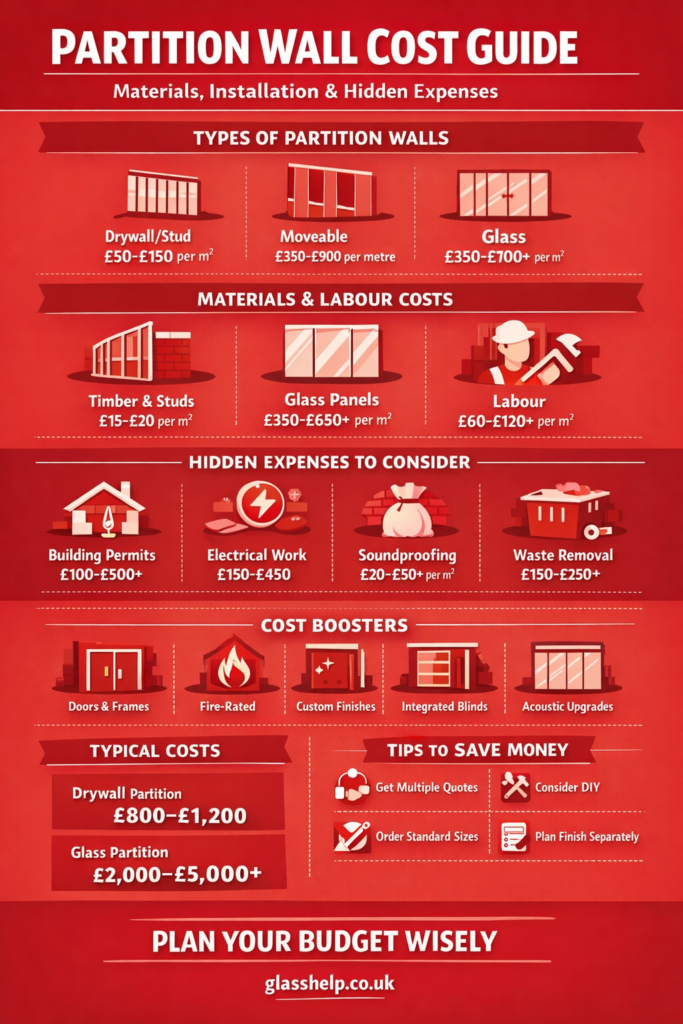
📊 Typical Costs by Partition Wall Type

Costs vary significantly based on material and complexity. Below are rough UK figures to help you plan your budget (labour and materials combined unless stated otherwise):

🔹 Drywall / Stud Partition Walls

One of the most common and cost‑effective options.

  • Materials: Timber or metal frame + plasterboard
  • Typical Cost: £50 – £150 per m² installed (varies by finish and insulation) partitionwallcompany.co.uk

🔹 Moveable Partition Walls

Modular or track‑mounted panels that can be reconfigured.

🔹 Glass Partition Walls

For more modern, light‑filled spaces see: Glass Partition Walls — a stylish solution often chosen for offices and contemporary homes.

Quick tip: Glass partitions usually cost more than drywall but can dramatically enhance aesthetics and light flow.


🛠️ Materials Breakdown & What They Cost

Here’s a closer look at common materials and how they contribute to total costs:

📌 Timber & Metal Studs

  • Stud Frame: £15 – £20 per m²
  • Plasterboard Sheets: £3 – £5 per m²
  • Insulation: £4 – £7 per m²
    These make up the backbone of drywall partition systems. MyBuilder

📌 Plaster and Finishing

Once studs and boards are up, partitions often need plastering:

  • Plastering: £150 – £200 per wall (for minor walls)
  • Painting / Decorating: £1 – £3 per ft²
    These finishing costs can be a significant portion of your budget.

📌 Glass Panels & Hardware

Glass panels vary dramatically in price depending on thickness, framing and finish:

  • Framed Glass: £200 – £450 per m²
  • Frameless or Premium Systems: £300 – £650+ per m²
    Custom glazing, privacy film or acoustic seals add to the cost. Kova

👷 Labour & Installation Costs

Labour is usually the biggest expense after materials, and rates vary across regions and trades.

🧰 Drywall & Stud Wall Installation

  • Labour Only: £60 – £85 per m² for standard stud partitioning smartspender.uk
  • Typical Installation Time: 1–3 days for a small‑to‑medium wall

🪟 Glass Partition Installation

Some specialist installers charge on a per‑panel basis — expect around £120+ per panel with added costs for doors, trims, and access complications. nationalglasspartitions.co.uk

Tip: Installation complexity (e.g., stairs, access, non‑standard heights) can push prices up significantly.


📌 Hidden & Additional Expenses

You might budget for materials and labour, but several less obvious costs often get overlooked:

➤ Building Regulations & Permits

If your partition wall affects fire safety or changes room sizes, building control may be required.
Cost impact: £100 – £500 or more depending on local authority fees.

➤ Electrical & Lighting Work

Adding sockets, switches or light fittings in a new partition adds:

  • Electrician: £50 – £80 per hour
  • Rewiring / Feed Costs: £150 – £450 depending on complexity

➤ Acoustic Treatment

Partitions in offices or studios might need soundproofing:

  • High‑performance insulation & seals: £20 – £50+ per m²

➤ Waste Removal & Site Prep

Don’t underestimate logistics:

  • Skip hire / waste removal: £150 – £250+
  • Extra site prep time: Charged at standard labour rates

🧩 Common Features That Raise Costs

Here’s a quick checklist of elements that typically increase your total:

✔ Adding a door or frame
✔ Fire‑rated systems
✔ Integrated blinds or privacy film on glass
✔ Custom finishes (feature textures, painting, wallpaper)
✔ Built‑in storage or shelving
✔ Higher acoustic performance

Each of these features adds time, skill and materials to the project.


📆 Timeline Expectations

Your project timeline influences labour costs too:

Partition TypeEstimated Installation Time
Simple stud wall1–2 days
Stud wall with insulation & finishing2–3 days
Glass partition2–4 days (site dependent)

Delays in delivery of custom panels or specialist hardware can hold up progress — so order materials early and confirm lead times with suppliers.


🏡 Cost Examples (UK Context)

To put figures into perspective:

These costs are averages — your exact quote could be higher or lower depending on site conditions and design complexity.


🧠 Tips to Save Money Without Sacrificing Quality

Here are practical ways to reduce overall cost:

1. Get Multiple Quotes
Always compare at least three suppliers/contractors.

2. Consider DIY for Simple Walls
If you have skills and time, you might save on labour — especially for drywall partitions.

3. Order Standard Sizes
Custom glass and framing add significantly to cost and lead time.

4. Plan Finish Work Separately
Painting and decorating can often be scheduled after installation to reduce job interruptions.

5. Minimise Electrical Moves
Plan layout to avoid moving sockets and switches if possible.


📌 Final Thoughts

Partition walls are one of the most effective ways to divide and enhance interior space — whether for functionality, privacy or visual appeal. Budgeting realistically means considering not just materials and labour but also the additional costs that come with electrical work, finishes, acoustics, and regulatory compliance.

For sleek and modern partitions that maximise light and space, consider exploring glass partition options — see Glass Partition Walls to learn more about stylish solutions and get inspiration for your next project.

Tips

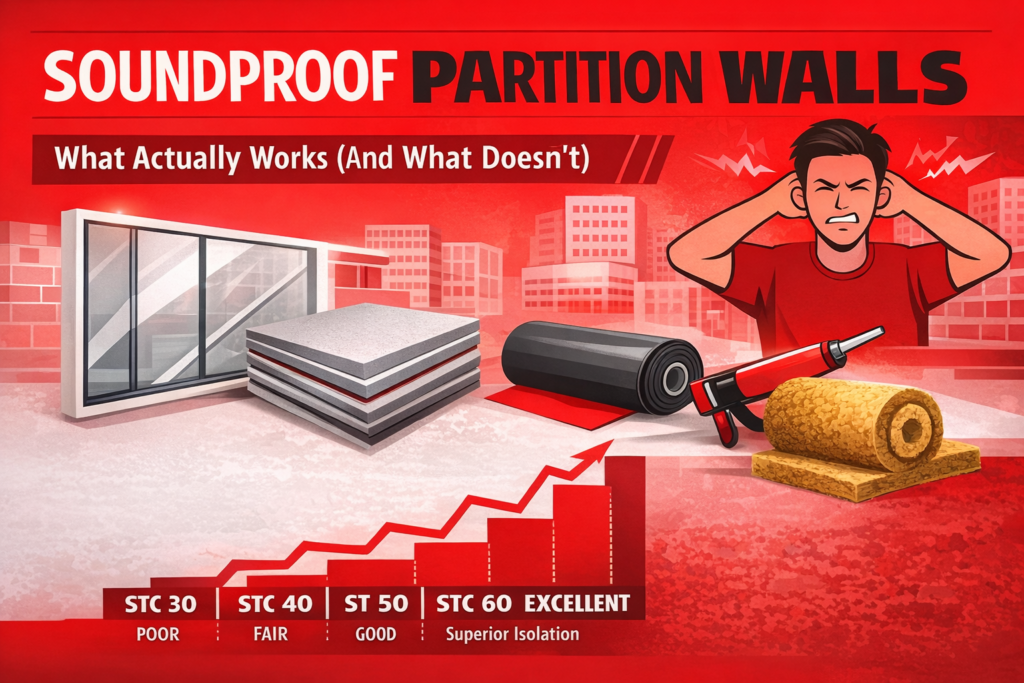
Soundproof Partition Walls: What Actually Works (And What Doesn’t)

Dec 18, 2025

In an increasingly noisy world — from open‑plan offices to shared apartments — the ability to block unwanted sound has become essential. Whether you’re creating quiet meeting rooms, peaceful home spaces, or professional studios, the right kind of soundproof partition walls can make all the difference.

But with countless products and construction methods being marketed, how do you separate what actually works from what’s merely hype? This comprehensive guide explains the acoustic principles behind effective soundproofing, reveals the best materials and construction strategies, and highlights common mistakes to avoid.


Understanding Sound Transmission

Before diving into solutions, it helps to understand how sound travels and why some walls fail to block it.

Sound moves through two main paths:

  • Airborne noise — voices, music, or traffic sound transmitted through air gaps.
  • Structure‑borne noise — vibrations traveling through solids, like the studs and framing of a wall.

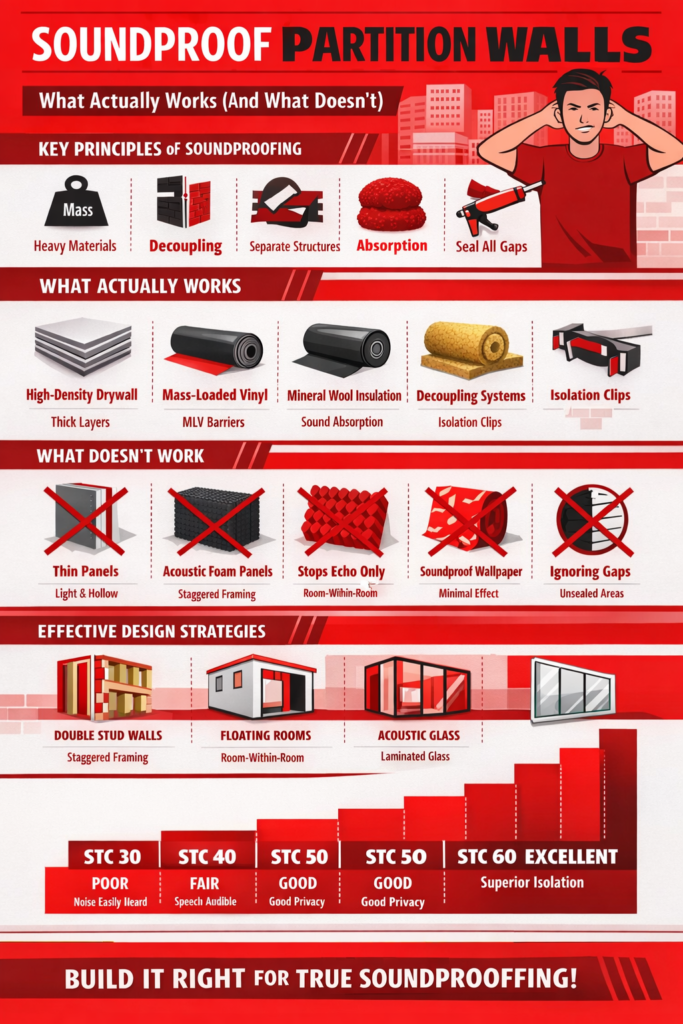
The Sound Transmission Class (STC) rating quantifies how well a wall blocks airborne sound: the higher the STC, the better the performance. Typical occupiable spaces aim for STC 45 or higher to significantly reduce audible noise between rooms. Malrox


Core Principles of Effective Soundproofing

Achieving good sound reduction isn’t about one single trick — it’s about combining multiple acoustic strategies effectively:

🧱 Mass

Heavier walls block sound more effectively because dense materials resist the passage of sound waves. Adding extra layers of dense drywall increases mass and improves acoustic performance. Coohom

🔗 Decoupling

If two sides of a wall are rigidly connected, vibration easily transfers through. Techniques like resilient channels, isolation clips, or double‑stud walls break that path, reducing vibration transmission. Interior GLOBAL

🧠 Absorption

Filling wall cavities with materials such as mineral wool or fiberglass absorbs sound energy and limits resonance inside the wall. Coohom

🪟 Sealing Gaps

Sound leaks through even tiny gaps at outlets, around doors, and at seams. Sealing with dedicated acoustic sealants around all penetrations creates a continuous barrier. Interior GLOBAL


Materials That Actually Work

The following materials and methods are widely validated as effective in real‑world soundproofing:

✔️ High‑Density Drywall

Also known as acoustic gypsum board, it is denser than standard drywall and provides improved sound blocking, especially when used in multiple layers. Ikoustic Soundproofing

✔️ Mineral Wool or Fiberglass Insulation

These materials fill wall cavities and trap sound waves. Mineral wool provides excellent acoustic performance and fire resistance, making it a top choice for partition walls. Coohom

✔️ Mass‑Loaded Vinyl (MLV)

A flexible but dense membrane that adds significant mass to a partition. MLV can be installed between drywall layers to enhance sound blocking without increasing wall thickness drastically. MQ Acoustics

✔️ Decoupling Systems

Resilient channels and sound isolation clips reduce structural vibration transfer by breaking direct contact between drywall and framing. Interior GLOBAL

✔️ Acoustic Glass Options

For spaces where transparency matters — like offices or lounges — acoustic laminated glass provides much better sound isolation than ordinary glass. To explore stylish and functional choices, check out this guide on glass partition walls which balances aesthetic needs with acoustic performance.


What Doesn’t Actually Work (Or Works Poorly)

There are plenty of products and methods marketed as “soundproofing” that offer limited real benefit:

❌ Acoustic Foam Panels (as Soundproofing)

While effective at reducing echo inside a room, foam panels do not meaningfully block sound transmission through the wall itself. They address reverberation, not sound insulation. Wikipedia

❌ Lightweight Single Panels

Cheap or thin partition boards that lack mass will fail to stop noise effectively, especially at lower frequencies.

❌ Decorative “Soundproof Wallpaper”

Despite claims, these typically add minimal mass or damping and therefore have negligible impact on actual sound transmission.

❌ Ignoring Small Openings

Great materials can be undermined by unchecked gaps around fixtures, conduits, and doors. Always ensure continuous sealing to prevent sound leaks. Interior GLOBAL


Design Strategies That Deliver Results

Here are practical construction approaches that have proven acoustic performance:

🔹 Staggered or Double Stud Walls

These wall assemblies separate the two faces of the partition, creating an air gap that significantly reduces structure‑borne noise. Interior GLOBAL

🔹 Floating Walls

For extreme noise control (e.g., recording studios or high‑privacy spaces), building a floating or room‑within‑a‑room structure provides excellent isolation by fully decoupling surfaces.

🔹 High‑Performance Sliding or Modular Partitions

Partitions with core materials like rock wool or polyurethane foam, combined with tight seals, offer superior STC ratings for office or event spaces. Malrox

🔹 Careful Edge Detailing

Make sure that all edges, electrical boxes, and service penetrations are sealed with acoustical sealant. This single step often improves measured sound performance by several decibels.


Practical Soundproofing Tips (By Space)

🏢 Office Environments

Modular, insulated partitions with high STC ratings and seals around doors create privacy without heavy construction. Consider laminated acoustic glass in collaborative areas.

🏠 Shared Homes & Apartments

If bedrooms or living areas share walls, a retrofit using insulation, extra drywall, and MLV can dramatically reduce noise transfer.

🎙️ Studios & Creative Spaces

Combine decoupling, damping compounds, and layered assemblies to control both airborne and structure‑borne noise.


Typical STC Ratings & What They Mean

STC RatingTypical Performance
25–35Low — voices easily heard
35–45Moderate — loud speech less clear
45–55High — good privacy
55+Excellent — very effective separation

Conclusion

Effective soundproof partition walls don’t come from fancy labels — they come from proven acoustic principles applied with the right materials and craftsmanship. Successful strategies combine mass, decoupling, absorption, damping, and airtight sealing. Conversely, solutions that rely on superficial products or ignore structural design offer minimal results.

Whether you’re upgrading an office, managing noise in a residential property, or creating a studio space, understanding what works and what doesn’t helps you invest wisely and achieve the quiet, comfortable environments you want.

Tips

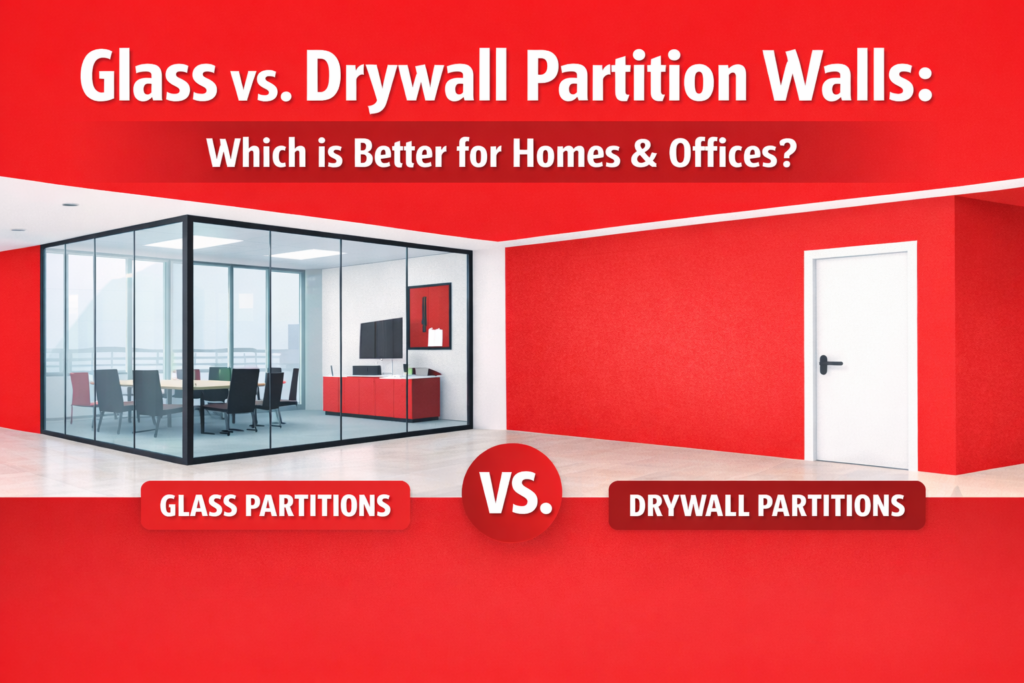
Glass vs. Drywall Partition Walls: Which Is Better for Homes & Offices?

Dec 18, 2025

Partition walls may seem minor, but they greatly influence light, privacy, acoustics, aesthetics, and long-term costs. Two dominant options are glass partition walls and drywall (gypsum) partitions. Both have their strengths, and this guide helps you choose the right one.


1. What Are Partition Walls?

Partition walls are non-load-bearing dividers that separate interior spaces without supporting structural weight. Common uses:

  • Homes: living areas, bedrooms, home offices
  • Offices: meeting rooms, breakout zones, private offices
  • Retail and commercial: changing rooms, work areas
  • Studios/creative spaces: flexible layouts

Most common systems:

  • Glass partition walls
  • Drywall (gypsum) partitions

2. Glass Partition Walls

Glass partitions use tempered or laminated glass panels, often frameless or with slim frames, to divide spaces while allowing natural light to flow. Ideal where openness, light, and modern aesthetics matter.

Explore real-world examples and finishes in this details on glass partition walls.

Glass partitions come in:

  • Clear, frosted, or tinted glass
  • Frameless or slim-framed systems
  • Fixed or demountable types

3. Drywall Partitions

Drywall partitions use metal or timber studs with plasterboard (gypsum) panels. They are widely used for privacy, sound insulation, and finishing flexibility.

Key features:

  • Fully opaque walls
  • Paint, wallpaper, or tiles applied easily
  • Can house wiring, insulation, and fixtures
  • Cost-effective for permanent layouts

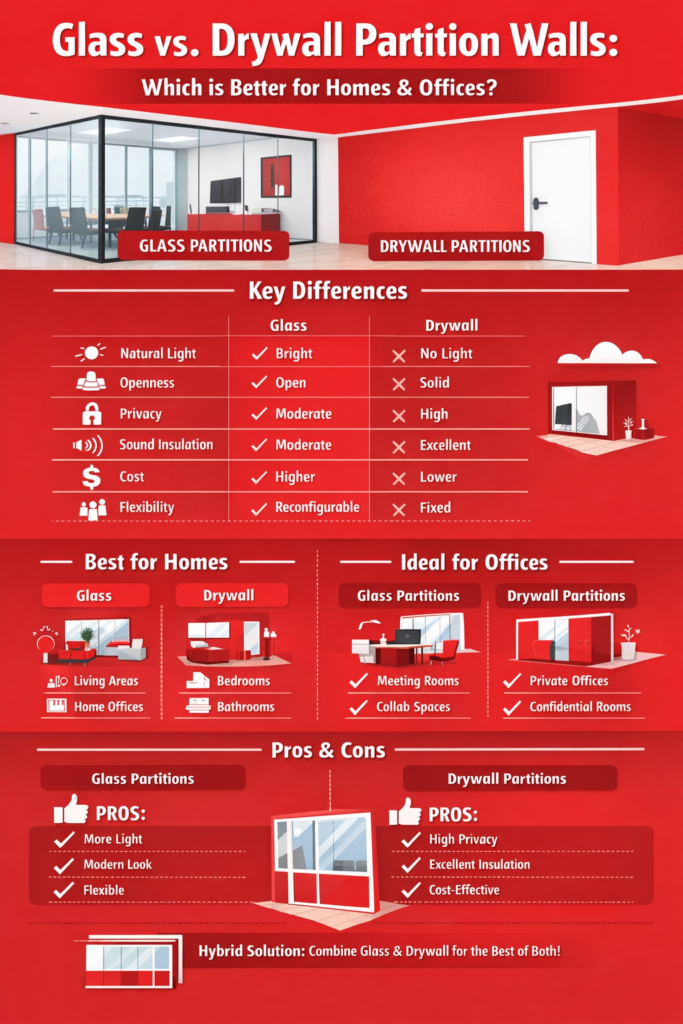
4. Glass vs. Drywall: Comparison

FeatureGlass Partition WallsDrywall Partitions
Natural LightExcellentBlocks light
Visual OpennessVery HighLow
PrivacyMedium–High (frosted/acoustic glass)High
Acoustic PerformanceModerate–High with acoustic glassHigh
Installation DisruptionFast, minimal messSlower, dusty
Initial CostHigherLower
Long-Term FlexibilityHighLow
MaintenanceEasy wipePatching/repaint

5. Aesthetics & Space Perception

Glass Partitions

Allow daylight to penetrate interiors, improving brightness, visual connection, and openness. Perfect for:

  • Open-plan offices
  • Reception areas
  • Modern residential layouts

See more insights on light and transparency benefits: mrglassmirror.com

Drywall Partitions

Provide a solid, traditional feel, ideal for privacy and areas where containment is essential:

  • Bedrooms
  • Bathrooms
  • Confidential offices

Additional reading: officerenovation.com


6. Acoustic Performance & Privacy

  • Drywall: Superior sound insulation; ideal for bedrooms, meeting rooms, offices (partition.my)
  • Glass: Moderate to high with acoustic laminated glass and seals (prancebuilding.com)

Hybrid solutions (solid lower panels + glass upper panels) are popular in modern office layouts.


7. Cost & Installation

Initial Cost

  • Drywall: Lower upfront cost (whatblueprint.com)
  • Glass: Higher cost due to premium materials

Installation

  • Glass partitions: Fast, low mess (officemantra.in)
  • Drywall: Slower, dusty, requires finishing

Long-Term Value

  • Glass partitions (demountable/modular) allow reconfiguration, saving renovation costs (kovapartitions.co.uk)
  • Drywall may require patching, repainting, or rebuild when layouts change

8. Maintenance & Durability

AspectGlassDrywall
CleaningEasy wipeRepaint/patch
Impact ResistanceGoodModerate
Moisture ResistanceExcellentSensitive unless treated
Visual WearMinimalMay require touch-ups

9. Fire Safety & Building Codes

Consult qualified contractors for compliance.


10. Best Choice by Space

Homes

  • Bedrooms & Bathrooms: Drywall
  • Home offices & Living areas: Glass
  • Small interiors: Glass enhances light and space

Offices

  • Meeting rooms & collaboration zones: Glass
  • Private/confidential offices: Drywall or acoustic glass
  • Flexible workplaces: Demountable glass partitions

11. Hybrid Solutions

Combine solid lower panels for privacy with glass upper panels for light and openness. This balances functionality, aesthetics, and acoustic performance.


12. Conclusion

No universal winner:

  • Drywall: Best for privacy, sound insulation, and cost-sensitive projects
  • Glass partitions: Best for light, openness, aesthetics, flexibility, and long-term adaptability
Tips

How To Choose Right Size Of Wall Mirror

Dec 15, 2025

Choosing the right size wall mirror is about balance, proportion, and purpose — not just aesthetics. Whether you’re placing a mirror above a console table, over a bathroom vanity, or on a feature wall, the correct dimensions can enhance space, reflect light, and improve visual harmony.

This guide walks you through practical size rules, placement tips, and design insights for mirrors in modern homes.


Why Mirror Size Matters

A mirror that’s too small can look lost on a wall, while one that’s too large can overwhelm a space. The right size enhances:

  • Spatial perception — larger mirrors can make small rooms feel bigger
  • Lighting — mirrors boost natural and artificial light
  • Design balance — proper proportions tie décor together

Getting the size right ensures your mirror complements — rather than competes with — the room’s layout. Journeyman HQ


1. Use Proportion Rules for Furniture and Walls

Above Furniture

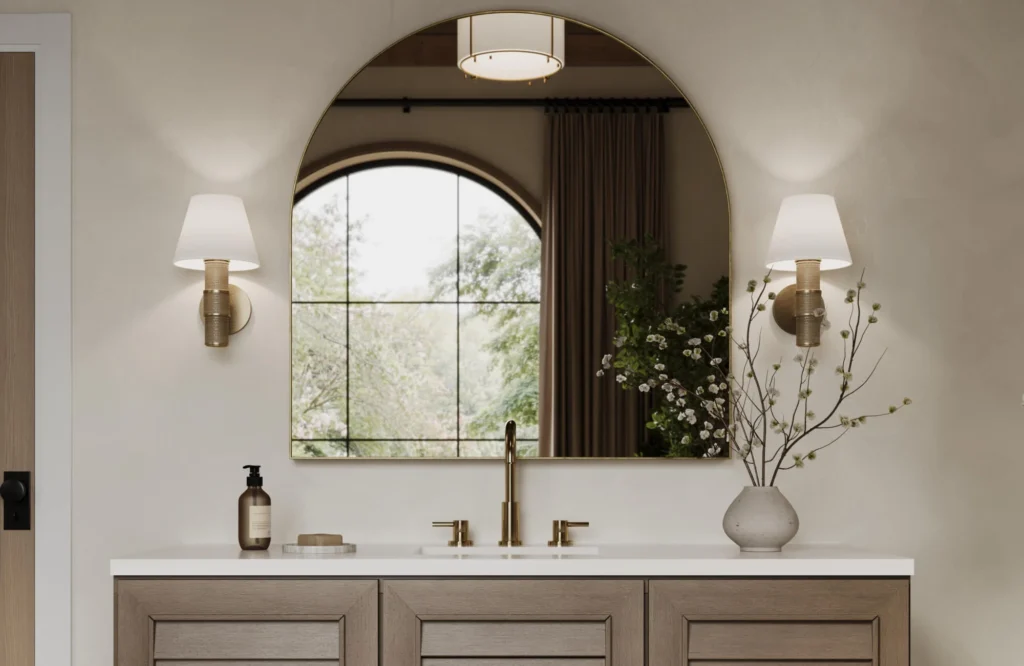
A key rule of thumb used by designers is that a mirror should be about 60–75% the width of the furniture it hangs over (like a console, dresser, or bathroom vanity). This keeps proportions visually balanced without overpowering the piece below it. Journeyman HQ

For example:

  • A console that’s 60″ wide works well with a mirror ~36–45″ wide
  • A bathroom vanity that’s 48″ wide should pair with a mirror ~30–36″ wide

Above a Sofa or Mantel

A mirror should typically span two‑thirds the width of a sofa or mantel to create harmony and a centered look, a guideline echoed by interior designers. Ideal Home


2. Consider Eye‑Level and Height Placement

Where you place your mirror matters as much as its size.

Eye‑level center: A common convention is to position the center of the mirror at roughly 60″ from the floor, aligning with average eye height for most adults. Moon Mirror
Vanity heights: In bathrooms, allow the bottom of the mirror to sit 4–10″ above the vanity top so lighting and fixtures don’t interfere with functionality. Moon Mirror

Design tip: If your household is taller or shorter than average, adjust slightly — but keep the centered height rule as a starting point.


3. Match Mirror Size to Room Function

Thinking about why you need the mirror helps you choose size and shape to suit its function:

Living Room Mirrors

These often serve both decorative and space‑enhancing purposes. Go for larger mirrors that reflect light and open up the room, ideally sized around:

  • 50–70% of wall width for focal walls
  • Positioned opposite windows for light reflection

Avoid tiny mirrors on large blank walls — they can look insignificant and mismatched. Property Finder

Bathroom Vanity Mirrors

In bathrooms, the mirror should be wide enough to cover the sink area but not so large that it hits cabinets or lighting. A good guideline is:

  • 70–80% of vanity width for single mirrors
  • Or two individual mirrors on double vanities, each sized proportionally to the sinks underneath. Journeyman HQ

Full‑Length Mirrors

For bedrooms or dressing areas, a full‑length mirror should be tall enough to show head‑to‑toe reflection:

  • Aim for at least 48–60″ tall
  • Width can be narrower, usually 16–24″, depending on space

4. Balance Visual Space with Practical Clearance

Designers often recommend leaving some visible wall space around a mirror so it doesn’t feel like it’s “pressed into” the space. When sizing your mirror:

✔ Leave at least 6″ of clear wall on all sides if possible
✔ Avoid edges hitting built-in fixtures like shelves, sconces, or heavy artwork
✔ Ensure the mirror doesn’t visually compete with nearby décor

This helps mirrors feel intentional rather than cramped or awkward. Moon Mirror


5. Choose Mirror Shape With Size in Mind

The shape of a mirror influences how big it feels in a room:

  • Rectangular mirrors can make walls look wider or taller depending on orientation
  • Round mirrors are ideal when you want softer visuals and lighter impact
  • Vertical mirrors add height perception in narrow spaces
  • Horizontal mirrors widen visual lines in broader rooms

Selecting a shape that complements your chosen size helps maintain visual balance and achieves your design goals. Moon Mirror


6. Common Mistakes to Avoid

Sizing too small for the wall: A tiny mirror on a large wall appears underwhelming and out of scale. Property Finder
Hanging too high or too low: Mirrors placed too high disconnect from everyday use and disrupt proportions. Property Finder
Ignoring mirror placement relative to lighting: Misplaced mirrors can reflect light badly or amplify glare. Property Finder

Always mark the wall with painter’s tape before purchasing to visualize scale and placement.


A Practical Mirror Size Checklist

✔ Measured wall width and furniture underneath
✔ Mirror width ~60–75% of furniture length
✔ Center ~60″ above floor for best eye‑level alignment
✔ Enough clearance from lights, cabinets, and fixtures
✔ Consider shape relative to room height and width


Conclusion

Choosing the perfect mirror size is about proportion, placement, purpose, and style. By following design rules — such as making the mirror around 60–75% the width of the furniture below, centering it at eye level, and considering room function — you ensure your mirror enhances both the space and its aesthetic.

And if you’re looking for mirrors that fit beautifully and precisely into your space — whether standard or custom sizes — explore GlassMirrorPro’s wall mirror collection for premium options that balance design and functionality.

Tips

Mirrored Walls: Are They Right for Your Space?

Dec 15, 2025

Mirrored walls have transitioned from a design trend to a powerful interior design tool that enhances light, creates the illusion of space, and adds visual drama. Whether you’re decorating a modern living room, a cozy hallway, or a stylish bedroom, mirrors offer both practical and aesthetic benefits. But they’re not right for every space — and thoughtful placement and execution are key to maximizing their impact.

In this guide, we’ll explore the advantages and potential drawbacks of mirrored walls, how to use them effectively, and design tips to help you decide if they’re right for your home.


What Are Mirrored Walls?

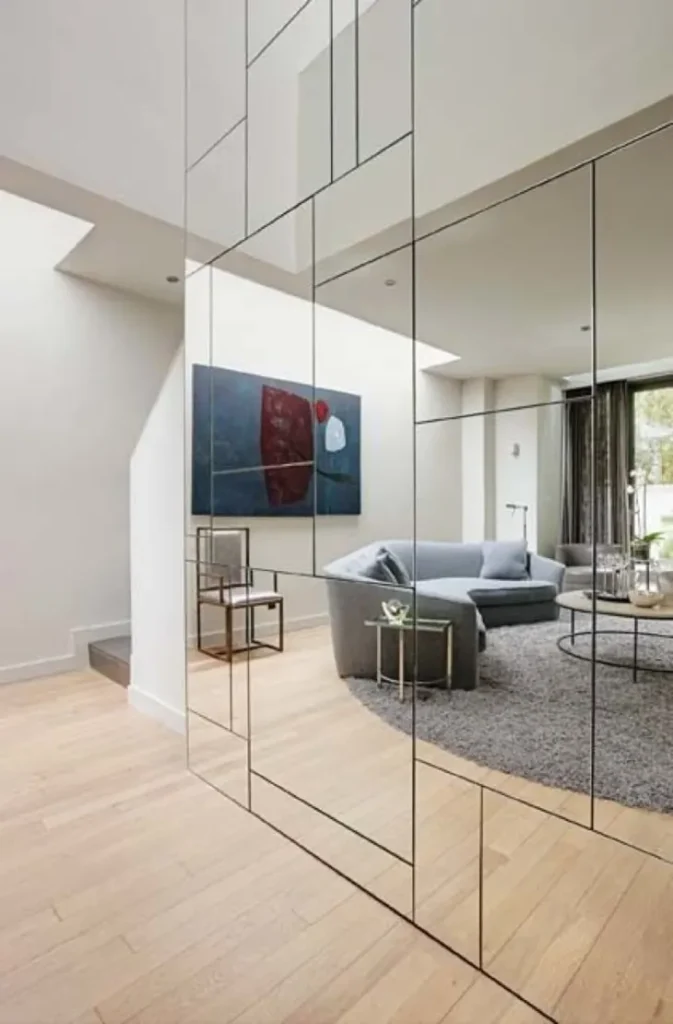
A mirrored wall is exactly what it sounds like — a wall that has been partially or fully covered with mirror panels or large mirror sheets. Rather than a single framed mirror, the surface becomes reflective, turning the entire wall into a dynamic design element.

Mirrored walls are often used to:

  • Amplify natural light
  • Visually enlarge small spaces
  • Create a focal feature in modern interiors
  • Reflect architectural details or viewpoints

They can be smooth, paneled, segmented, patterned, or arranged in artistic configurations, depending on your aesthetic goals. NoBroker


Benefits of Mirrored Walls

1. Amplify Natural and Artificial Light

When paired with well‑placed lighting, mirrored walls can double the brightness in a room by bouncing both daylight and lamp light around the space. Placing mirrors opposite windows or near light fixtures sends illumination deeper into the room, making even dim spaces feel light and airy. Edward Martin

Design tip: For the best effect, use mirrored walls across from a primary light source, such as a large window or a series of wall sconces.


2. Create the Illusion of Space

One of the most compelling reasons to install mirrored walls is their ability to make rooms appear larger than they are. This optical illusion works particularly well in:

  • Small apartments
  • Narrow hallways
  • Compact living rooms
  • Windowless interiors

By reflecting walls and ceilings, mirrors create a sense of visual depth that extends beyond the actual physical boundaries. Archeworks


3. Enhance Aesthetic Impact

Mirrored walls can become a signature design statement. Whether it’s a sleek, framed wall in a modern home or a panel‑arranged wall with artistic flair, mirrors can act as functional art — reflecting furniture, textures, and décor elements around your space. Murshid Interiors

They also pair beautifully with accent lighting, textured paint, or decorative wall panels, giving your room an upscale, curated look.


Where Mirrored Walls Work Best

Living Rooms

Mirrored walls in living spaces can reflect architectural details, furniture groupings, or outdoor scenery, making the room feel more expansive and inviting.

Hallways and Entryways

These often narrow spaces benefit immensely from mirrored walls. They make corridors feel wider and brighter, and can transform an underwhelming entryway into a dramatic focal experience.

Dining Rooms

Mirrors opposite windows or artwork in dining rooms create layered reflections, amplifying light and making dinner gatherings feel more open and lively.

Bedrooms

Mirrored walls in bedrooms should be used carefully — they can enhance space, but overly reflective surfaces behind the bed may feel too visually intense. Consider partial mirrored panels or mirrored accents for a softer effect.


Potential Drawbacks to Consider

While mirrored walls offer significant design advantages, there are a few challenges to keep in mind:

1. Maintenance and Cleaning

Large mirrored surfaces require regular cleaning to prevent smudges, fingerprints, and streaks — especially near high‑traffic areas or in homes with children and pets.

2. Overwhelming Reflection

If not placed thoughtfully, mirrored walls can feel overwhelming or too bright. Mirrors that reflect clutter, unappealing views, or busy patterns can detract from rather than enhance a room.

Design tip: Aim to reflect attractive areas — outdoor views, architectural features, or curated décor — rather than functional but cluttered zones like desk piles or busy shelves. Good Housekeeping


Design and Placement Tips for Mirrored Walls

Here are professional tips to help you plan mirrored walls that look intentional and stylish:

1. Choose the Right Wall

The best wall to mirror is often the one opposite a window or primary light source, which maximizes reflected brightness.

2. Use Mirror Panels for Flexibility

Instead of a single large sheet — which can be hard to install and maintain — consider mirror panels arranged in symmetry or pattern. This gives you design flexibility and easier maintenance. NoBroker

3. Frame or Edge Treatment

Framed mirror panels can balance their reflective impact and help them integrate with your décor. Consider metal, wood, or even decorative edge treatment for a custom look.

4. Layer With Other Décor

Mirrors don’t have to stand alone. Pair them with artwork, sconces, or textiles to create layered visual interest.

5. Mind Scale and Proportion

  • A mirror that’s too small on a large wall can feel out of place.
  • A mirrored wall that’s too dominant may overpower delicate furnishings.

A simple rule: Scale your mirror to fill 60–80% of the wall width for balanced impact.


Mirrored Walls and Mirror Products

Mirrored walls share much in common with decorative and functional wall mirrors. For customized projects — whether you want mirrored panels, large wall mirrors, or specific glass finishes — high‑quality mirrors tailored to your space are key.

Explore premium options such as:

👉 Wall mirrors from GlassMirrorPro — including designs that work beautifully as focal points or architectural features in residential and commercial spaces.


Conclusion — Are Mirrored Walls Right for You?

Mirrored walls can be a transformative design element when used thoughtfully. They are especially powerful when:

✔ You want to brighten dark spaces
✔ You need to enlarge a small room visually
✔ You’re creating a modern, dramatic focal point
✔ You want to reflect garden views or architectural details

However, they require maintenance, careful placement, and design integration to avoid overwhelming the space or reflecting unattractive views.

With the right strategy — pairing mirrored walls with smart lighting, quality glass products, and intentional décor — this design technique can be both practical and breathtaking, turning ordinary walls into dynamic, light‑enhancing features.

Tips

Creative Mirror Shapes for Modern Homes

Dec 15, 2025

Mirrors are more than functional surfaces — they are architectural design elements that can define a space, amplify light, and express your personal style. In modern homes, mirror shapes play a huge role in shaping ambiance and enhancing décor. From geometric compositions to organic silhouettes, creative mirror shapes transform walls into expressive design statements that are both stylish and practical.

Below, we explore the most compelling mirror shapes for contemporary interiors — how they influence space, where to place them, and why they’re trending in modern homes.


Why Mirror Shape Matters in Modern Design

In interior design, the shape of a mirror affects both aesthetic flow and spatial perception:

Curved shapes soften angular layouts
Geometric shapes add crisp, modern rhythm
Asymmetrical mirrors bring artistic flair
Clustered shapes create dynamic wall installations

Choosing a unique shape (rather than a basic rectangle or square) turns a mirror into functional art — reflecting light while enhancing the visual narrative of a room. Housely


1. Round and Oval Mirrors — Soft, Elegant Statements

Round Mirrors

Round mirrors bring harmony and softness to spaces heavy with straight lines.

  • Perfect over consoles, sofas, or vanities
  • Great for minimalist or Scandinavian interiors
  • Helps visually open small rooms without sharp edges

Round and oval mirrors work beautifully in transitional styles, lending serene balance. Camden Isle

Oval Mirrors

Oval mirrors elongate walls and can increase the perception of vertical space.

  • Very effective in entryways and bedrooms
  • Softer than rectangles but more dynamic than simple circles
  • Adds an elegant curve without overwhelming a modern aesthetic Camden Isle

2. Geometric Shapes — Bold and Contemporary

Geometric mirrors are trending because they mix art with utility. These include:

Hexagonal Mirrors

Six‑sided mirrors create visual interest and structure. They can be used solo or in clusters for a modern gallery wall. Locksmith Townsville

Triangular & Diamond Mirrors

Angular shapes add sharpness and edge, making them ideal for contemporary and minimalist spaces. They can be clustered for a dynamic effect on a feature wall. Locksmith Townsville

Octagonal Mirrors

Octagon mirrors offer a hybrid between square and circular designs — sharp but elegant, perfect for entryways or dining rooms. MagicBricks

These shapes aren’t just decorative — they reflect light in interesting directions and can visually expand a space in unique ways. Archeworks


3. Arched and Architectural Mirrors — Timeless with a Modern Twist

Arched mirrors blend classical architectural curves with contemporary simplicity. Their shape evokes the feel of soft windows or portals, adding height and openness to interior walls.

  • Works well above mantels, sofas, or hall consoles
  • Adds a sense of grandeur, especially in narrow spaces
  • Pairs beautifully with modern farmhouse or transitional décor Pavilion Broadway

4. Asymmetrical and Organic Forms — Artistic and Playful

Modern interiors increasingly embrace mirrors with irregular outlines and organic silhouettes.

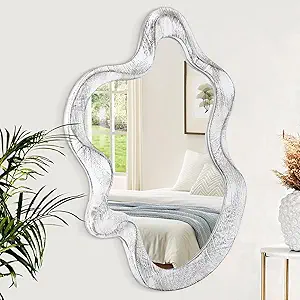
  • Known as blob, free‑form, or fluid mirrors
  • These mimic shapes found in nature and create a relaxed, artistic vibe
  • Works great in living rooms, galleries, or bathroom feature walls

Interior design trend reports highlight that asymmetrical mirrors are emerging as a key element in contemporary décor, adding subtle motion and personality to interiors. Livingetc


5. Sunburst and Starburst Mirrors — Eye‑Catching Focal Points

Inspired by mid‑century modern design, sunburst and starburst mirrors blend radial lines with reflective surfaces. These shapes make dramatic centerpieces, particularly over fireplaces or dining walls.

  • Add a sculptural element to a room
  • Reflect light dynamically, brightening surrounding spaces
  • Pair well with neutral palettes and minimalist furnishings Pavilion Broadway

6. Clustered & Multi‑Mirror Arrangements

Rather than a single mirror, modern design is embracing mirror groupings — multiple shapes arranged like wall art.

  • Combines round, geometric, and organic mirrors
  • Can be symmetrically or asymmetrically arranged
  • Works as a feature gallery wall that amplifies visual depth

This practice turns reflective surfaces into art installations that enhance light and spatial perception. Archeworks


Choosing the Right Mirror Shape for Your Space

When selecting a mirror shape, consider these design principles:

Room Size & Ceiling Height

  • Tall, narrow mirrors elongate walls
  • Round or grouped mirrors soften tight corridors

Lighting Conditions

  • Placing shaped mirrors opposite windows amplifies natural daylight
  • Shapes that “catch” light (like sunbursts or octagons) can brighten dim corners

Existing Decor Style

  • Minimalist/interior: Geometric or frameless organic shapes
  • Transitional/classic: Arched and oval mirrors
  • Eclectic/boho: Mixed shapes and layers of mirrors

Functional Art Meets Reflective Utility

Creative mirror shapes bridge art and practicality. They not only serve reflective functions — helping you groom, brighten, or open up a room — but also act as decorative anchors that tie interior themes together.

For tailored mirror options that elevate modern interiors — from elegant round forms to bold geometric and organic silhouettes — explore the contemporary designs on GlassMirrorPro’s wall mirror collection, where both style and function are thoughtfully curated.


Final Thoughts

Whether you choose soft curves, crisp geometric edges, or playful asymmetrical forms, creative mirror shapes are a powerful design tool in modern homes:

✨ Round & oval for a friendly, balanced look
✨ Geometric for bold, architectural flair
✨ Arched for elevated elegance
✨ Organic shapes for artistic expression
✨ Clustered formats for dramatic visual storytelling

With the right shape and placement, a mirror instantly makes a room feel brighter, larger, and more intentional — turning reflection into remarkable design.