
Common Mistakes People Make When Ordering Custom Cut Mirrors
Custom cut mirrors are designed to fit perfectly, enhance light, and elevate interiors. But because they are made to exact measurements, small mistakes during ordering can become expensive problems.
Whether you’re buying a mirror for a bathroom, hallway, gym, or furniture project, understanding the most common ordering mistakes can save time, money, and frustration.
This guide highlights the most frequent errors people make when ordering custom mirrors—and how to avoid them.
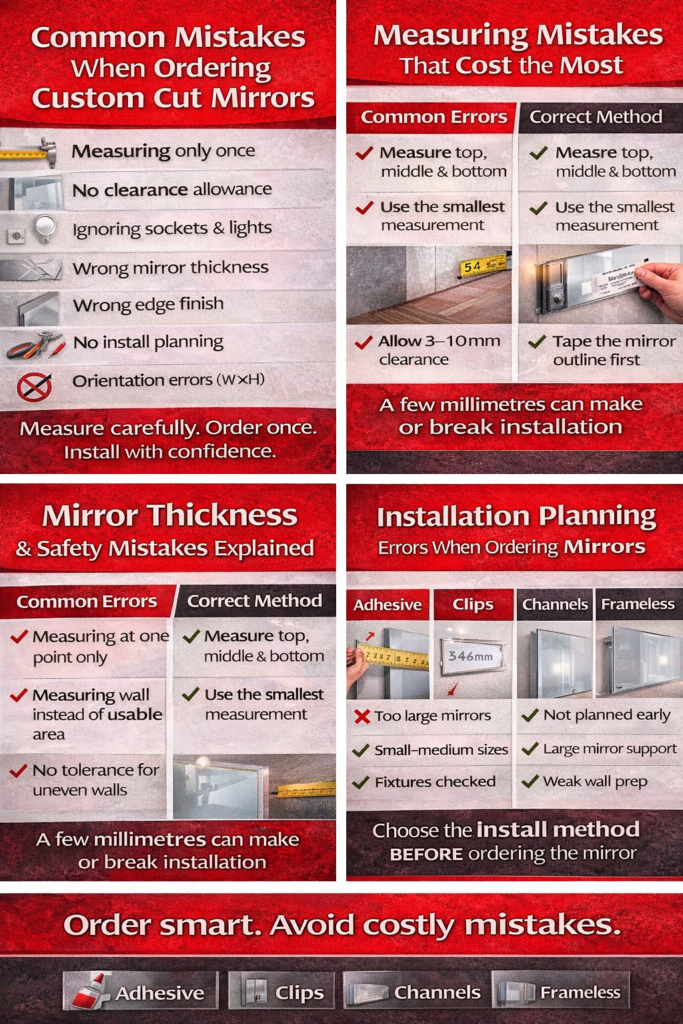
1. Measuring Only Once
Walls are rarely straight. Tiles, plaster, and older construction introduce small variations that matter when ordering glass.
What Goes Wrong
- Mirror is too tight to install
- Edges collide with tiles or trims
- Stress cracks appear during fitting
How to Avoid It
- Measure width and height in at least three places
- Always use the smallest measurement
- Re-measure on a different day if possible
Interior design professionals regularly recommend double- and triple-checking mirror measurements to account for wall irregularities.
Authority reference: Houzz
2. Forgetting Installation Clearance
A mirror cut to the exact wall size almost never fits cleanly.
Why This Causes Problems
- Walls are not perfectly flat
- Adhesive and fixings need space
- Minor movement occurs during installation
Best Practice
- Allow 3–5 mm total clearance for small–medium mirrors
- Allow up to 10 mm for large mirrors or tiled walls
This clearance is invisible once installed but makes fitting far safer.
3. Ignoring Sockets, Lights & Fixtures
One of the most common oversights is measuring the wall—but not what’s on it.
Typical Issues
- Mirror blocks sockets or switches
- Lights cast shadows across the mirror
- Cabinets can’t open properly
How to Avoid It
- Mark the mirror outline with masking tape
- Check doors, drawers, and light positions
- Measure the usable mirror area, not just the wall
Professional designers often tape out mirror sizes on the wall before ordering to confirm alignment.
4. Choosing the Wrong Mirror Thickness
Mirror thickness affects strength, distortion, and safety.
Common Mistakes
- Using thin mirrors for large sizes
- Choosing thickness purely on price
- Not matching thickness to installation method
General Guidance
- 4 mm → Small decorative mirrors
- 6 mm → Standard bathroom mirrors
- 8 mm+ → Large mirrors, gyms, feature walls
Thicker mirrors sit flatter and feel more substantial—especially at larger sizes.
5. Not Planning the Installation Method First
Ordering the mirror before deciding how it will be mounted is a major mistake.
What Can Go Wrong
- Adhesive used for mirrors that are too heavy
- Clips placed under stress
- No allowance for channels or brackets
Solution
Choose the installation method before ordering:
- Adhesive → Small to medium mirrors
- Clips → Removable or heavier mirrors
- Channels → Large or wall-to-wall mirrors
- Frameless systems → Feature or luxury mirrors
Installation method influences thickness, edge finish, and tolerances.
6. Ordering the Wrong Edge Finish
Edges aren’t just cosmetic—they’re about safety.
Common Errors
- Exposed mirrors with unfinished edges
- Decorative bevels where space is tight
- Forgetting to specify edge finish at all
Correct Approach
- Polished edges → Exposed mirrors
- Raw/hidden edges → Framed mirrors only
- Bevelled edges → Decorative feature mirrors
Unfinished exposed edges are both unsafe and visually poor.
7. Mixing Up Width & Height
Orientation errors happen more often than people expect.
Typical Problems
- Portrait ordered instead of landscape
- Supplier interprets dimensions differently
- Mirror arrives rotated incorrectly
Best Practice
Always specify clearly:
Width × Height (mm)
Example:
1200 mm (W) × 800 mm (H)
Never rely on assumptions.
8. Ignoring Reflection & Placement Impact
Mirrors reflect everything—including things you may not want to highlight.
Common Style Mistakes
- Reflecting clutter or storage areas
- Harsh glare from lights or windows
- Oversized mirrors dominating a space
Architectural Digest stresses that mirror placement should always consider reflection lines and room balance, not just wall size.
Authority reference:
👉 https://www.architecturaldigest.com
9. Not Considering the Room Environment
Different rooms require different mirror specifications.
Environmental Factors
- Bathrooms → Moisture & steam
- Gyms → Impact resistance
- Hallways → High traffic
- Kitchens → Frequent cleaning
Ignoring environment can shorten mirror lifespan or create safety issues.
10. Assuming Custom Mirrors Are Returnable
This is one of the most costly misunderstandings.
Custom mirrors are cut specifically to your measurements and usually cannot be returned unless faulty.
What This Means
- Measurements must be final
- Rushing the order increases risk
- Errors usually can’t be corrected later
Always double-check everything before confirming.
11. Ordering Without Full Specification Control
Some suppliers offer limited options, increasing risk.
Red Flags
- No thickness choices
- No edge finish selection
- Unclear measuring guidance
- No installation advice
Choosing a supplier that allows full customisation reduces mistakes.
If you’re planning a project, explore made-to-measure mirrors that give control over size, thickness, and finish:
Quick Checklist Before Ordering
Before placing your order, confirm:
- ✅ Measured multiple times
- ✅ Clearance included
- ✅ Fixtures checked
- ✅ Thickness chosen
- ✅ Installation method planned
- ✅ Edge finish selected
- ✅ Orientation clearly stated
Final Thoughts
Almost all problems with custom mirrors come down to ordering mistakes, not manufacturing defects.
By taking time to:
- Measure carefully
- Plan installation
- Consider environment and reflections
You can ensure your custom mirror fits perfectly, installs safely, and looks exactly as intended.