
Custom Cut Mirrors vs Standard Mirrors: Which Is Better for Your Space?
Mirrors aren’t just “décor.” They change how a room feels, how bright it looks, and even how big it appears. The real question isn’t only which mirror looks nicer—it’s which option fits your wall, your layout, your lifestyle, and your budget with the least compromise.
In this guide, we’ll compare custom cut (made-to-measure) mirrors vs standard off-the-shelf mirrors, with practical examples so you can choose confidently.
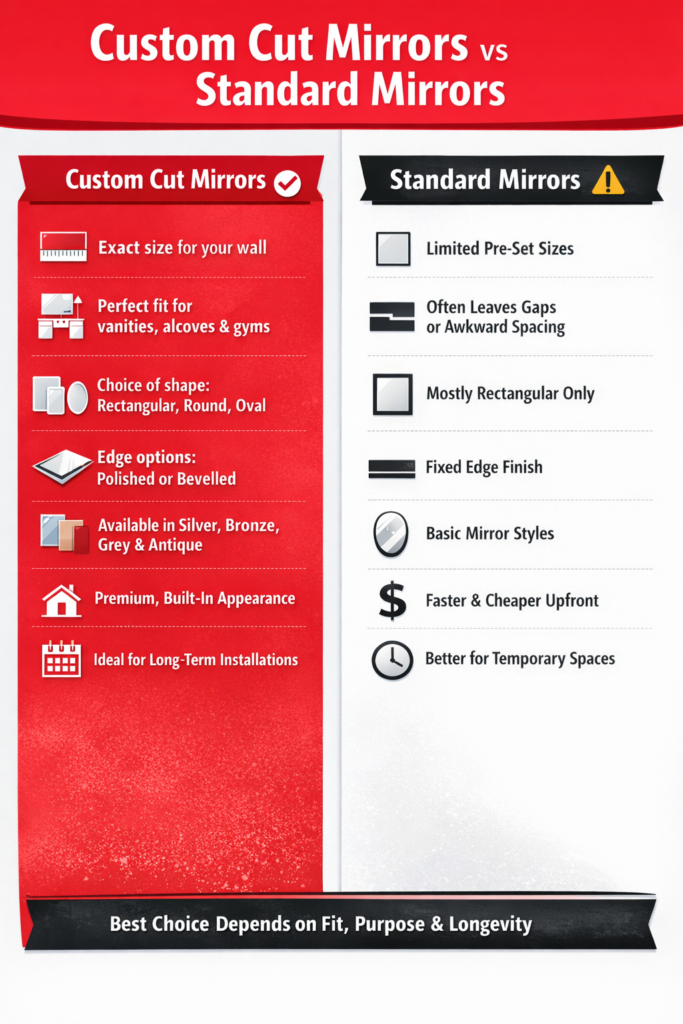
1) What’s the difference?
Standard mirrors (off-the-shelf)
These are the ready-made mirrors you buy in common sizes (for example 60×80 cm, 70×100 cm, 90×60 cm). They’re fast and convenient, but you’re limited to what’s available.
Best for: quick upgrades, rentals, low-effort styling, common wall sizes.
Custom cut mirrors (made-to-measure)
Custom mirrors are cut to the exact size and shape you need—often with options like polished or bevelled edges, different tints, and specific thickness choices. Glass Help Ltd
Best for: awkward wall sizes, full-width vanity runs, alcoves, made-to-fit gym walls, premium “built-in” looks.
2) The biggest deciding factor: fit (and how “intentional” the room looks)
If your space has any of these, custom usually wins:
- A wall that’s not a standard width
- Furniture that needs a mirror two-thirds to three-quarters of its width for good proportion
- A vanity area where you want the mirror to line up perfectly with taps/lights/cabinets
- A narrow hallway where the wrong size mirror looks “floating” or off-centre
A well-sized mirror makes a room feel designed—while a “close enough” mirror can look like an afterthought (even if it’s expensive). For sizing guidance and proportions, this mirror size and shape guide is genuinely useful.
3) Cost: what you’re actually paying for
Standard mirror costs tend to be lower upfront
Because they’re mass-produced, standard mirrors often look like a bargain.
But watch the “hidden extras”:
- You may need to buy a second mirror to “make it work”
- You might pay more for a special frame to distract from awkward sizing
- You may compromise on style (and end up replacing it sooner)
Custom mirrors cost more—but reduce compromise
With custom cut mirrors, you pay for:
- Precise cutting to your measurements
- Edge finishing (flat polish or bevel)
- Shape options (including circles/ovals/irregular)
- Potential thickness upgrades and safer installation planning Glass Help Ltd
If you’re planning a long-term room (your “main bathroom,” your home gym, a salon corner, a feature hallway), custom often has better value because you don’t have to “design around” an imperfect fit.
4) Design freedom: shape, tint, edge finish
Standard mirrors usually come in limited styles. Custom mirrors give you control over:
Shapes
- Rectangle, square, round, oval—and sometimes more bespoke shapes Glass Help Ltd
Mirror types (the “look” of the reflection)
Different mirror finishes change the mood of a room:
- Silver = crisp, bright reflection
- Bronze = warm, softer ambience
- Grey/smoked = modern, muted reflection
- Antique = decorative, vintage character Glass Help Ltd+1
If you’re unsure which tint suits your room style, this breakdown helps: Common mirror types: silver, bronze, grey and antique. Glass Helper
Edge finish
Custom mirrors often let you choose:
- Flat polished edge (clean, modern)
- Bevelled edge (more decorative/premium look) Glass Help Ltd
5) Safety & practicality: when the “cheap” option can be a bad idea
This matters most in:
- Bathrooms (humidity)
- Gyms (impact risk)
- Family homes (kids, high traffic areas)
- Commercial spaces (public use)
A mirror is glass. If the mirror is too thin for its size, poorly mounted, or installed in the wrong place, it can become a safety risk.
A good rule of thumb:
- The bigger the mirror, and the more “active” the room, the more you should care about proper spec + proper fixing.
Some guidance sources reference standards like BS EN 1036 for mirror quality and EN 12600 for impact considerations in safety glazing contexts (especially useful when you’re choosing mirrors for high-risk areas). Glass Helper
(If you’re not sure what’s appropriate for your room, ask the supplier what they recommend for that application.)
6) Room-by-room: which one is better?
Bathroom
Custom is usually better if:
- You want a mirror that spans a vanity width neatly
- You have wall lights/sconces that must align
- You’re working around tiles, niches, or sloped ceilings
Standard is fine if:
- It’s a small cloakroom
- You’re replacing quickly on a budget
Bedroom / dressing area
Custom wins for:
- Full-length mirrors on wardrobe doors
- Alcove fits (between walls)
- “Built-in” dressing table layouts
Standard wins if:
- You want a framed decorative statement mirror and the proportions already work
Hallway / landing
Custom is often best because hallways are narrow, and sizing matters to avoid awkward reflection angles. A well-placed mirror can double brightness by bouncing natural light deeper into the home. Glass Helper
Home gym
Custom is strongly recommended for wall-to-wall mirror runs, cleaner joins, and a more professional finish. It also reduces “gaps” that make alignment and sightlines annoying during training. Glass Help Ltd
Living room feature wall
It depends:
- If you want symmetry, precision, or a large “architectural” mirror look → custom
- If you want a designer frame and the size works → standard
7) The decision checklist (use this and you’ll pick right 90% of the time)
Choose custom cut if you answer “yes” to any of these:
- Do I need an exact width/height (no gaps, no “almost” fit)?
- Is this a “main” room where the mirror should look built-in?
- Do I want a specific shape (round/oval/custom)?
- Do I want a specific tint (grey/bronze/antique)?
- Is this a high-humidity or higher-risk area (bathroom/gym)?
- Do I want a premium edge finish?
Choose standard if:
- I need it quickly and the standard size looks correct on the wall
- I’m styling a temporary space (rental / staging / short-term update)
- The mirror is mostly decorative and will be framed anyway
- My budget is tight and I’m comfortable compromising slightly on size
8) Common mistakes to avoid (especially when ordering custom)
- Measuring only the wall, not the “visual space.”
Consider furniture width, wall lights, and where the reflection will land. - Forgetting installation clearance.
Sockets, switches, skirting boards, and tile edges can affect mounting. - Choosing a mirror that’s “too small” above furniture.
A mirror that’s undersized can look lost—better to match proportions deliberately. Glass Helper - Not planning edge finishing.
Exposed edges usually look best polished (especially for frameless designs). Glass Help Ltd
9) So… which is better for your space?
If your space is simple and standard sizes look right, a standard mirror can be the perfect choice—fast, affordable, and stylish.
But if your room has any “constraints” (tight width, alcoves, full runs, symmetry needs, premium finish goals), custom cut mirrors are usually the better long-term decision because they solve the real problem: fit and intention.