
Custom-Made vs Off-the-Shelf Glass Juliet Balconies: Which Is Safer?
When homeowners start shopping for a glass Juliet balcony, one of the first decisions they face is whether to choose a custom-made system or an off-the-shelf (standard) option.
At first glance, both may look similar — glass panels, metal fixings, and clean lines. But when it comes to safety, compliance, long-term performance, and peace of mind, the differences can be significant.
This guide explains how custom-made and off-the-shelf glass Juliet balconies compare from a safety perspective, helping you make a confident and informed choice.
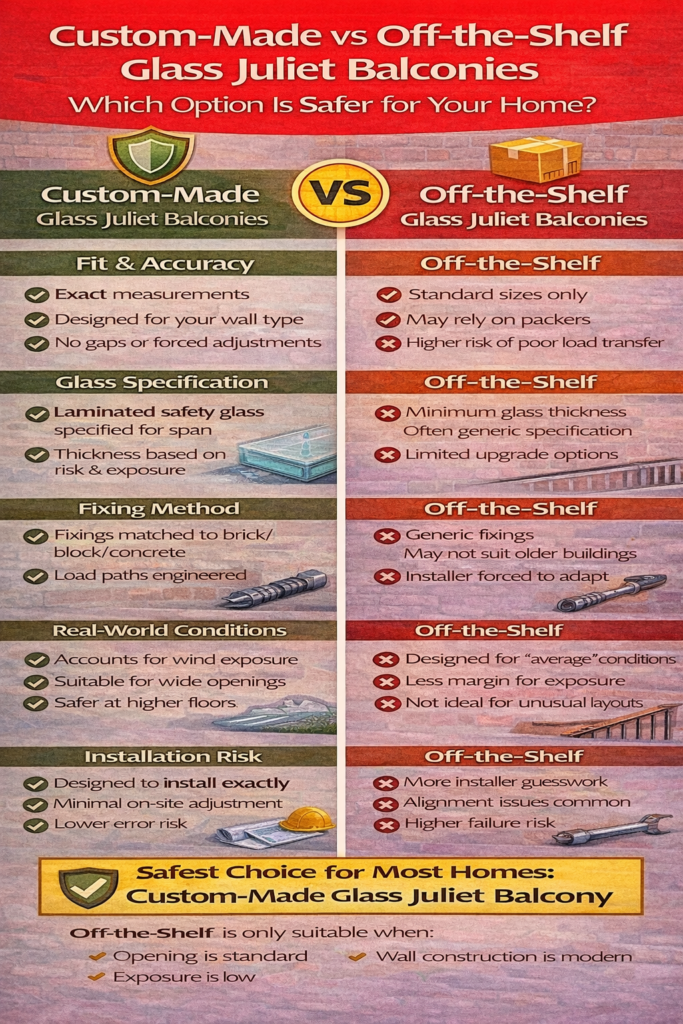
Understanding the Two Options
What Is an Off-the-Shelf Glass Juliet Balcony?
An off-the-shelf Juliet balcony is a pre-manufactured system produced in fixed sizes and configurations. These are typically sold online or through trade suppliers and are designed to fit “most” common openings.
Key characteristics:
- Standard widths and heights
- Limited fixing options
- Generic glass thickness
- Faster availability
- Lower upfront cost
They rely on the assumption that your property closely matches standard dimensions and wall construction.
What Is a Custom-Made Glass Juliet Balcony?
A custom-made Juliet balcony is designed specifically for your opening, wall structure, and exposure conditions. Measurements are taken precisely, and the system is manufactured to suit those exact requirements.
Key characteristics:
- Exact sizing
- Tailored fixing method
- Glass specification based on risk and exposure
- Greater flexibility in design
- Higher upfront cost, but greater control
Custom systems are built around performance first, rather than convenience.
Safety Starts With Fit — and Fit Is Everything
One of the biggest safety differences between the two options is how accurately the balcony fits your opening.
Off-the-Shelf Safety Risk
- Small gaps between fixings and structure
- Reliance on packers or adjustments
- Reduced load efficiency
- Greater stress on fixings
Even small mismatches can compromise how loads are transferred into the building.
Custom-Made Advantage
- Glass sized exactly to opening
- Fixings positioned optimally
- Even load distribution
- Reduced risk of movement over time
From a structural perspective, precision equals safety.
Glass Specification: Not All “Safety Glass” Is Equal
Many buyers assume that if a system uses “safety glass,” it must be safe. This is a dangerous oversimplification.
Off-the-Shelf Glass Limitations
- Often uses minimum-spec glass
- Glass thickness may not reflect exposure
- May rely on toughened glass alone
- Limited options for lamination upgrades
While these systems may pass basic requirements, they often offer little margin for real-world conditions.
Custom-Made Glass Selection
Custom systems typically specify:
- Laminated safety glass as standard
- Glass thickness matched to span and load
- Interlayers that hold glass together if broken
- Enhanced performance under impact
If safety is the priority, laminated glass specified for your exact setup is critical.
Fixing Method: The Most Overlooked Safety Factor
The fixing method is often more important than the glass itself.
Off-the-Shelf Fixings
- Designed to work in “average” walls
- Limited flexibility for unusual construction
- May not suit older brickwork or timber frames
- Often installed without structural assessment
If the fixings aren’t compatible with your wall, safety is compromised — regardless of how strong the glass is.
Custom-Made Fixings
Custom systems consider:
- Wall type (brick, block, concrete, timber)
- Fixing depth and anchor type
- Load paths and spacing
- Exposure to wind and height
This tailored approach ensures the balcony works with the building, not against it.
Real-World Loads vs Catalogue Conditions
Off-the-shelf products are tested in controlled environments, not necessarily for your property’s conditions.
What Standard Systems May Not Account For
- High wind exposure
- Elevated floors
- Coastal corrosion risk
- Non-standard wall construction
- Large door openings
Custom-made balconies factor these risks in from the start.
Building Regulations & Compliance Reality
UK building regulations focus on performance, not product labels.
Both options can comply — but compliance depends on how well the system suits the building.
If you want a clear overview of how compliant systems are designed and what factors matter most, this guide to glass Juliet balconies explains modern system design and safety expectations in detail:
glass Juliet balconies – https://www.glasshelp.co.uk/glass-juliet-balcony/
Custom-made systems generally make compliance easier to demonstrate, especially when building control asks questions.
Installation Risk: One Size Does Not Fit All
Installation errors are a leading cause of safety issues.
Off-the-Shelf Risk
- Installers forced to “make it work”
- Improvised packing and alignment
- Fixings installed in sub-optimal positions
- Greater reliance on installer judgment
Custom-Made Benefit
- Designed to install exactly as specified
- Fewer on-site adjustments
- Clear fixing instructions
- Lower risk of deviation
Reducing installer guesswork significantly improves safety outcomes.
Long-Term Safety & Durability
Safety isn’t just about day one — it’s about how the system performs 10 or 20 years later.
Off-the-Shelf Longevity Concerns
- Fixings under constant stress
- Glass edges closer to tolerance limits
- Greater chance of loosening over time
- Limited ability to replace parts
Custom-Made Longevity
- Balanced structural loads
- Reduced stress concentrations
- Better corrosion resistance options
- Easier future maintenance
Custom systems age more predictably — a key safety factor often overlooked.
Cost vs Risk: A Realistic Perspective
| Factor | Off-the-Shelf | Custom-Made |
|---|---|---|
| Initial cost | Lower | Higher |
| Fit accuracy | Variable | Exact |
| Glass safety margin | Minimal | Optimised |
| Fixing suitability | Generic | Tailored |
| Long-term safety | Moderate | High |
A lower upfront cost may feel attractive, but safety-critical features are not the place to cut corners.
When Is Off-the-Shelf Acceptable?
Off-the-shelf systems can be suitable when:
- Opening size is standard
- Wall construction is modern and known
- Exposure is low
- Height above ground is limited
- Installation is carried out by experienced professionals
Even then, careful verification is essential.
When Custom-Made Is the Safer Choice
Custom-made Juliet balconies are strongly recommended when:
- Openings are wide or unusual
- Property is older or non-standard
- Building is exposed to wind
- Safety margin is a priority
- Building control scrutiny is expected
From a safety standpoint, customisation reduces unknowns.
Expert Insight
Many structural specialists agree that Juliet balconies fail not because glass is weak, but because systems are poorly matched to buildings. Custom-made designs minimise these mismatches.
For an additional industry perspective on safety considerations and specification choices, this overview is useful:
Juliet balcony glass safety explained – https://www.theglasswarehouse.co.uk/news/is-glass-strong-enough-for-balustrades/
Final Verdict: Which Is Safer?
Custom-made glass Juliet balconies are objectively safer in most real-world situations because they:
- Fit precisely
- Use correctly specified laminated glass
- Match fixings to the structure
- Reduce installation risk
- Provide greater long-term reliability
Off-the-shelf systems can work — but only when conditions are ideal and verified.
When safety is the priority, customization is not a luxury; it’s a safeguard.