
Frameless vs Framed Glass Staircases: Pros, Cons, and Costs
Glass staircases instantly modernize a space. They brighten interiors, open up sightlines, and create a “floating” feel that traditional spindles and bulky rails can’t match. But when you start planning a real project, the biggest decision usually isn’t “glass or not”—it’s frameless vs framed.
Both options can be safe, strong, and building-code compliant when specified correctly. The difference is how the glass is supported, how it looks day-to-day, how much it costs, and what you’ll maintain over the years.
This buyer-friendly guide explains the differences in plain English, including practical pros/cons, realistic cost drivers, and what to ask before you order.
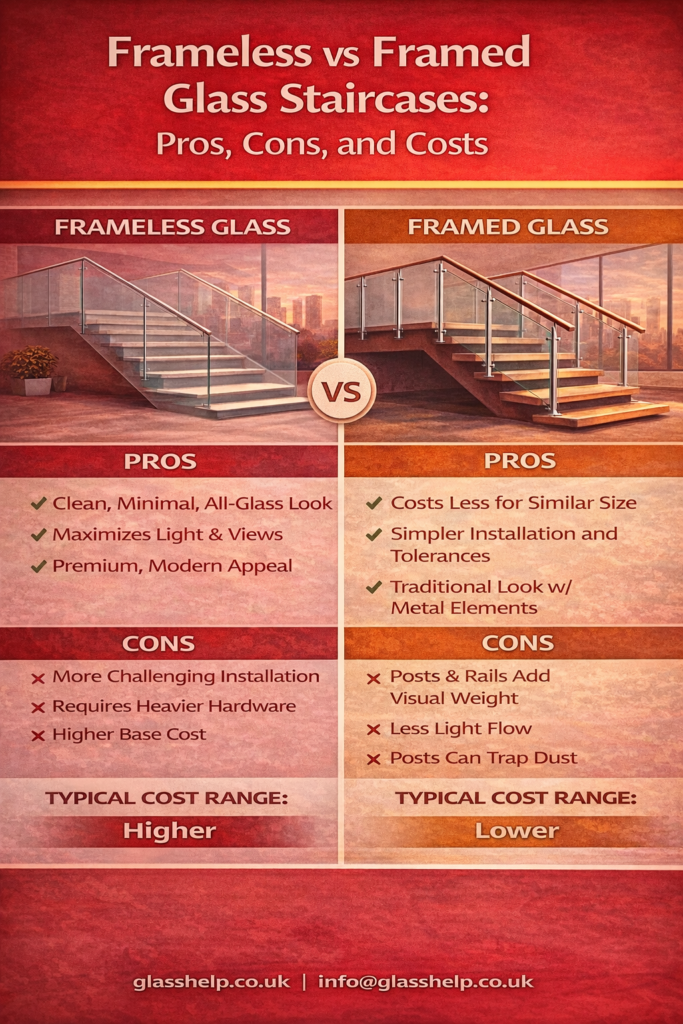
What “frameless” and “framed” mean in real staircase builds
Frameless glass staircase (rail/balustrade)
A frameless glass staircase usually means the glass panels have minimal visible support—no chunky posts every few inches. The glass is typically held in place by:
- Base channels (base shoe) fixed into the stair/landing structure
- Spigots / clamps / concealed fixings, depending on the design
This delivers the cleanest “all-glass” look, but it relies on precision installation and often heavier-duty hardware. whitemetal.co.uk+1
Framed glass staircase (rail/balustrade)
A framed glass staircase has a visible supporting structure—usually:
- Metal posts (uprights)
- A top rail and/or side framing
- Glass used as infill panels inside the frame
It’s still modern and premium, but the frame adds visible lines and support.
Visual impact: which looks better?
Choose frameless if you want:
- The most open, uninterrupted view
- Maximum light flow (especially in tight hallways)
- A true “luxury minimal” style
Frameless is the look most people imagine when they say “glass staircase.”
Choose framed if you want:
- A modern look with more visible structure
- A staircase that visually “matches” other metal elements (handrails, industrial features)
- Slightly more traditional proportions (posts can make a space feel grounded)
Safety and strength: which is safer?
When built correctly, both can be safe. The bigger difference is how they behave and what they rely on:
Frameless safety realities
- Relies heavily on the base/channel/fixings and what they’re anchored into
- Demands accurate alignment; small errors can show and can reduce performance
- Often needs higher-grade hardware choices (especially outdoors)
A key point from installation guidance is that a balustrade is only as strong as what it’s fixed into—structure matters as much as glass. whitemetal.co.uk
Framed safety realities
- The frame provides additional mechanical support and may feel sturdier to some users
- Generally more forgiving if the building substrate isn’t perfectly flat
- Posts/rails can simplify load transfer and installation
Bottom line: neither is “automatically safer.” Safety comes from:
- correct glass specification (toughened/laminated where needed),
- correct fixing system,
- correct installation to the right loads for your location.
Maintenance: cleaning and long-term upkeep
Frameless maintenance
Pros
- No posts to trap dust every few inches
- The “glass wall” is easy to wipe in long runs
Cons
- Any misalignment or unevenness is more noticeable
- Base channels and exposed fixings need occasional inspection
- Outdoors: you must be careful about corrosion-resistant hardware selection
Framed maintenance
Pros
- Rails and posts can hide minor imperfections and alignment tolerances
- Some framed systems allow easier panel replacement in modular sections
Cons
- More surfaces to clean (posts, rails, corners)
- If painted/powder-coated, you may eventually touch up chips/scratches
Costs: what you can realistically expect (and what drives price)
Pricing varies by layout, glass height, hardware choice, and site conditions—but it’s still useful to understand typical patterns.
A UK price guide comparing glass balustrade systems notes that framed options are typically cheaper per linear metre than frameless, while frameless systems cost more due to premium hardware and installation demands. Class Glass Limited
Typical cost pattern (UK-style guidance)
- Framed glass balustrades: usually lower cost range
- Frameless glass balustrades: typically higher cost range Class Glass Limited
Why frameless costs more:
- More expensive mounting systems (base channels, precision clamps, concealed fixings)
- More demanding labour/installation
- Higher “fit and finish” expectations (because everything is visible)
Why framed can cost less:
- Posts/rails can reduce reliance on heavy base channels
- Install tolerances are often more forgiving
- Simpler site conditions can reduce labour time
Practical tip: If your staircase run is complex (turns, winders, landings, angled transitions), the labour portion can rise quickly for frameless systems because alignment is everything.
Which one is best for your staircase?
Pick frameless if:
- Your priority is the cleanest possible look
- You have a solid substrate (concrete or properly reinforced structure)
- You want a premium “architectural” finish and you’re okay paying more
- You’re working with an experienced installer who does frameless systems regularly whitemetal.co.uk+1
Pick framed if:
- You want glass + modern style but with better cost control
- You want extra visible structure (especially for family homes or high-traffic stairs)
- You expect simpler installation and easier future modifications
- Your design suits posts/rails (industrial, mixed materials, classic-modern)
What to ask before you buy (avoid expensive surprises)
Use these questions when comparing quotes:
- What fixing system is included? (base channel, spigots, clamps, posts)
- What is the substrate and how will it be reinforced? (critical for frameless) whitemetal.co.uk
- Is the quote supply-only or supply + install?
- What’s included in finishing? (end caps, trims, cover plates, rail finish)
- What’s the plan for corners, turns, and stair angles?
- What warranty covers hardware corrosion and installation movement?
- How will the installer handle tolerances and leveling? (especially frameless)
A helpful starting point for your design choices
If you’re still comparing layouts, glass styles, and staircase configurations, start here and shortlist the look you want first. It’ll also make supplier conversations much easier:
👉 Explore glass staircase options here (use it for style + configuration planning):
https://www.glasshelp.co.uk/glass-staircase/ Glass Help
Conclusion
Frameless glass staircases deliver the cleanest, most high-end look—but they usually cost more and demand more precision in structure and installation. Framed glass staircases are often more budget-friendly, can be simpler to install, and still look modern and premium—just with visible posts/rails.