
Glass Balustrade Fixings Explained: Channels, Clamps & Spigots
When choosing a glass balustrade, most homeowners focus on the glass itself — thickness, transparency, and style. But one equally important decision often gets overlooked:
How will the glass be fixed in place?
The fixing method is not just a design choice. It directly affects:
- safety and compliance
- structural strength
- appearance
- installation complexity
- long-term durability
In the UK, glass balustrades are commonly installed using three main fixing systems:
- Base channels
- Glass clamps
- Spigots
Each has its own advantages, limitations, and ideal use cases. This guide explains how each fixing system works, where it performs best, and how to choose the right option for your home.
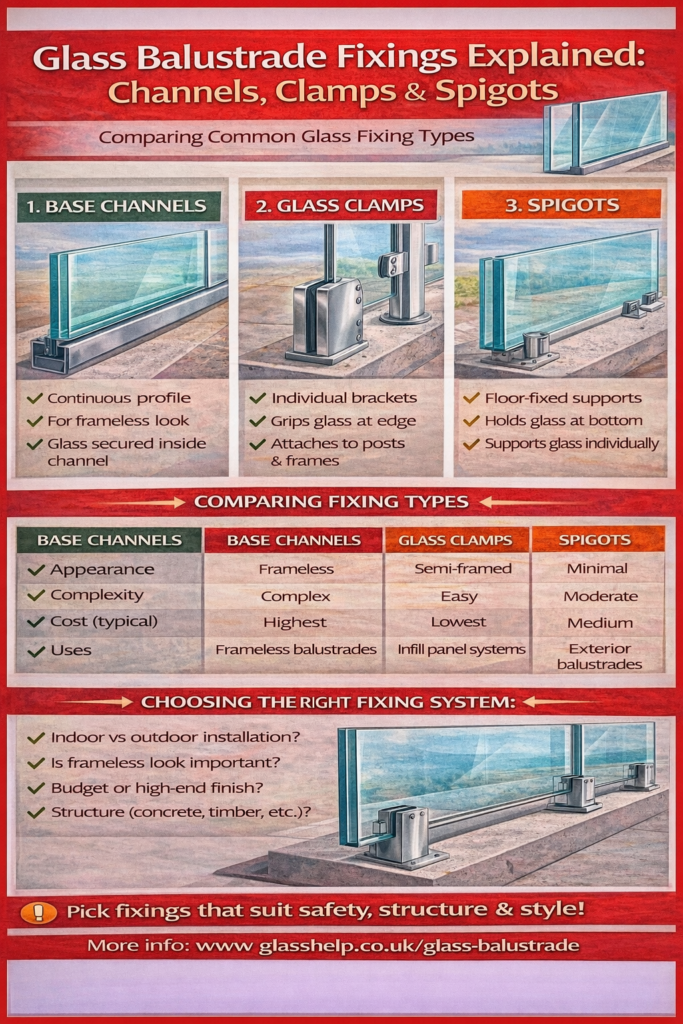
Why Glass Balustrade Fixings Matter
A glass balustrade is a guarding system, not a decorative feature. The fixings must:
- resist horizontal loads
- secure the glass without stress
- perform safely if the glass breaks
- suit the structure they’re attached to
Choosing the wrong fixing type can lead to:
- visible movement
- failed inspections
- poor aesthetics
- expensive retrofits
Understanding fixing systems before ordering glass avoids most common mistakes.
1. Glass Balustrade Base Channels (Continuous Channels)
What Is a Base Channel?
A base channel is a continuous aluminium or steel profile fixed to the floor or slab. The glass panel sits inside the channel and is secured using:
- wedges
- dry-glaze systems
- pressure plates
This system is most commonly used for frameless glass balustrades.
Where Base Channels Are Commonly Used
- Frameless balconies
- Roof terraces
- Mezzanine edges
- Modern staircases
- High-end residential and commercial projects
Advantages of Base Channel Systems
✅ Clean, Frameless Appearance
Base channels allow the glass to rise directly from the floor, creating:
- uninterrupted sightlines
- a premium, architectural look
This is the closest option to a “fully frameless” balustrade.
✅ Excellent Structural Performance
Because the channel runs continuously:
- loads are distributed evenly
- glass is supported along its full length
- movement is minimised
✅ Ideal for Laminated Glass
Base channels are designed to work with laminated glass, which is essential where glass is the primary safety barrier.
Disadvantages of Base Channel Systems
❌ More Complex Installation
Base channels require:
- precise alignment
- accurate drilling
- careful waterproofing (outdoors)
❌ Higher Cost
Channels are usually more expensive than spigots or clamps due to:
- material cost
- labour time
- precision requirements
❌ Less Forgiving of Measurement Errors
Because the channel is continuous, small measurement mistakes can affect the entire run.
2. Glass Balustrade Clamps
What Are Glass Clamps?
Glass clamps are individual metal brackets that grip the glass panel and attach it to:
- posts
- walls
- stair strings
- structural frames
They are typically made from stainless steel or aluminium.
Where Glass Clamps Are Commonly Used
- Semi-framed balustrades
- Staircases with posts
- Internal balustrades
- Installations where glass is an infill panel
Advantages of Glass Clamps
✅ Versatile and Adaptable
Clamps can be used in many configurations and are suitable where:
- posts already exist
- the glass is not the sole barrier
✅ Easier to Install
Compared to base channels, clamps:
- require less precision
- allow more adjustment on site
- are quicker to install
✅ Cost-Effective
Clamps are generally cheaper than full channel systems, making them popular for:
- internal staircases
- budget-controlled projects
Disadvantages of Glass Clamps
❌ More Visible Hardware
Clamps are intentionally visible, which may not suit:
- ultra-minimal designs
- modern frameless aesthetics
❌ Not Suitable for Fully Frameless Systems
Because clamps hold glass at specific points:
- they rely on posts or frames
- they are not ideal where glass is the only barrier
❌ Higher Stress Concentration
Loads are transferred at specific points rather than evenly along the glass, so correct spacing and specification are critical.
3. Glass Balustrade Spigots
What Are Spigots?
Spigots are individual floor-mounted supports that hold the bottom edge of a glass panel. The glass sits between two plates inside the spigot and is secured mechanically.
Spigots are typically:
- stainless steel
- surface-mounted
- spaced at regular intervals
Where Spigots Are Commonly Used
- Balconies
- Decking areas
- Pool surrounds
- Outdoor terraces
Advantages of Spigot Systems
✅ Modern Look with Minimal Hardware
Spigots provide:
- a light, open appearance
- less visible metal than posts
- easier visual integration with outdoor spaces
✅ Simpler Installation Than Channels
Spigots:
- are individually fixed
- allow tolerance adjustments
- are forgiving on uneven surfaces
✅ Good for Retrofit Projects
Spigots work well where:
- continuous channels are impractical
- drilling depth is limited
Disadvantages of Spigot Systems
❌ Less Rigid Than Channels
Because support is at intervals:
- slight movement is more noticeable
- precise spacing is essential
❌ Floor Space Impact
Spigots sit on the walking surface, which:
- reduces usable width slightly
- can interfere with furniture placement
❌ Glass Specification Is Critical
Spigot systems usually require thicker laminated glass to compensate for point loading.
Channels vs Clamps vs Spigots: Key Comparison
| Feature | Base Channels | Clamps | Spigots |
|---|---|---|---|
| Appearance | Frameless, premium | Semi-framed | Minimal, modern |
| Structural rigidity | Excellent | Moderate | Moderate |
| Visible hardware | Very low | High | Medium |
| Installation complexity | High | Low–Medium | Medium |
| Cost (typical) | Highest | Lowest | Medium |
| Best for | Frameless balustrades | Infill panels | Outdoor balustrades |
Safety & Compliance Considerations
Regardless of fixing type:
- the balustrade must meet minimum height requirements
- fixings must resist horizontal loads
- laminated glass is required where glass is the primary guard
UK guidance focuses on preventing falls, not just holding glass in place. A useful overview of guarding requirements can be found via the Planning Portal.
Common Homeowner Mistakes with Fixings
❌ Choosing fixings based on looks alone
❌ Using clamps where glass should be structural
❌ Under-specifying glass thickness for spigots
❌ Ignoring waterproofing with base channels
❌ Mixing incompatible metals outdoors
Most issues arise from mismatch between fixing type and structural role.
How to Choose the Right Fixing System
Ask these questions:
- Is the glass the main safety barrier?
- Is the installation indoor or outdoor?
- How important is a frameless appearance?
- What is the structural substrate?
- Is budget or aesthetics the priority?
Answering these honestly usually makes the correct fixing choice clear.
To see how fixing systems integrate into properly engineered designs, review compliant glass balustrade systems here:
Final Thoughts
There is no single “best” glass balustrade fixing — only the one that best suits your structure, safety requirements, and design goals.
- Base channels deliver the cleanest, most rigid frameless look
- Clamps offer flexibility and affordability for infill designs
- Spigots balance modern aesthetics with installation practicality
When chosen and installed correctly, all three systems can deliver a safe, durable, and visually striking glass balustrade.