
How to Order a Custom Mirror Online: Step-by-Step Guide
Ordering a custom mirror online is easier than ever — but only if you follow the right process. Whether you’re buying a mirror for a bathroom, bedroom, gym, wardrobe, or feature wall, small mistakes in measurement, thickness choice, or installation planning can lead to costly problems later.
This step-by-step guide walks you through exactly how to order a custom cut mirror online, from planning and measuring to delivery and installation — so you get a mirror that fits perfectly, looks professional, and lasts for years.
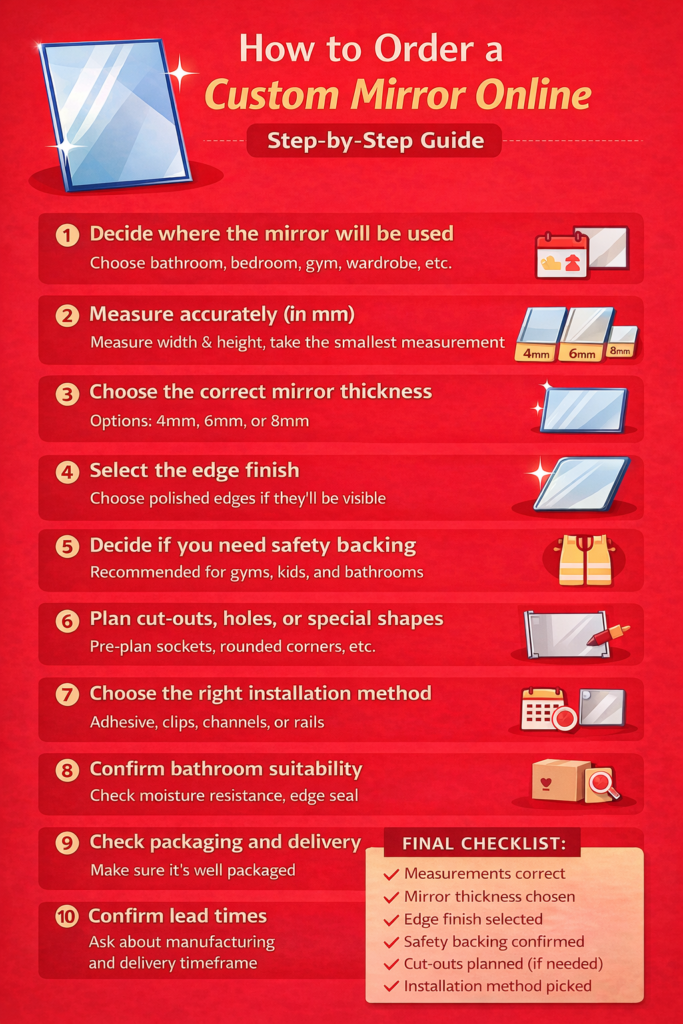
Step 1: Decide where the mirror will be used
Before measuring or choosing finishes, be clear about where and how the mirror will be used.
Ask yourself:
- Is this for a bathroom, bedroom, gym, hallway, or furniture?
- Will the mirror be exposed to moisture or steam?
- Will it be installed wall-to-wall, inside an alcove, or as a standalone piece?
- Will the edges be visible or hidden by a frame?
Why this matters:
The location affects thickness, safety backing, edge finish, and installation method. A bathroom mirror has different requirements than a gym or wardrobe mirror.
Step 2: Measure accurately (this is critical)
Incorrect measurements are the number one cause of custom mirror issues.
How to measure properly:
- Measure width and height in millimetres
- Take measurements in at least three places (top, middle, bottom)
- Use the smallest measurement to avoid tight fitting
- Account for tiles, skirting, uneven walls, and gaps
Important tips:
- Do not round up measurements
- Allow a small clearance if fitting wall-to-wall
- Measure after tiling, not before
Why this matters:
Custom mirrors are made to order. Even a 2–3mm error can cause fitting issues that cannot be fixed after delivery.
Step 3: Choose the correct mirror thickness
Mirror thickness affects strength, stability, weight, and reflection quality.
Common thickness options:
- 4mm – Suitable for small mirrors or framed installations
- 6mm – Most popular choice for bathrooms and wall mirrors
- 8mm – Ideal for large mirrors, gyms, and feature walls
Ask yourself:
- Is the mirror large or small?
- Will it be frameless?
- Will it be installed in a high-traffic area?
Why this matters:
Larger mirrors benefit from thicker glass, which stays flatter and reduces distortion.
Step 4: Select the edge finish
If your mirror edges will be visible, edge finishing is essential.
Common edge finishes:
- Polished edges – Smooth, shiny, and safe (most popular)
- Seamed edges – Lightly smoothed, not decorative
- Unfinished edges – Only suitable if fully hidden in a frame
Why this matters:
Unfinished edges are sharp and unsafe if exposed. Polished edges give a clean, professional look.
Step 5: Decide if you need safety backing
Safety backing is a protective film applied to the back of the mirror.
Safety backing is strongly recommended for:
- Gyms and studios
- Family homes
- Bathrooms
- Large wall mirrors
Why this matters:
If the mirror breaks, safety backing helps hold the glass together, reducing injury risk.
Step 6: Plan cut-outs, holes, or special shapes (if needed)
Many mirrors require custom shaping.
Consider if you need:
- Cut-outs for sockets or switches
- Holes for fixings
- Rounded corners
- Notches for furniture or pipes
Important:
All cut-outs must be planned before ordering. Mirrors cannot be modified after manufacturing.
Step 7: Choose the right installation method
How you plan to install the mirror affects thickness and safety choices.
Common installation options:
- Mirror adhesive – Clean, frameless look
- Clips or brackets – Visible fixings, easier removal
- Channels or rails – Secure for larger mirrors
Ask:
- Is professional installation recommended?
- What adhesive or fixings are suitable?
- Does wall type matter (plasterboard, brick, tile)?
Why this matters:
Incorrect installation can cause stress cracks, distortion, or failure over time.
Step 8: Confirm bathroom suitability (if applicable)
Bathrooms expose mirrors to steam and moisture.
Before ordering, confirm:
- The mirror is suitable for humid environments
- Edges are properly sealed
- Cleaning guidelines are provided
Why this matters:
Poor edge protection can cause black spots or corrosion on the mirror backing over time.
Step 9: Check packaging and delivery details
Mirrors are fragile and must be packaged correctly.
Ask the supplier:
- How is the mirror packaged?
- Is delivery insured?
- What should I do if the mirror arrives damaged?
Why this matters:
Good packaging reduces breakage risk and ensures replacements are handled smoothly if needed.
Step 10: Confirm lead times
Custom mirrors are made to order.
Check:
- Manufacturing time
- Delivery timeframe
- Any seasonal delays
Why this matters:
If the mirror is part of a renovation, delays can impact your entire project schedule.
Step 11: Understand the return and replacement policy
Custom mirrors are often non-returnable unless faulty.
Before ordering:
- Confirm replacement policy for damage
- Understand responsibility for measurement errors
- Check inspection time on delivery
Why this matters:
Knowing the policy protects you if something goes wrong.
Step 12: Prepare for delivery day
When your mirror arrives:
- Inspect packaging before signing
- Check for cracks, chips, or damage
- Report issues immediately
Do not install a damaged mirror — contact the supplier first.
Final checklist before ordering
Before placing your order, confirm:
- ✔ Exact measurements
- ✔ Correct thickness
- ✔ Polished edge finish
- ✔ Safety backing (if required)
- ✔ Cut-outs and shapes confirmed
- ✔ Installation method planned
- ✔ Delivery and lead time checked
Final thoughts
Ordering a custom mirror online doesn’t have to be risky. By following these steps and confirming the right details upfront, you’ll avoid common mistakes and get a mirror that fits perfectly, looks professional, and lasts for years.
If you’re looking for professionally made, made-to-measure options, explore custom cut mirrors online here:
👉 https://www.glasshelp.co.uk/mirrors/