
Partition Wall Regulations & Building Codes Explained Simply
Building or modifying partition walls — whether in a home, office, commercial space, or renovation — isn’t just about choosing materials and aesthetics. There are building codes and regulations designed to ensure the structural integrity, safety, energy performance and welfare of occupants. Understanding these rules helps you plan correctly, avoid costly mistakes, and ensure that your work is compliant with UK standards.
This guide explains the most important regulations you should know about, in simple terms, and tells you when you do and don’t need approval.
What Are Partition Walls — and Why Regulations Matter?
A partition wall is a non-load-bearing wall that divides internal space but doesn’t carry the structure’s weight (roof, floors). Some partition types — for example internal glass partitions — add light and modern design flair without taking up much space.
However, even if they don’t support loads, partition walls can still affect:
- Fire safety
- Sound insulation
- Structural stability
- Accessibility
- Energy performance
For more on the kinds of partition options and styles available, including glazed solutions, see this guide to glass partition walls which highlights design and functional ideas for modern interiors.
Understanding applicable regulations will help you install partitions safely, legally, and cost effectively.
Do You Need Building Regulations Approval?
1. Simple Non-Load Bearing Walls — Often No Approval Needed
Usually, constructing a basic internal partition wall that is non-load-bearing does not require formal Building Regulations approval in England and Wales. The key point is whether the new wall affects the structure or safety of the building. Fast Build Supplies
For example:
✔ Adding a new stud wall that simply divides a room does not normally trigger approval. Fast Build Supplies
However — and this is crucial — even if approval is not needed, your work still must comply with regulatory standards on matters such as fire safety, sound insulation, and materials.
2. Changes That Do Need Approval
Building Regulations approval is usually required if your partition work:
- Forms part of a structural alteration (e.g., removing a load-bearing wall to insert a support beam). Building Control Partnership
- Is in a listed building or conservation area (special consent may be required). RFM Group
- Involves fire safety upgrades or doors in certain locations. (Some partitions create means of escape pathways.)
If the partition affects fire escape routes, especially in commercial or multi-storey buildings, you should check with Building Control.
Planning Permission vs Building Regulations
In the UK, planning permission is generally not required for internal partitions, as they are classed as internal changes so long as the building’s use isn’t changed (e.g., from residential to commercial). CCL Interiors
However, planning consent may still be needed for major structural changes or if you are in a listed building. Local authority planning departments should be consulted early.
Key Building Regulations That May Apply to Partition Walls
The Building Regulations framework in the UK is split into Approved Documents, each addressing a different aspect of safety or performance. Here are the ones most relevant to partition walls:
A. Structural Safety — Approved Document A
Even if a partition wall is non-load-bearing, any work that alters the layout or structure of a building must ensure stability and safety. Approved Document A covers structural integrity of walls, voids, openings and alterations. GOV.UK
For example, knocking through a load-bearing wall to insert a new partition in its place will usually require calculations and approvals to ensure the structure remains safe.
B. Fire Safety — Approved Document B
One of the most important regulatory areas for partition walls is fire safety. Approved Document B sets standards for:
- Fire resistance
- Means of escape
- Fire stopping between floors, walls and ceilings
- Doors and corridors in escape routes
Even internal partitions can affect how fire and smoke spread in a building, especially in flats, commercial premises, or areas near stairs and exits. Fire-rated partition walls may be necessary if your walls sit in critical zones.
If you are designing partitions that impact escape routes or separate fire protected areas, Building Control will need to be involved.
C. Resistance to Sound — Approved Document E
Noise transmission is a major consideration, especially in homes and apartments. Approved Document E sets out the sound insulation standards for walls, floors and partitions between dwellings and within residential spaces. GOV.UK
Key points:
✔ Party walls and partitions between different dwellings usually need to meet specific sound insulation performance. GOV.UK
✔ Sound insulation requirements may also apply to internal partitions that separate noisy spaces (e.g., kitchen and study).
If you’re designing partitions in new builds or conversions, it’s worth consulting Part E requirements early, as failure to comply can result in costly remedial work.
D. Thermal & Energy Regulations — Part L (Where Relevant)
Internal partitions do not typically affect energy performance unless they separate heated vs unheated zones or are part of envelope upgrades. In such cases, insulation and performance expectations under Part L could apply. GreenMatch.co.uk
Even when not required, insulating partition walls — especially those that separate rooms like living areas and bedrooms — improves comfort and energy efficiency.
E. Accessibility — Part M
If the space you’re altering must be accessible — for visitors, tenants, or public access — Part M requires certain dimensions, door clearances and wheelchair access provisions. While this is more common in commercial or multi-unit buildings, it can be relevant for residential layouts too.
Special Considerations for Specific Partition Types
Glass Partition Walls
Glass partitions are aesthetic and light-enhancing, but they still fall under regulations regarding:
- Safety glazing
- Manifestation to prevent collision
- Fire and smoke barrier integrity in certain locations
Make sure your glass partition system meets safety glazing standards to avoid hazards. And for stylish yet compliant partitioning, learn more about options in this guide to glass partition walls, where you can see how different systems balance regulation, light, and design.
Stud Walls & Insulation
Stud partition walls — often timber or metal frames clad with plasterboard — are common in DIY and professional builds. Regulations require them to be:
- Structurally secure and stable
- Able to meet sound insulation performance, if separating dwellings or habitable areas
- Safely detailed around electrical or insulation services to avoid condensation or fire issues Workplace Interior Shop
Where insulation is included, it must be appropriate to location and performance goals.
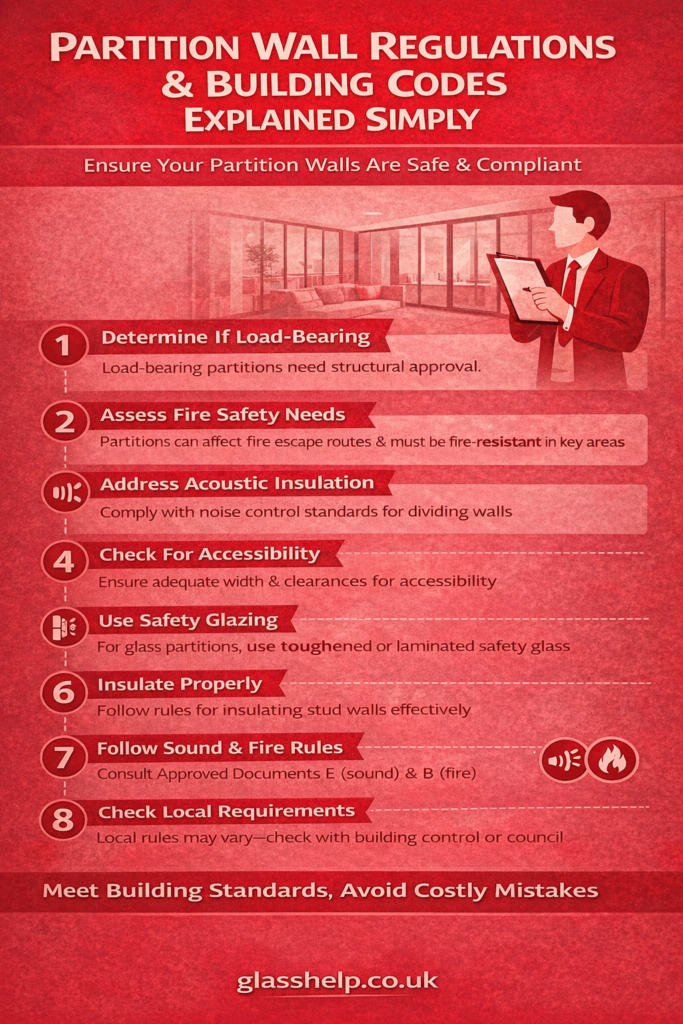
How to Ensure Compliance — A Practical Checklist
Here’s a simple way to verify if your partition wall project meets regulatory requirements:
- Determine whether the wall is load-bearing.
- If yes, consult a structural engineer + building control. Building Control Partnership
- Check fire safety implications.
- If the partition affects escape routes or separates protected spaces, design accordingly.
- Assess sound insulation needs.
- Consider sound performance between rooms, flats, or commercial spaces. GOV.UK
- Consider accessibility issues.
- Ensure doors and spaces meet minimum widths if required.
- Consult Building Control where in doubt.
- Early engagement avoids expensive rework.
Planning Permission — Is It Needed?
In the UK, internal partitions normally do not require planning permission, as they are considered internal alterations that do not change building use. RFM Group
However, there are exceptions:
- Listed buildings
- Conservation areas
- Projects that change the use class of space (e.g., residential to commercial)
- Alterations that affect building exterior or structural integrity
When in doubt, check with your local planning authority.
What Happens If You Don’t Comply?
Failing to meet building regulations can lead to:
- Refused completion certificates
- Increased insurance premiums
- Difficulty selling or remortgaging your property
- Mandatory corrective work at your expense
Building Control inspections aim to protect safety and quality; it’s better to involve them early than face costly fixes later.
Conclusion: Knowledge Protects Your Project
Partition walls may seem simple — but the rules around them are there to protect your safety, your investment, and others’ wellbeing. Knowing when you need approval, what standards apply, and how to integrate performance requirements like acoustics and fire safety ensures your project stays legal and hassle-free.
When considering design options, don’t underestimate the value of modern glazed partition systems. They not only help define space but can be integrated in a compliant and stylish way — see this guide to glass partition walls for ideas on combining regulatory requirements with beautiful design.