
When Is Toughened or Laminated Glass Required for Balustrades?
Choosing the right glass for a balustrade is not just a design decision — it is a safety and compliance requirement. One of the most common (and most important) questions homeowners ask is:
“Do I need toughened glass or laminated glass for my balustrade?”
The short answer is: it depends on where the balustrade is installed, how it’s fixed, and what risk exists if the glass breaks. Using the wrong type of glass can lead to non-compliance with UK building standards, safety hazards, and costly replacements later.
This guide explains:
- The difference between toughened and laminated glass
- When each type is required for balustrades
- How UK regulations influence the choice
- Indoor vs outdoor considerations
- Common mistakes homeowners make
- How to choose the correct glass for your project
What Is the Difference Between Toughened and Laminated Glass?
Before we discuss when each is required, it’s essential to understand how these two glass types behave differently.
Toughened Glass (Tempered Glass)
Toughened glass is heat-treated to make it much stronger than standard float glass.
Key characteristics:
- Around 4–5 times stronger than ordinary glass
- When broken, it shatters into small, blunt fragments
- Reduces the risk of serious cuts
- Widely used for doors, shower screens, and some balustrades
However, once toughened glass breaks, it completely fails and falls away.
Laminated Glass
Laminated glass is made from two or more layers of glass bonded together with a plastic interlayer (usually PVB or similar).
Key characteristics:
- If broken, the glass stays bonded to the interlayer
- Maintains a physical barrier even after breakage
- Provides higher fall protection
- Often thicker and heavier than toughened glass
This difference — remaining in place when broken — is the single most important factor in balustrade safety.
Why Glass Type Matters for Balustrades
A balustrade is not decorative glass. It is a guarding system designed to:
- Prevent falls from height
- Resist horizontal loads
- Remain safe in accidental impact situations
Because of this, the type of glass used must account for what happens if the glass breaks.
If glass shatters and disappears, the balustrade no longer functions as a guard — which is why laminated glass is required in many situations.
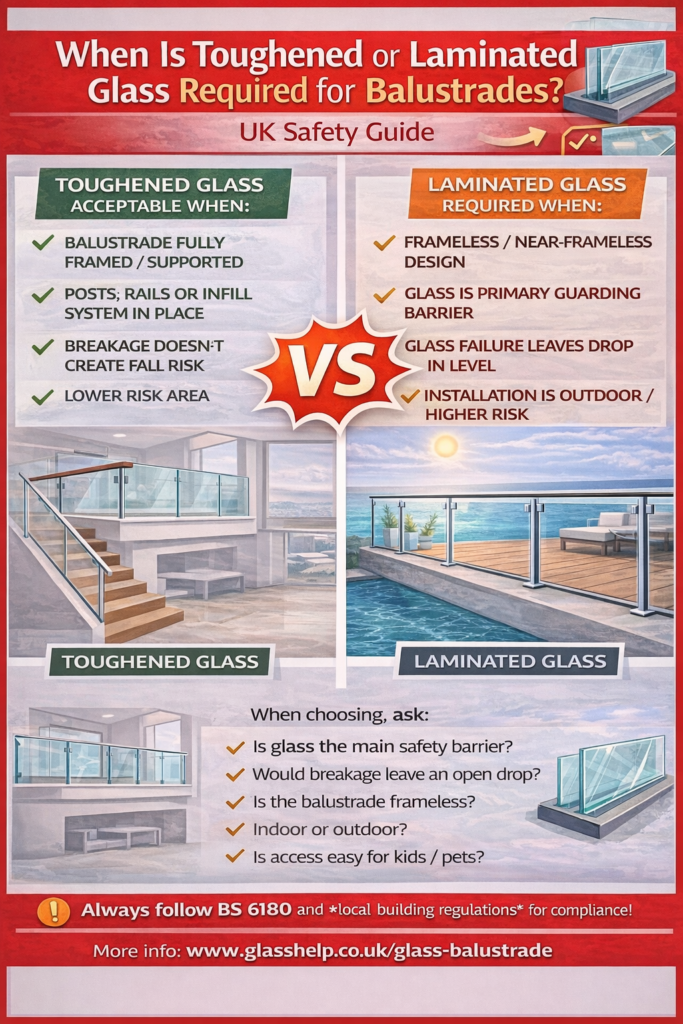
When Is Toughened Glass Acceptable for Balustrades?
Toughened glass can be used for balustrades in certain controlled situations.
Toughened Glass Is Typically Acceptable When:
✔ The balustrade is fully framed or supported
✔ There are posts, rails, or infill systems that prevent a full opening if glass breaks
✔ The glass is not the sole structural barrier
✔ The fall risk is lower or secondary protection exists
Common Examples
- Semi-framed balustrades with metal posts
- Internal stair balustrades where glass is an infill panel
- Systems where a continuous handrail and post structure remains even if glass fails
In these cases, the structure continues to provide some level of guarding even if the glass panel breaks.
When Is Laminated Glass Required for Balustrades?
Laminated glass is required whenever the glass itself forms the primary barrier and loss of the glass would create a fall risk.
Laminated Glass Is Required When:
✔ The balustrade is frameless or near-frameless
✔ The glass panel is the main or only guarding element
✔ The balustrade protects a drop in level
✔ The installation is external or exposed
✔ The balustrade is on a balcony, terrace, or mezzanine
Why Laminated Glass Is Essential in These Cases
If toughened glass shatters in a frameless balustrade:
- The entire panel can disappear instantly
- The opening is left unprotected
- There is a serious fall hazard
Laminated glass avoids this by remaining intact even after breakage, maintaining a physical barrier until replacement.
Frameless Glass Balustrades: Laminated Glass Is Essential
Frameless balustrades rely on glass as:
- The structural barrier
- The fall protection element
- The visual boundary
Because there are no posts or rails to act as backup, laminated glass is the correct and expected choice.
If you’re considering frameless designs, it’s important to review systems specifically designed for laminated glass. A clear overview of compliant glass balustrade systems can be found here:
Indoor vs Outdoor Balustrades: Does Location Matter?
Yes — location plays a major role in glass selection.
Indoor Balustrades
- Lower exposure to impact, weather, and temperature change
- Toughened glass may be acceptable in framed systems
- Laminated glass is still preferred where glass is load-bearing
Outdoor Balustrades
- Higher exposure to wind loads
- Greater consequences if glass fails
- More likely to protect significant drops
For outdoor balustrades, laminated glass is strongly recommended and often expected, especially for balconies and terraces.
Staircases: Toughened or Laminated?
Stair balustrades sit in a grey area, and the correct choice depends on design.
Toughened Glass May Be Acceptable If:
- The staircase has posts and rails
- The glass is only an infill panel
- There is no direct fall through if the glass breaks
Laminated Glass Is Preferred If:
- The staircase uses large glass panels
- The design is minimal or frameless
- The glass provides primary guarding
Many designers now default to laminated glass for staircases to future-proof compliance and safety.
What About Handrails and Top Rails?
A common misconception is that adding a handrail makes toughened glass acceptable everywhere.
This is not always true.
If:
- The glass panel below the handrail is large
- There are no vertical posts
- The glass still acts as the main barrier
Then laminated glass is still required, even with a handrail.
Common Homeowner Mistakes to Avoid
❌ Assuming toughened glass is always enough
❌ Choosing glass based on price alone
❌ Using indoor-rated glass outdoors
❌ Installing frameless balustrades with toughened glass
❌ Relying on handrails instead of proper glass specification
These mistakes often lead to non-compliance, failed inspections, or forced replacements.
Cost Considerations: Is Laminated Glass Worth It?
Yes — for balustrades, laminated glass is almost always worth the extra cost.
While laminated glass:
- Costs more than toughened glass
- Is heavier and slightly more complex to install
It also:
- Provides superior safety
- Meets expectations for modern balustrade systems
- Reduces liability risk
- Increases long-term durability
In most balustrade projects, the difference in glass cost is small compared to total installation cost — but the safety benefit is significant.
How to Choose the Right Glass for Your Balustrade
Ask these key questions:
- Is the glass the main fall protection?
- Would a broken panel leave an open drop?
- Is the balustrade framed or frameless?
- Is the installation indoor or outdoor?
- Is the area accessible to children or pets?
If the answer to any of these points increases risk — laminated glass is the correct choice.
Final Thoughts
Understanding when toughened or laminated glass is required for balustrades is critical for safety, compliance, and peace of mind.
In simple terms:
- Toughened glass can be acceptable in framed or secondary-infill situations
- Laminated glass is required when the glass is the primary guarding element
- Frameless and outdoor balustrades should always use laminated glass
If you’re planning a balustrade and want to ensure the correct glass type is used from the start, reviewing compliant glass balustrade systems is the safest approach